MBIR™ Foundations
Personal regulation, nervous-system awareness, and understanding of core MBIR™ principles.

Professional competency standards supporting safe, ethical, trauma-informed, and nervous-system-oriented MBIR™ practice.
MBIR™ is being developed as a competency-based professional methodology designed to support safe, ethical, trauma-informed, and regulation-oriented practice.
The competency framework is intended to support the development of practitioners who are able to work responsibly, safely, and professionally within the principles and philosophy of MBIR™.
Competency development within MBIR™ includes:
The intention is to support practitioner capability rather than technique memorisation alone.
Interconnected competency areas support safe, ethical, nervous-system-informed practitioner development.
MBIR™ competency development is designed as a progressive professional pathway supporting increasing levels of practitioner capability, safety, nervous-system awareness, ethical responsibility, and professional leadership.
The MBIR™ professional framework recognises practitioner development as an evolving process rather than a single certification event.
Each level builds upon increasing capacity for regulation-oriented, trauma-informed, ethical, and professionally grounded practice.
The pathway is intended to support both practitioner development and safe client facilitation across progressively deeper levels of application and responsibility.
Personal regulation, nervous-system awareness, and understanding of core MBIR™ principles.
Safe and ethical client facilitation using regulation-oriented and trauma-informed practice principles.
Working with more complex presentations, deeper integration processes, and advanced practitioner discernment.
Supporting practitioner development through reflective practice, mentoring, and competency guidance.
Teaching the MBIR™ methodology while maintaining professional standards and framework integrity.
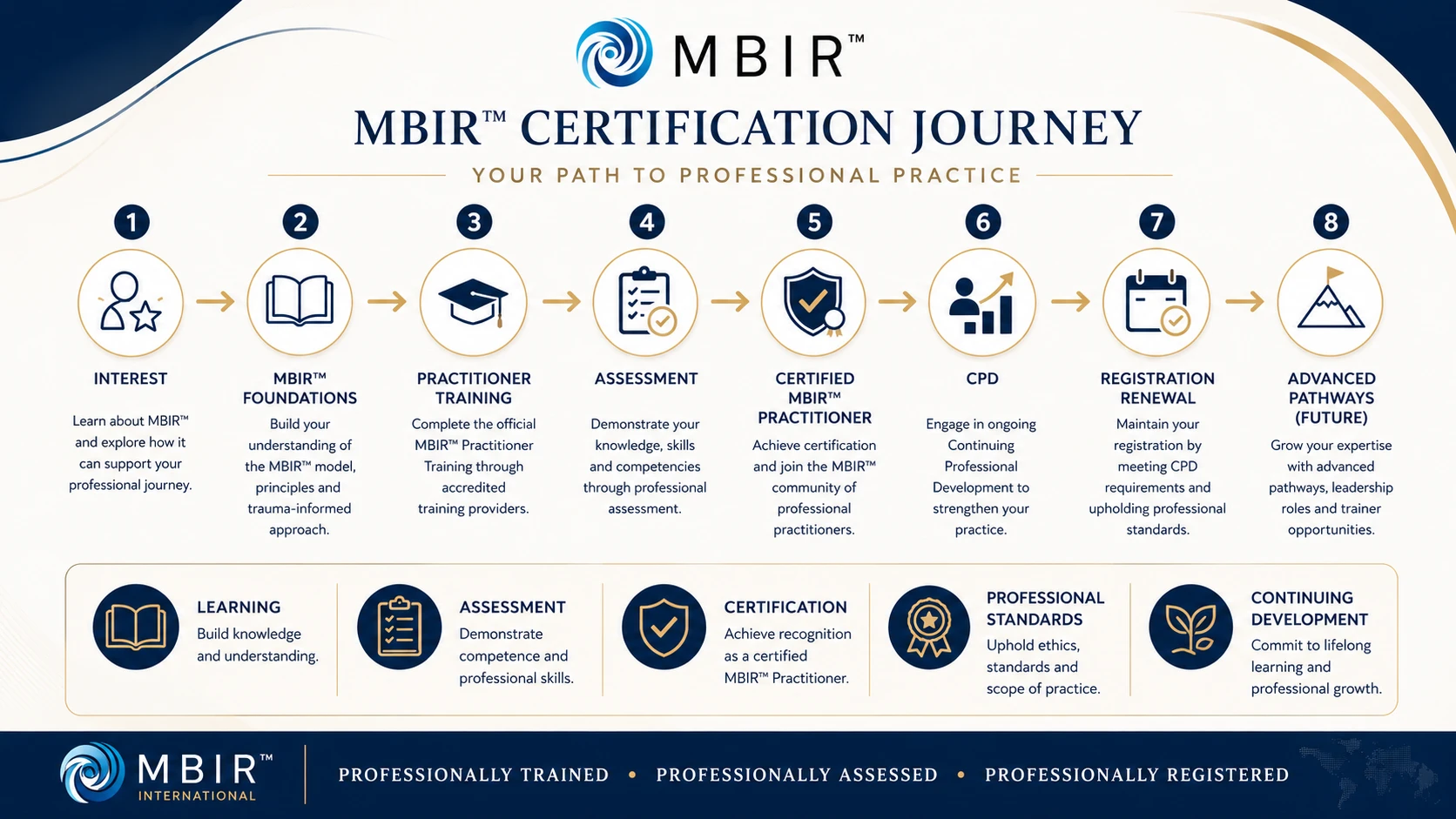
MBIR™ recognises competency as a developmental process rather than a fixed achievement.
Progression through levels is intended to support:
The emphasis remains on practitioner embodiment, regulation capacity, safety, and professional integrity rather than technique memorisation alone.
MBIR™ practitioner competency is developed through regulation-oriented, trauma-informed, ethical, and professionally boundaried practice.
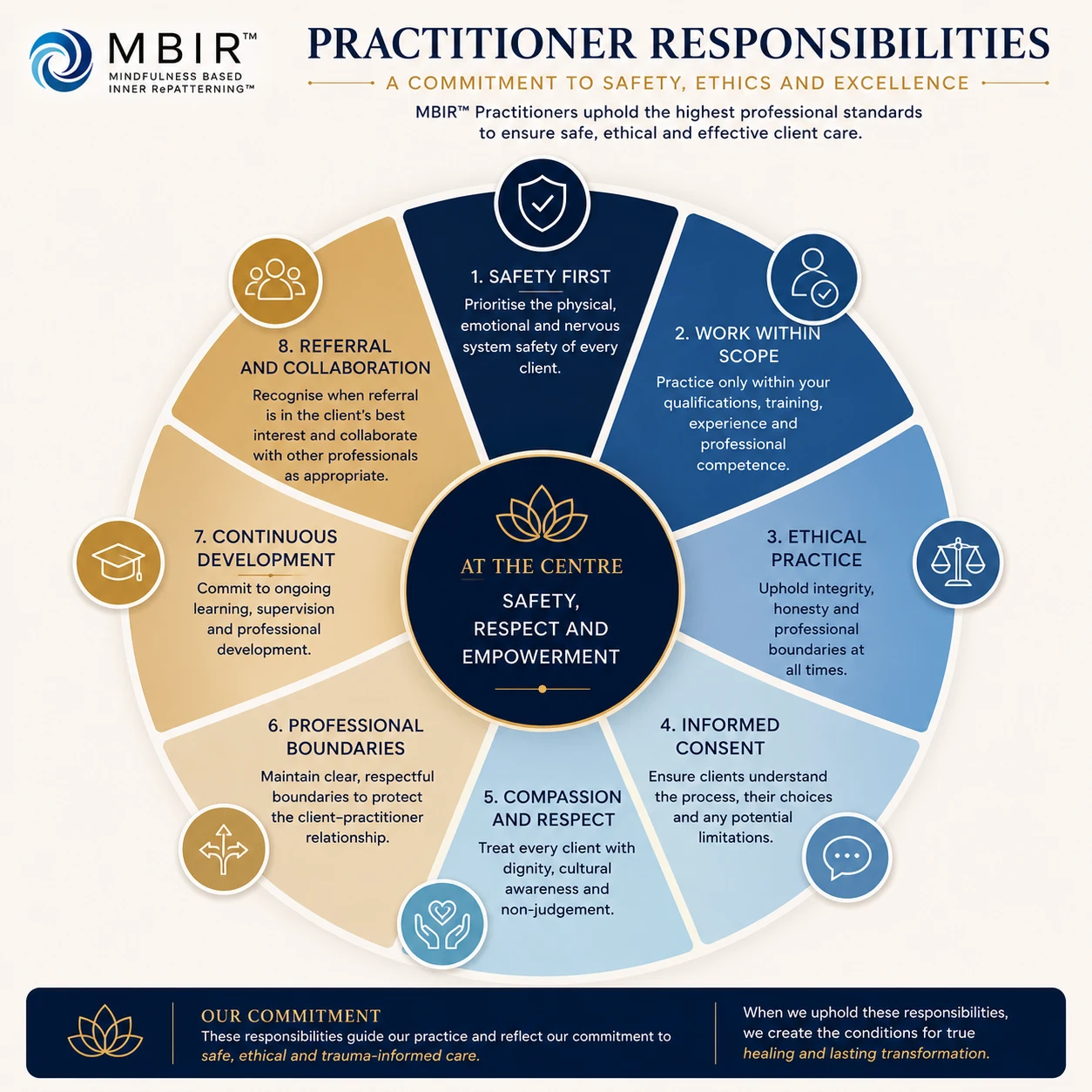
MBIR™ practitioners are expected to develop awareness of nervous system activation, regulation, stabilisation, and dysregulation patterns within both themselves and clients.
Practitioners are expected to work in a trauma-informed manner that prioritises safety, stabilisation, client pacing, and ethical responsibility.
This competency aligns with the wider Trauma-Informed Practice framework, including awareness of appropriate scope of practice and responsible ethical standards.
MBIR™ practitioners are expected to support regulation and stabilisation through safe-state-oriented facilitation and present-state awareness.
Practitioners are encouraged to develop awareness of their own nervous-system state and the impact of practitioner presence within the therapeutic environment.
MBIR™ places strong emphasis on present-state awareness as a foundation for safe, regulation-oriented, trauma-informed practice within the wider MBIR™ professional framework.
Rather than relying primarily on analytical exploration, interpretive processing, or extensive narrative focus, practitioners are encouraged to support awareness of what is occurring within present experience in real time, consistent with trauma-informed MBIR™ practice.
The emphasis remains on noticing, regulation, pacing, stabilisation, and relational safety rather than pressure to analyse, explain, or emotionally intensify experience.
Present-state awareness within MBIR™ may include awareness of:
The intention is not to suppress emotional experience, but to support safe and regulated engagement with experience within the client’s capacity.
MBIR™ practitioners are encouraged to develop the capacity to:
MBIR™ practitioners are expected to maintain professional integrity, ethical awareness, and responsible client practice.
Practitioners are expected to support clients in integration, grounding, and stabilisation throughout the process.
MBIR™ recognises that practitioner state significantly influences therapeutic process, relational safety, and client experience.
Practitioner competency is therefore understood not only as technical knowledge, but also as the capacity to maintain grounded, regulated, attuned, and ethically aware presence within the therapeutic environment.
Within MBIR™, practitioner presence is considered part of the therapeutic process itself.
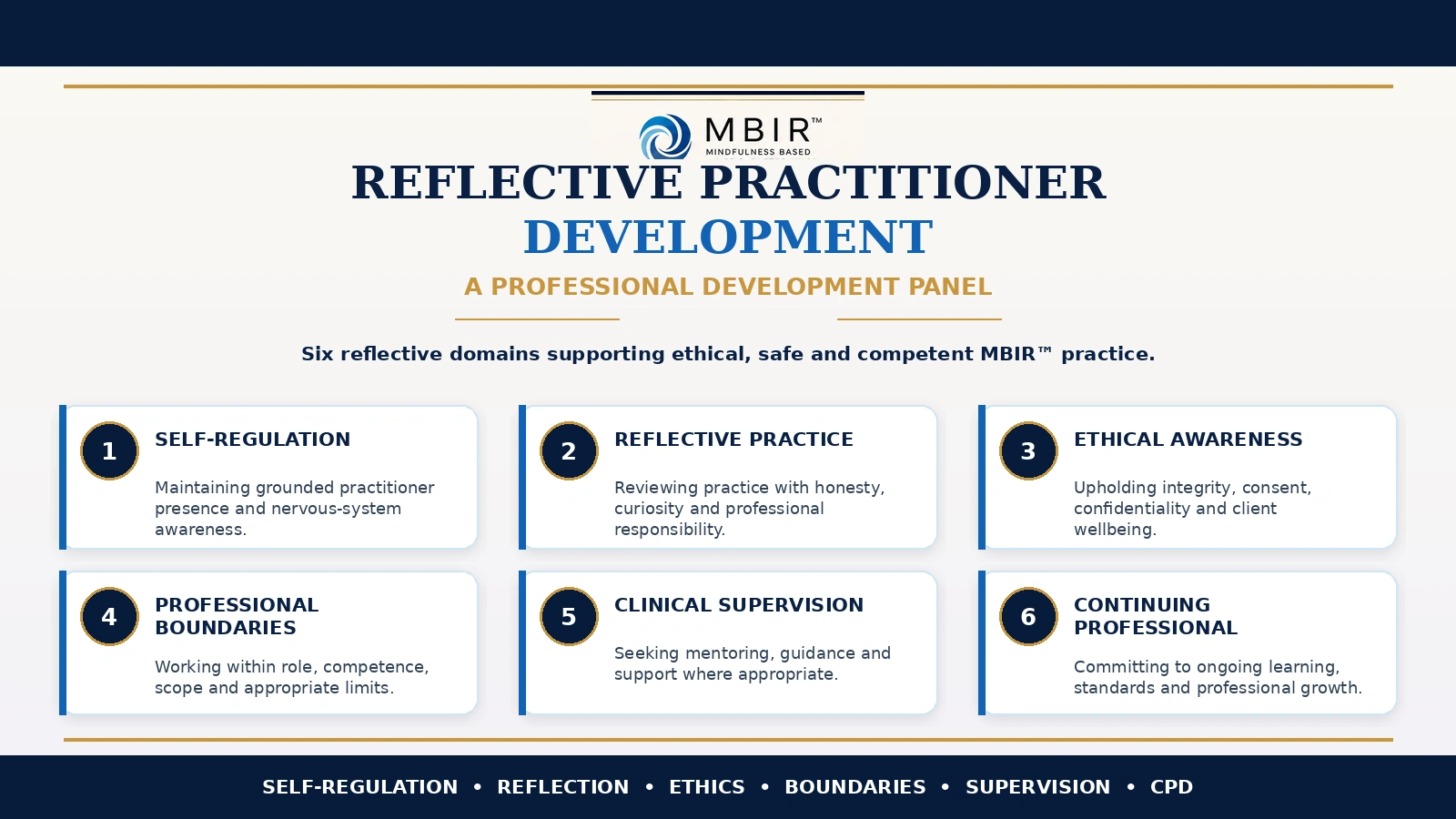
Practitioners are encouraged to cultivate increasing awareness of their own nervous-system state, pacing, emotional responses, and relational impact.
The emphasis is not on perfection, but on developing reflective capacity, grounded presence, regulation-oriented awareness, and safe professional facilitation.
Practitioner embodiment within MBIR™ supports:
“Within MBIR™, the practitioner is considered part of the therapeutic environment.”
MBIR™ recognises that practitioner competency is not determined by intensity, emotional excavation, or interpretive analysis.
The emphasis remains on supporting safe, regulated, trauma-informed, and ethically grounded practitioner capability.
Competency within MBIR™ is intended to prioritise nervous-system safety, present-state awareness, relational attunement, and non-overwhelming facilitation.
The intention is to support safe and sustainable practitioner development alongside responsible client facilitation.
MBIR™ places emphasis on awareness, regulation, stabilisation, and integration rather than interpretive or overwhelm-based processing.
Practitioners are encouraged to work with what is emerging safely within present experience, without imposing meaning, pressure, or unnecessary emotional intensity.
“The intention is not to suppress emotional experience, but to support safe and regulated engagement with experience within the client’s capacity.”
MBIR™ competency development is intended to support practical capability rather than theoretical understanding alone, and sits within the wider MBIR™ Professional Standards and Certification Pathways.
The long-term intention is to support meaningful professional competency within safe and ethical standards of practice.
Download the MBIR™ Practitioner Competency Framework outlining the professional competencies, developmental principles, practitioner expectations, and regulation-oriented standards underpinning MBIR™ professional practice.
The MBIR™ Reflective Practice & Practitioner Development Guide supports ongoing practitioner awareness, reflective development, nervous-system-informed facilitation, and grounded professional presence within MBIR™ practice.
MBIR™ practitioners are expected to work within the limits of their training, professional background, experience, and legal scope of practice within their country, profession, or regulatory environment.
The MBIR™ framework recognises the importance of ethical awareness, appropriate referral, professional boundaries, and responsible client facilitation within the wider Professional Standards framework.
Practitioner competency includes awareness of when additional support, supervision, mentoring, referral, or collaborative care may be appropriate.
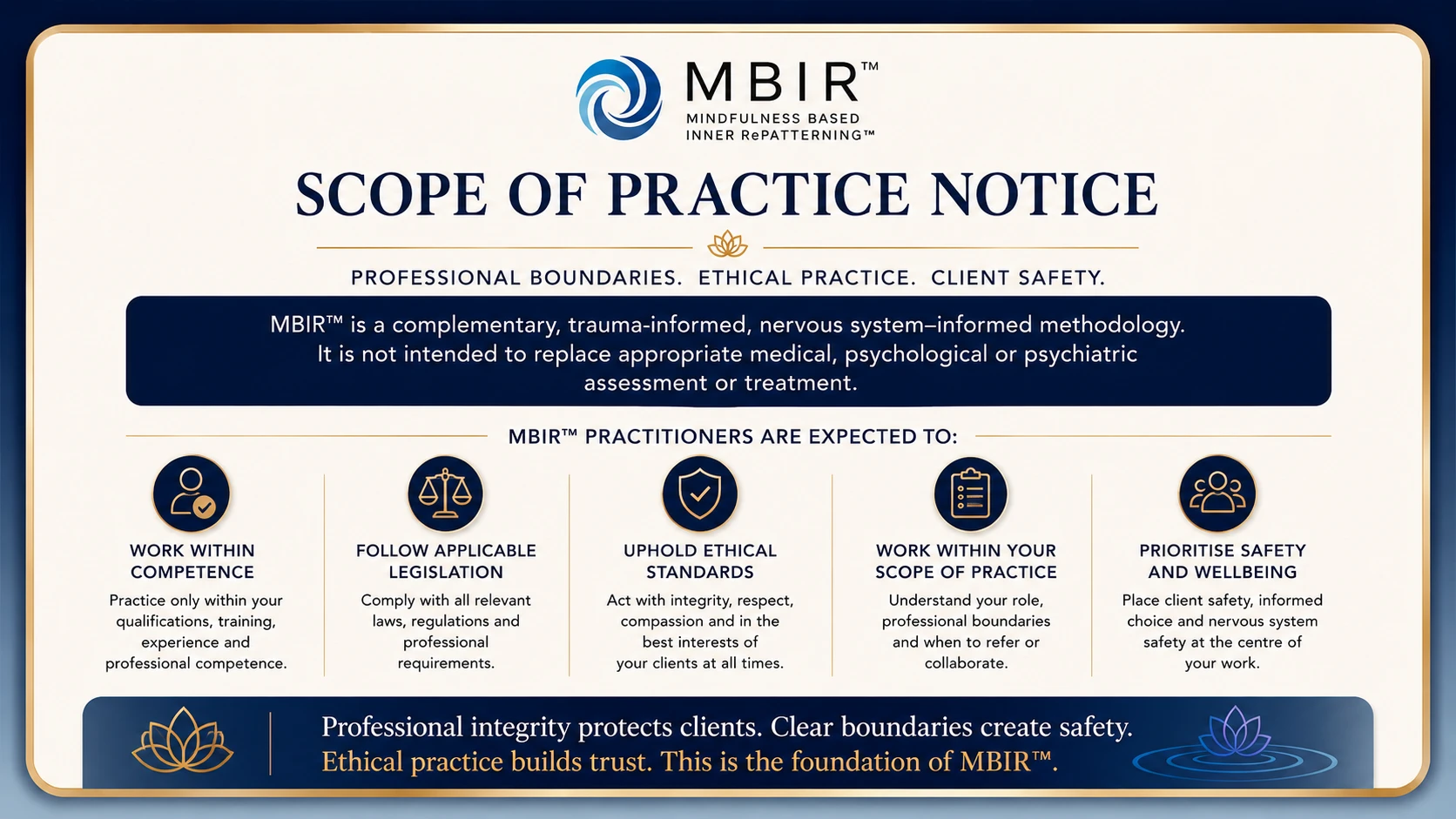
Professional scope awareness supports responsible, ethical, and trauma-informed practice within appropriate practitioner boundaries.
MBIR™ does not replace medical, psychological, psychiatric, or emergency care where such support is required.
Practitioners are encouraged to work responsibly, collaboratively, and ethically within appropriate professional contexts.
The emphasis remains on safe, regulation-oriented, trauma-informed facilitation and responsible practitioner awareness.
“Professional competency includes recognising both capability and limitation.”
MBIR™ recognises competency as an ongoing developmental process supported through Certification Pathways, practitioner resources, mentoring, and continuing professional development.
Ongoing development supports both practitioner wellbeing and responsible client work.