Exploring the scientific, theoretical, and clinical influences that inform the development of MBIR™.
Research-Informed Foundations
An Evidence-Informed Approach
MBIR™ is an evolving integrative methodology informed by contemporary neuroscience, trauma theory, somatic regulation research, psychophysiology, mindfulness-based approaches, and clinical outcome observation.
Rather than relying on a single explanatory model, MBIR™ draws from multiple evidence-informed perspectives to support safe, non-analytical, present-state therapeutic change.
MBIR International recognises that research continues to evolve. As such, MBIR™ encourages critical thinking, professional curiosity, reflective practice, and responsible interpretation of emerging evidence.
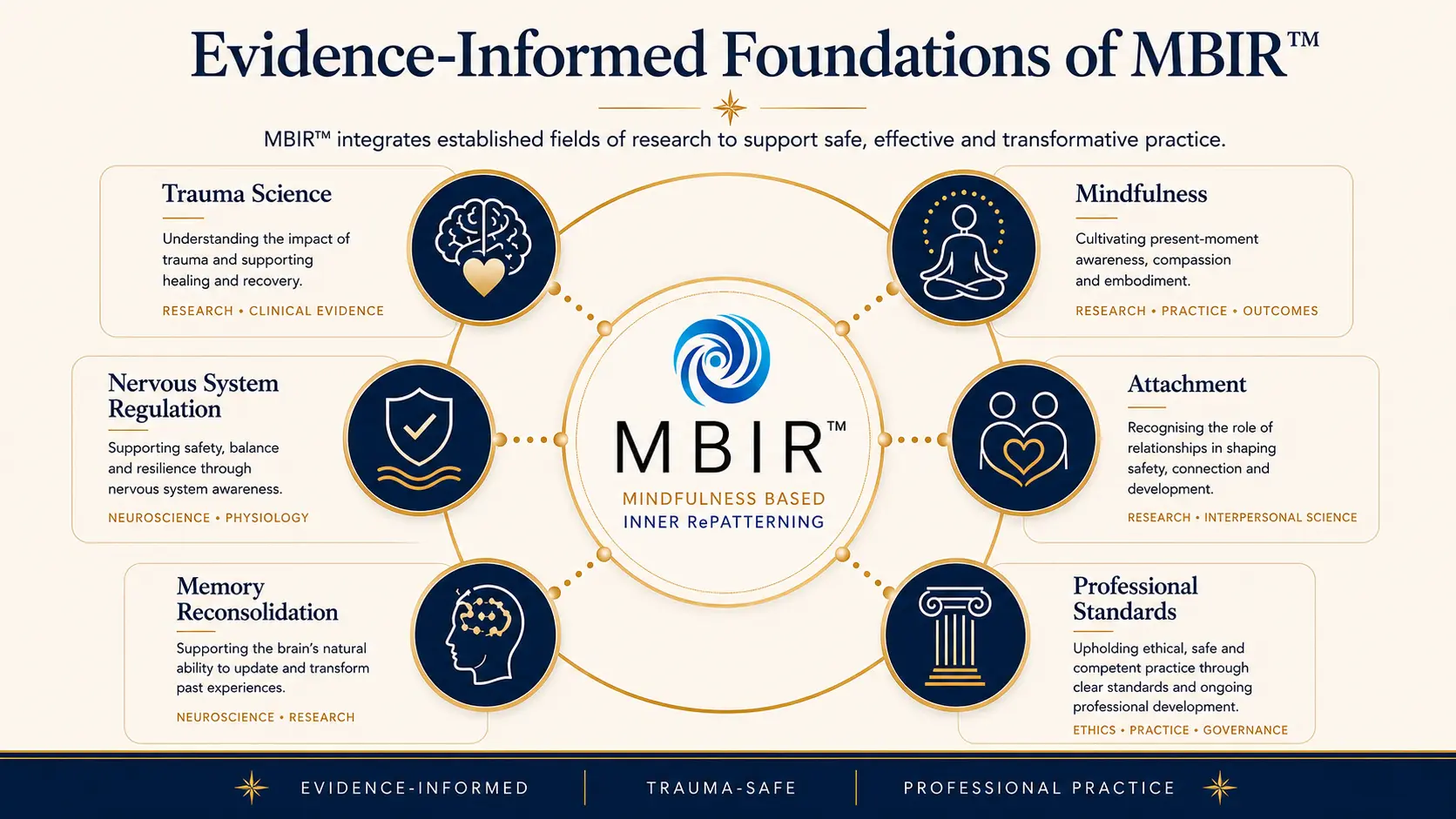
Evidence-Informed Foundations of MBIR™. Six established disciplines that contribute to safe, effective and professionally grounded MBIR™ practice.
Tap or expand image to view full detail.
Interdisciplinary Context
Scientific Influences
MBIR™ is influenced by multiple scientific and clinical disciplines that help explain regulation, adaptation, perception, and human change processes.
Neuroscience
Psychophysiology
Trauma Studies
Somatic Therapies
Mindfulness Research
Nervous System Regulation
Bioelectric Models
Clinical Observation
Autonomic Regulation
Polyvagal Theory
MBIR™ is influenced by principles from Stephen Porges’s Polyvagal Theory, which explores how the autonomic nervous system continuously evaluates safety and threat.
Relevant concepts include:
Autonomic state shifts
Mobilisation and shutdown
Co-regulation
Social engagement
Defensive survival responses
MBIR™ incorporates practical approaches designed to support regulation and greater nervous system flexibility.
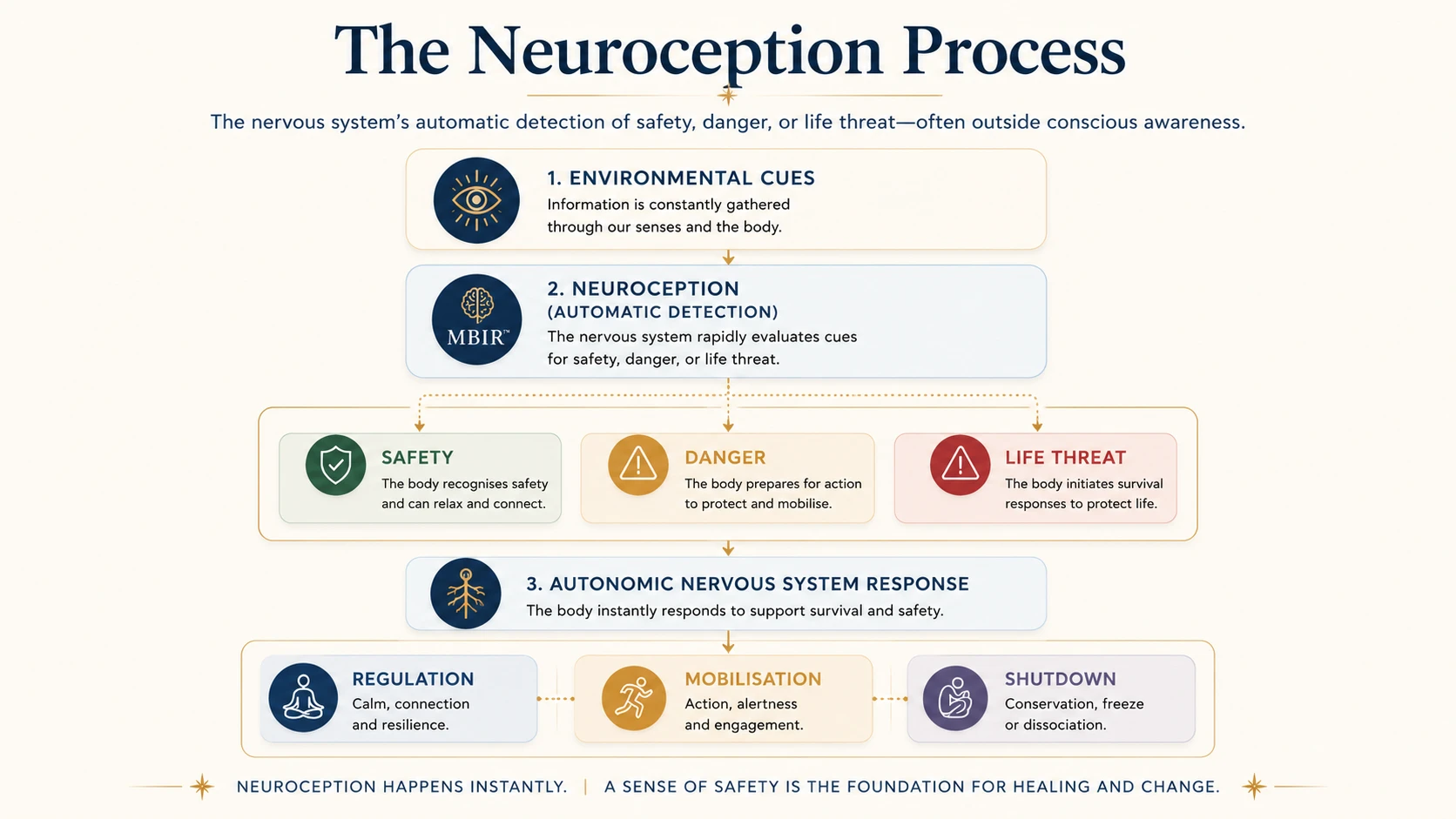
Safety Detection
Neuroception & Safety Detection
Neuroception refers to the nervous system’s automatic detection of safety, danger, or life threat, often outside conscious awareness.
This concept helps explain why individuals may experience freeze responses, hypervigilance, shutdown, or physiological distress without obvious cognitive cause.
MBIR™ places strong emphasis on creating conditions that increase perceived safety before deeper change work.
Threat
→
Protection
→
Regulation
Emerging Research Area
Bioelectricity & Regulatory Signalling
Emerging research increasingly recognises the importance of electrical signalling within biological systems.
Bioelectric communication contributes to:
Cellular signalling
Tissue coordination
Nervous system communication
Physiological regulation
MBIR™ remains interested in evolving research exploring how electrical and electromagnetic processes may influence human regulation and healing.
Trauma-Informed Practice
Trauma Research
Modern trauma research has significantly expanded understanding of how overwhelming experiences affect body, brain, perception, and behaviour.
Important Areas Informing MBIR™
Developmental trauma
Attachment disruption
Dissociation
Survival adaptations
Freeze responses
Implicit memory
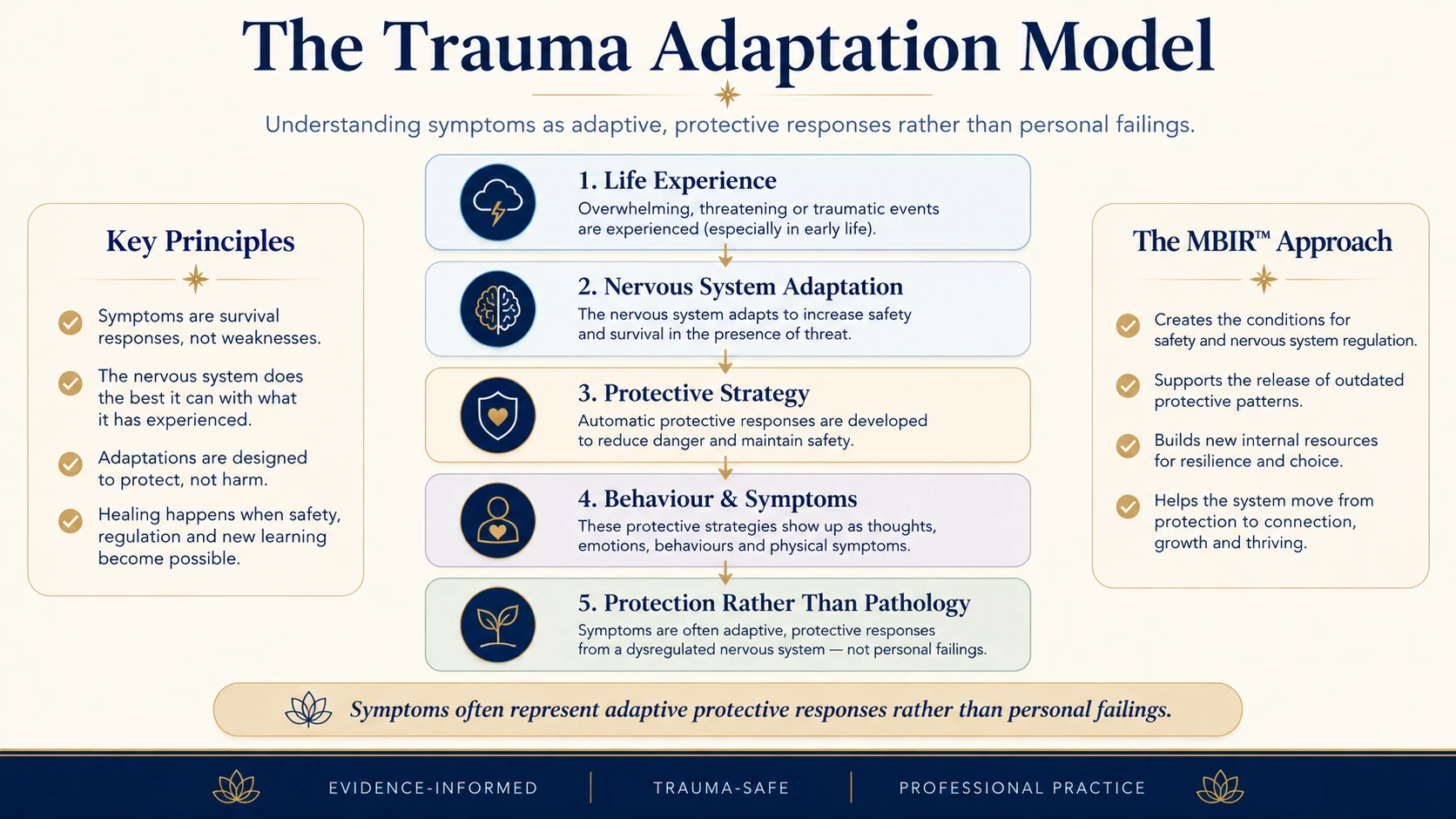
Adaptive Meaning
MBIR™ recognises that symptoms often represent adaptive protective responses rather than pathology alone.
Event
→
Adaptation
→
Protection Pattern
Practice-Based Learning
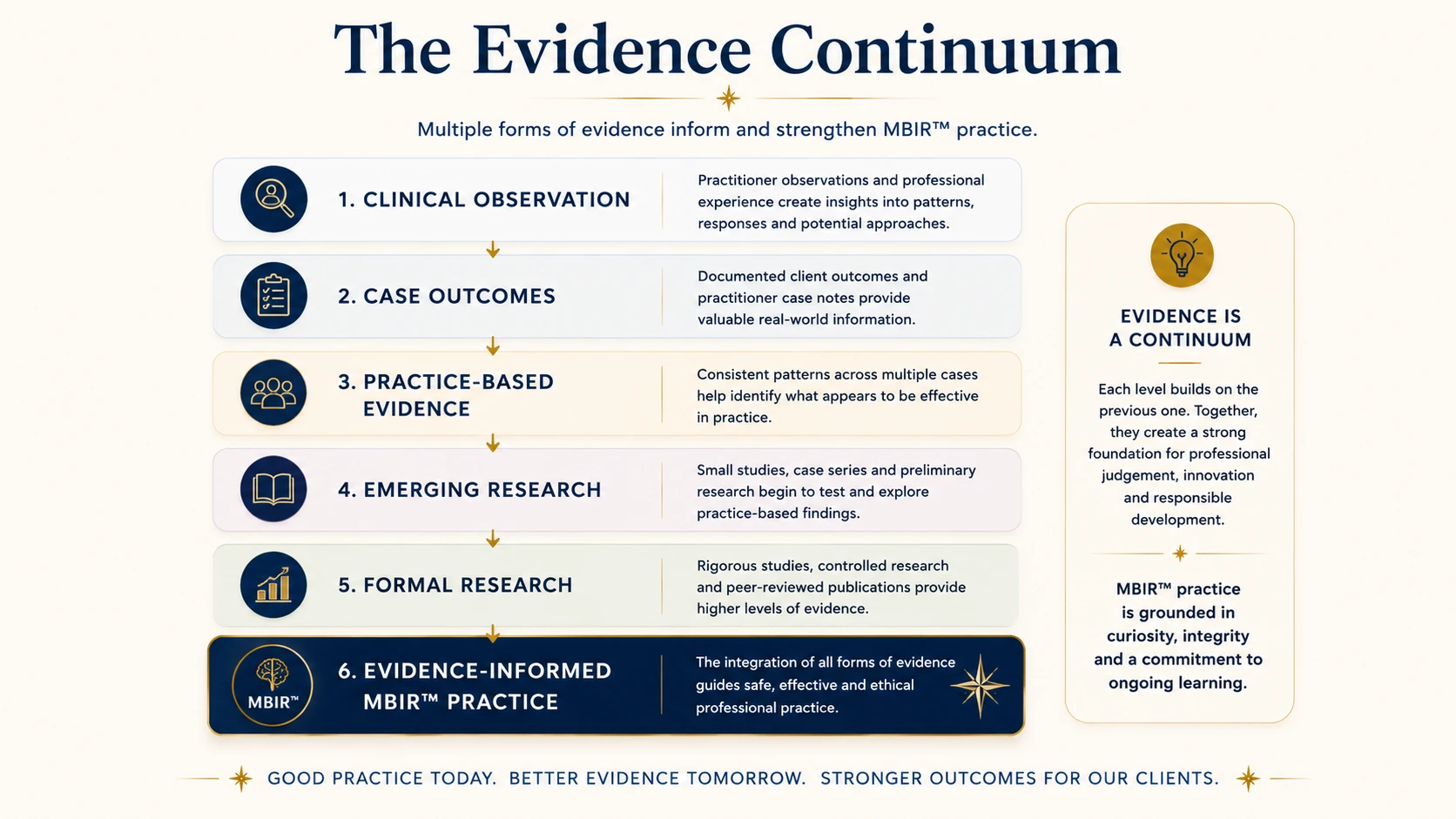
Clinical Observation & Case Outcome Collection
In addition to formal research, MBIR™ continues to evolve through practitioner observation, case outcome collection, supervision, and reflective practice.
MBIR International encourages practitioners to contribute to ongoing learning through reflective case review, anonymised outcome reporting, pattern recognition, and practice-based evidence collection.
This supports continual refinement of training and methodology.
Current Evidence Position
Current Evidence Position
MBIR™ should currently be understood as an evidence-informed emerging methodology rather than a fully research-validated standalone treatment model.
MBIR International supports ongoing research, ethical innovation, outcome evaluation, and interdisciplinary collaboration.
Future evidence development may include formal research studies, practitioner outcome databases, and collaborative academic inquiry.
References & Further Reading
Further Reading
The existing reading list is organised below by its primary area of relevance to evidence-informed professional practice.
Trauma Science
Book
The Body Keeps the Score Bessel van der Kolk (2014)
Nervous System Regulation
Clinical Text
The Polyvagal Theory Stephen W. Porges (2011)
Professional Practice
Clinical Text
Waking the Tiger: Healing Trauma Peter A. Levine (1997)
Mindfulness
Clinical Text
Full Catastrophe Living Jon Kabat-Zinn (1990)
Downloads & Professional Resources
Access current MBIR™ evidence documents, practitioner guides and professional reference materials through the central Resources & Downloads Library.
To provide the best experiences, we use technologies like cookies to store and/or access device information. Consenting to these technologies will allow us to process data such as browsing behaviour or unique IDs on this site. Not consenting or withdrawing consent, may adversely affect certain features and functions.
Functional
Always active
The technical storage or access is strictly necessary for the legitimate purpose of enabling the use of a specific service explicitly requested by the subscriber or user, or for the sole purpose of carrying out the transmission of a communication over an electronic communications network.
Preferences
The technical storage or access is necessary for the legitimate purpose of storing preferences that are not requested by the subscriber or user.
Statistics
The technical storage or access that is used exclusively for statistical purposes.The technical storage or access that is used exclusively for anonymous statistical purposes. Without a subpoena, voluntary compliance on the part of your Internet Service Provider, or additional records from a third party, information stored or retrieved for this purpose alone cannot usually be used to identify you.
Marketing
The technical storage or access is required to create user profiles to send advertising, or to track the user on a website or across several websites for similar marketing purposes.