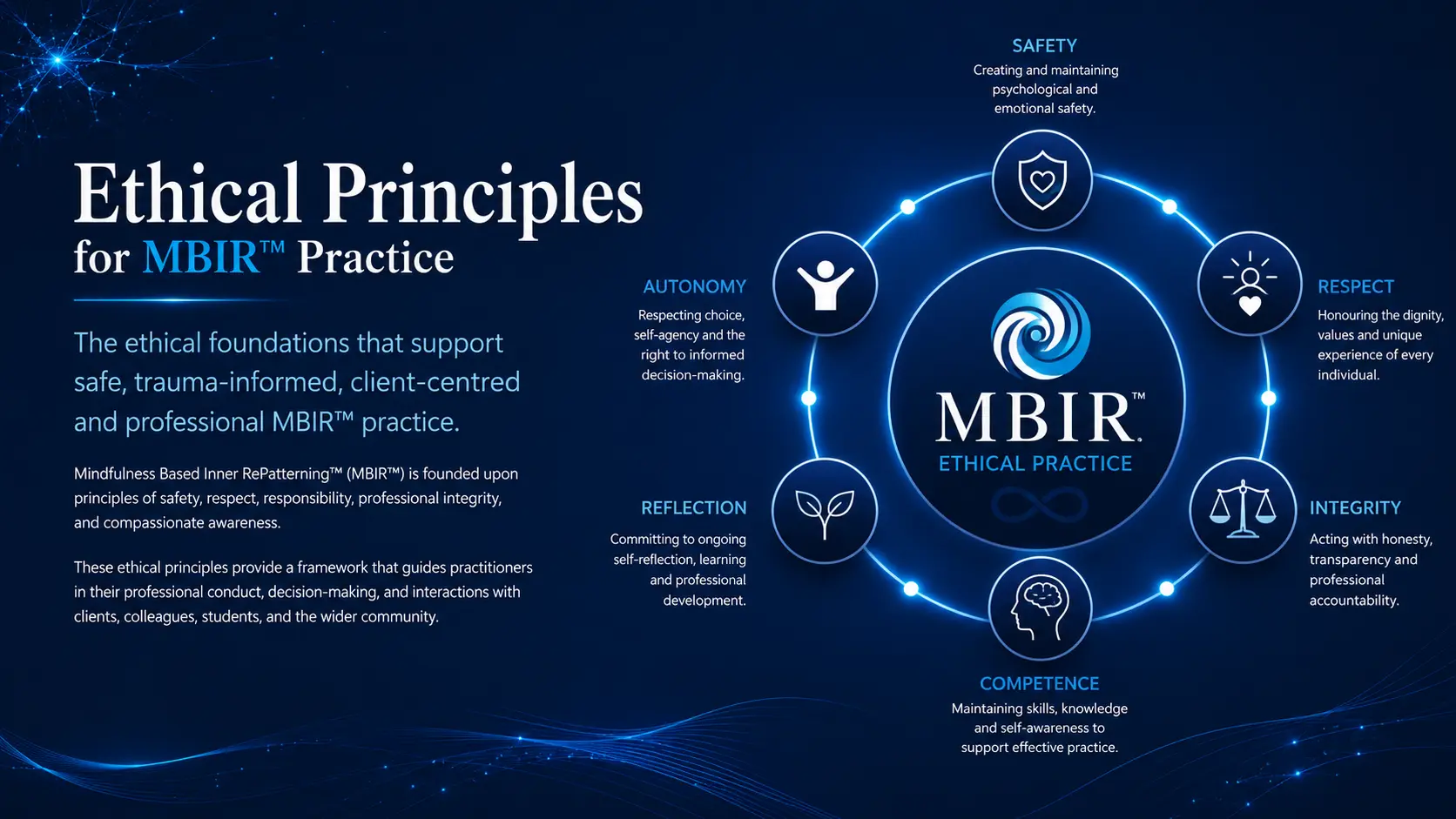
Ethical Principles for MBIR practice showing Safety, Respect, Integrity, Competence, Reflection and Autonomy surrounding the official MBIR logo.
Why Ethical Principles Matter

Ethics as values expressed through practice

Ethical MBIR™ practice is not simply a set of rules. It is a professional commitment to client welfare, practitioner responsibility, public confidence, and safe, effective practice.

The ethical principles on this page provide a values-based framework for professional conduct. They support practitioners, trainers, mentors, assessors, and professional members in making thoughtful decisions and maintaining high standards of care.

Ethics are expressed through everyday practice: the way information is shared, consent is obtained, boundaries are maintained, confidentiality is protected, and professional limitations are recognised.

These principles sit within the wider MBIR™ International standards framework, including the Practitioner Hub, Competencies Framework, Scope of Practice, Trainer Standards, Digital Standards, and Professional Development & Inquiry.

Client welfarePlacing wellbeing, safety, autonomy, and dignity at the centre of practice.
Practitioner responsibilitySupporting accountable, transparent, and professional decision-making.
Professional standardsStrengthening consistency across MBIR™ practice, training, and mentoring.
Public confidenceHelping clients and communities understand the values guiding MBIR™ practitioners.

Ethical Foundations

The Ethical Foundations Framework

Ethical MBIR™ practice emerges through the integration of multiple professional responsibilities. These foundations work together to support safe, trauma-informed, respectful, and effective professional practice.

The framework below illustrates how ethical decision-making is informed by client welfare, professional competence, reflective practice, scope awareness, professional boundaries, and professional integrity.

Ethical Foundations Framework showing the interconnected ethical principles that underpin MBIR practice.
The Ethical Foundations Framework Ethical MBIR™ practice is supported by interconnected foundations including client welfare, trauma-informed practice, professional integrity, informed consent, confidentiality, competence, scope awareness, professional boundaries, and reflective practice. Together these principles contribute to responsible, ethical, and professional client care.

Understanding the Framework

At the centre of the framework is Ethical MBIR™ Practice. Surrounding this centre are the professional foundations that guide ethical decision-making and practitioner behaviour.

Each foundation contributes to the overall quality, safety, and effectiveness of professional practice. No single principle exists in isolation. Ethical practice emerges through the ongoing integration of interconnected responsibilities to clients, colleagues, the community, and ourselves.

This framework connects directly with the Competencies Framework, Scope of Practice, Certification Pathways, and Professional Development & Inquiry.

Core Ethical Principles

Principles that guide professional MBIR™ practice

The following principles support safe, trauma-informed, client-centred, and professionally responsible practice. They provide a framework for ethical awareness rather than a rigid rulebook.

Client Welfare

The wellbeing of the client remains the primary consideration in professional practice.

Principle in practice
  • Supporting safety and emotional wellbeing.
  • Avoiding unnecessary harm or reactivation.
  • Respecting individual needs, readiness, and context.
  • Working in the client’s best interests.
  • Encouraging autonomy and informed choice.

Respect for Autonomy

Clients have the right to make informed choices regarding their participation and care.

Principle in practice
  • Supporting personal choice and self-agency.
  • Encouraging informed decision-making.
  • Respecting beliefs, values, identity, and lived experience.
  • Avoiding coercion, pressure, or dependency.
  • Checking consent throughout the professional relationship.

Trauma-Informed Practice

Practitioners recognise the impact of trauma and prioritise safety, regulation, pacing, and client choice.

Principle in practice
  • Creating emotional and psychological safety.
  • Working with nervous system awareness.
  • Respecting readiness and pacing.
  • Prioritising regulation before deeper exploration.
  • Avoiding unnecessary reactivation or overwhelm.

Professional Integrity

Practitioners act honestly, responsibly, and transparently.

Principle in practice
  • Communicating clearly and honestly.
  • Representing qualifications and experience accurately.
  • Using ethical marketing and avoiding exaggerated claims.
  • Maintaining accountability in professional actions.
  • Acting consistently with MBIR™ professional values.

Informed Consent

Clients should understand the nature and purpose of services before participation.

Principle in practice
  • Providing clear explanations of services.
  • Clarifying expectations, limitations, and responsibilities.
  • Viewing consent as an ongoing process.
  • Supporting questions and informed participation.
  • Respecting the client’s right to pause or stop.

Confidentiality

Information shared within professional relationships is treated respectfully and confidentially.

Principle in practice
  • Protecting client information and records.
  • Maintaining appropriate record security.
  • Considering digital confidentiality and privacy.
  • Clarifying legal, safeguarding, or professional exceptions.
  • Using discretion in all professional communication.

Professional Competence

Practitioners maintain and develop their professional skills, knowledge, and self-awareness.

Principle in practice
  • Engaging in continuing professional development.
  • Maintaining current skills and professional knowledge.
  • Using reflective practice to support growth.
  • Seeking support, mentoring, or supervision when needed.
  • Connecting learning with safe client practice.

Scope Awareness

Practitioners recognise the limits of their training, experience, and professional role.

Principle in practice
  • Recognising professional limitations.
  • Making referrals where appropriate.
  • Collaborating with other professionals when beneficial.
  • Maintaining clarity about MBIR™ practice boundaries.
  • Reviewing the Scope of Practice.

Professional Boundaries

Healthy boundaries support safe and effective professional relationships.

Principle in practice
  • Maintaining clear roles and responsibilities.
  • Using appropriate communication channels.
  • Avoiding conflicts of interest.
  • Protecting the integrity of the professional relationship.
  • Maintaining professionalism in all settings.

Reflective Practice

Ethical practice requires ongoing self-reflection, consultation, and professional awareness.

Principle in practice
  • Learning from professional experience.
  • Developing self-awareness and professional curiosity.
  • Using consultation, supervision, or mentoring when helpful.
  • Reflecting on decisions, outcomes, and learning edges.
  • Continuing development through Professional Development & Inquiry.
Ethical Decision-Making

When Ethical Questions Arise

Ethical practice often involves balancing multiple considerations. This framework provides a simple process that practitioners can use when making professional decisions, navigating uncertainty, or responding to ethical challenges.

The goal is not to provide predetermined answers but to support thoughtful, responsible, and client-centred decision-making.

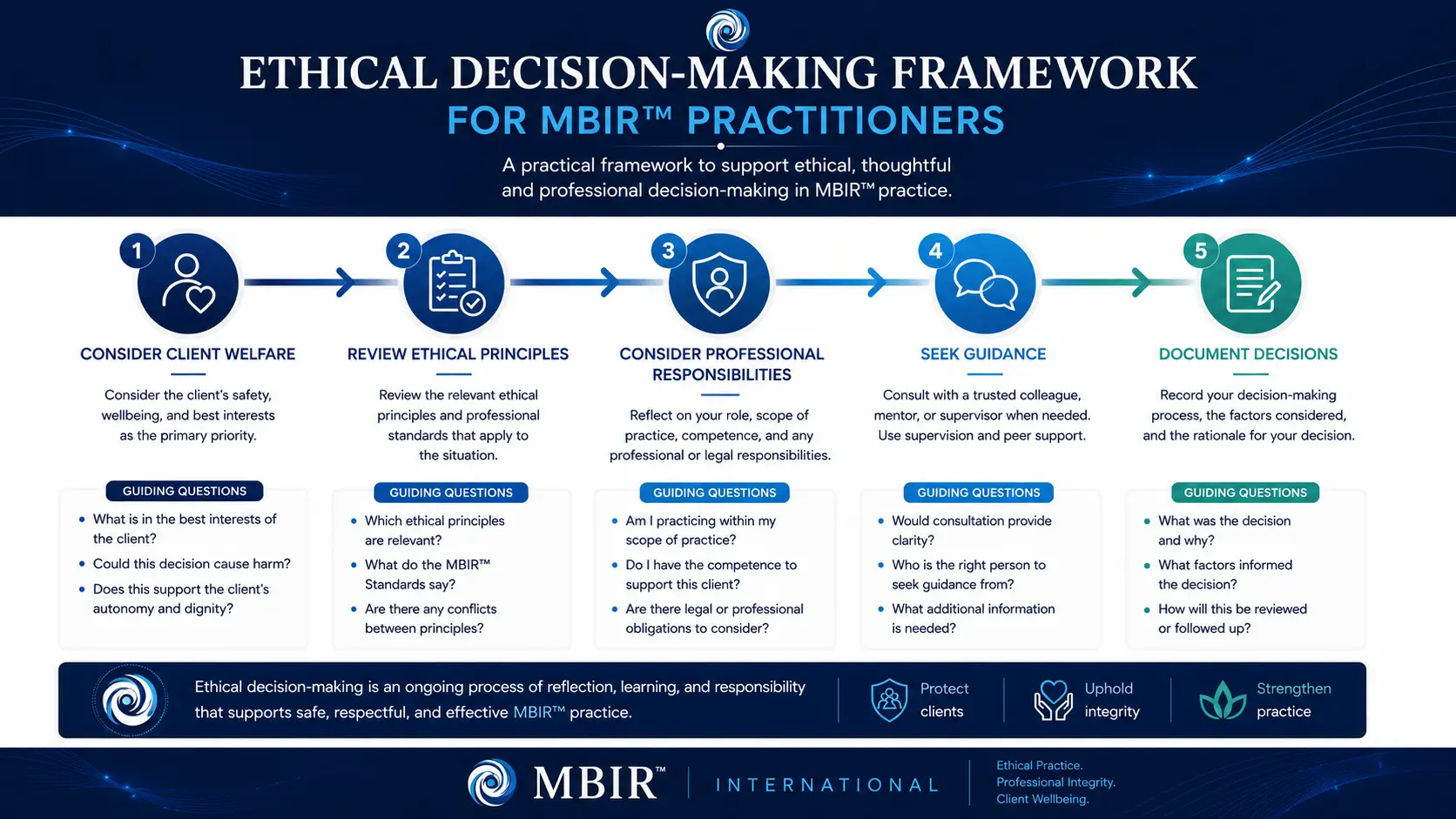
Ethical Decision-Making Framework for MBIR Practitioners showing a five-step process: Consider Client Welfare, Review Ethical Principles, Consider Professional Responsibilities, Seek Guidance, and Document Decisions.
Ethical Decision-Making Framework Ethical decision-making involves considering client welfare, reviewing relevant ethical principles, reflecting on professional responsibilities, seeking guidance when appropriate, and documenting decisions when necessary. This process supports thoughtful, accountable, and trauma-informed professional practice.

Understanding the Framework

Ethical practice is rarely about finding a perfect answer. More often, it involves carefully considering multiple factors and making decisions that support client wellbeing while maintaining professional integrity.

The Ethical Decision-Making Framework encourages practitioners to pause, reflect, and consider the wider implications of their actions before proceeding.

1

Consider Client Welfare

What is in the client’s best interests? Could this decision cause harm? Does this support autonomy, dignity, and safety?

2

Review Ethical Principles

Which ethical principles are relevant? Are there competing considerations? How does this align with trauma-informed practice?

3

Consider Responsibilities

Am I working within my competence and scope of practice? Are there legal or professional obligations to consider?

4

Seek Guidance

Would consultation provide clarity? Is supervision appropriate? What additional information may be helpful?

5

Document Decisions

What decision was made? Why was it chosen? What factors informed it? How will it be reviewed or followed up?

Ethics as an Ongoing Practice

Ethical decision-making is not a single event but an ongoing process of awareness, reflection, learning, and responsibility.

Practitioners are encouraged to engage in reflective practice, continuing professional development, supervision, and professional dialogue to support high standards of ethical practice. This section connects with the Practitioner Hub, Competencies Framework, Scope of Practice, Trainer Standards, Digital Standards, and Professional Development & Inquiry.

Professional Standards Library

Ethical Practice Resources

The following resources are designed to support ethical awareness, professional responsibility, reflective practice, and ongoing development within MBIR™ practice.

Together they provide a complete professional learning pathway from understanding ethical principles to applying them in practice and reflecting upon professional growth.

Learn the Principles

MBIR™ Ethical Principles Guide

A professional standards guide outlining the ethical principles that support safe, trauma-informed, client-centred and professional MBIR™ practice.

  • Core ethical principles
  • Practitioner responsibilities
  • Professional integrity
  • Informed consent
  • Confidentiality
  • Scope awareness
  • Reflective practice checklist
Download Ethical Principles Guide
Apply the Principles

MBIR™ Ethical Decision-Making Quick Reference Guide

A concise practical tool to help practitioners pause, reflect, and make thoughtful ethical decisions when faced with uncertainty, complexity, or professional dilemmas.

  • 5-step decision-making framework
  • Client welfare questions
  • Scope awareness prompts
  • Consultation reminders
  • Documentation checklist
  • Referral considerations
Download Quick Reference Guide
Reflect and Develop

MBIR™ Reflective Practice & Ethical Awareness Workbook

A structured workbook supporting ethical reflection, self-awareness, professional development, and trauma-informed reflective practice.

  • Reflective practice exercises
  • Ethical awareness prompts
  • Client welfare reflection
  • Scope of practice review
  • Professional integrity reflection
  • Learning logs
  • Professional development planning
  • Annual ethical self-review
Download Reflective Practice Workbook

How to Use These Resources

These resources are intended to support professional awareness and reflective practice. They should be used alongside the wider MBIR™ International standards framework, including the Practitioner Hub, Competencies Framework, Scope of Practice, Trainer Standards, Digital Standards, and Professional Development & Inquiry pages.

They are not a substitute for professional judgement, supervision, consultation, legal responsibilities, safeguarding duties, or appropriate referral where required.

Ethical Principles Guide Understanding the standards.
Decision-Making Quick Reference Guide Applying the standards.
Reflective Practice Workbook Integrating the standards through reflection and professional growth.
Wider Professional Ecosystem

Ethics Within the Wider Professional Ecosystem

Ethical practice does not exist in isolation. It is supported by professional standards, ongoing development, reflective practice, professional relationships, competence, accountability, and a commitment to client wellbeing.

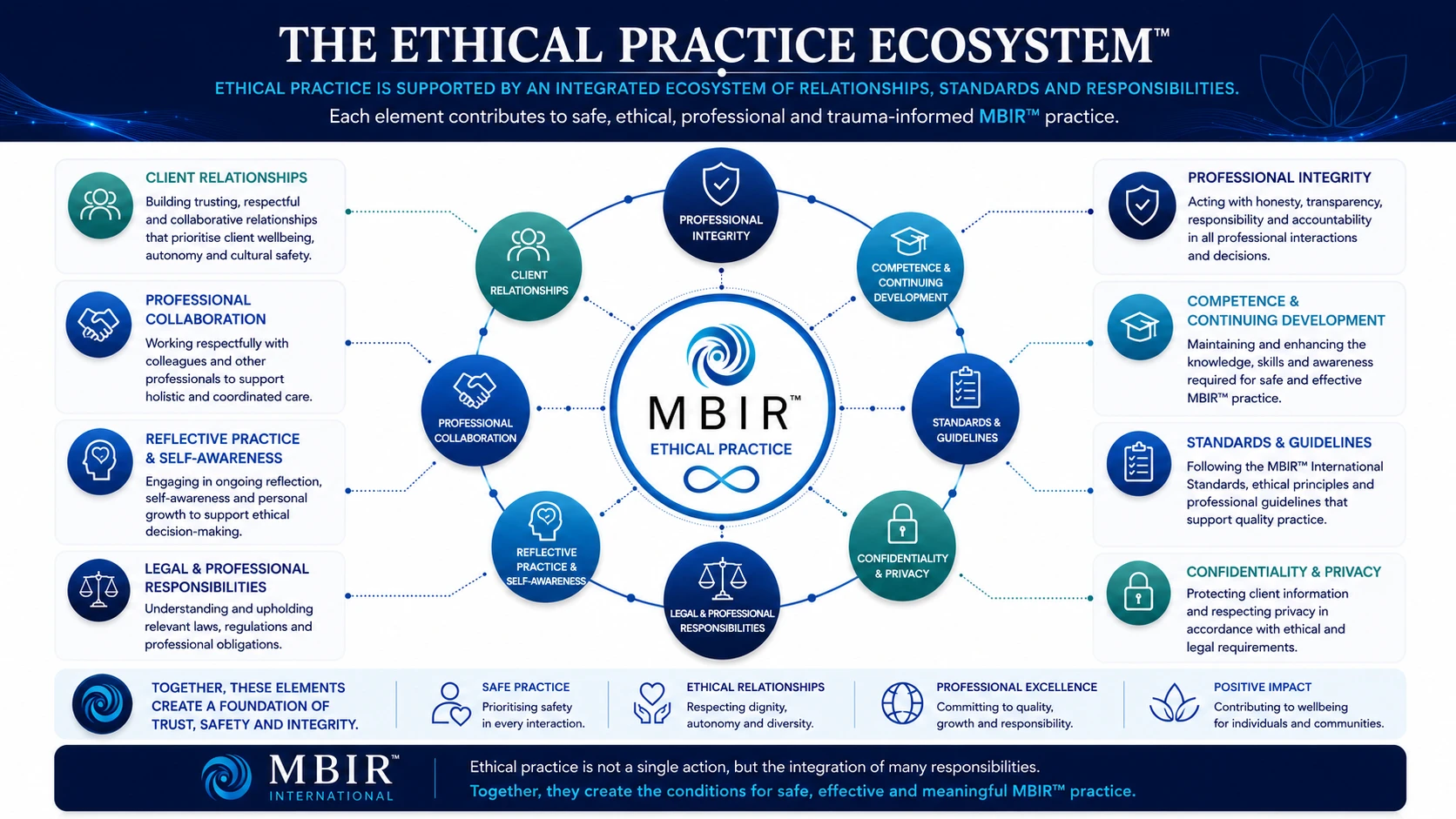
The Ethical Practice Ecosystem illustrates how these elements work together to create safe, effective, and responsible MBIR™ practice.

Ethical Practice Ecosystem showing how professional integrity, competence, standards, confidentiality, collaboration and client relationships support ethical MBIR practice.
The Ethical Practice Ecosystem Ethical MBIR™ practice is supported by an integrated ecosystem of relationships, standards, responsibilities, professional development, competence, reflection, confidentiality, and collaboration. Together these elements create the conditions for safe, ethical, trauma-informed, and effective professional practice.

Understanding the Ecosystem

At the centre of the ecosystem is Ethical MBIR™ Practice. Surrounding this centre are the professional elements that support ethical behaviour, responsible decision-making, and client wellbeing.

Each element strengthens and supports the others. When one area is neglected, the quality and safety of practice may be affected. When these elements work together, they create a strong foundation for professional excellence and ethical stewardship.

Client Relationships

Building respectful, collaborative, and client-centred professional relationships.

  • Trust
  • Respect
  • Safety
  • Autonomy
  • Compassionate communication

Professional Integrity

Acting honestly, transparently, and responsibly.

  • Accountability
  • Ethical marketing
  • Professional honesty
  • Consistency between values and actions

Competence & Development

Maintaining and expanding professional knowledge and skills.

  • CPD
  • Lifelong learning
  • Professional growth
  • Skills development

Standards & Guidelines

Following MBIR™ International standards and professional expectations.

  • Ethical Principles
  • Scope of Practice
  • Professional Conduct
  • Certification Standards

Confidentiality & Privacy

Protecting client information and maintaining professional trust.

  • Confidential records
  • Data protection
  • Digital privacy
  • Professional discretion

Legal & Professional Responsibilities

Understanding professional obligations and responsibilities.

  • Legal awareness
  • Duty of care
  • Professional accountability
  • Risk management

Reflective Practice & Self-Awareness

Ongoing self-reflection and professional awareness.

  • Reflection
  • Self-awareness
  • Supervision
  • Personal growth

Professional Collaboration

Working effectively with colleagues and other professionals.

  • Referrals
  • Consultation
  • Collaboration
  • Interdisciplinary communication

A Connected Standards Framework

The Ethical Practice Ecosystem demonstrates how the various MBIR™ International standards pages work together. Ethical practice is supported by competencies, scope awareness, professional development, certification standards, digital standards, and ongoing professional reflection.

Together these create a coherent framework for safe and effective professional practice across the MBIR™ International community.

Supporting Safe and Professional Practice

Ethical principles form the foundation of effective MBIR™ practice.

They support safe client work, professional accountability, reflective awareness, and the continued development of the MBIR™ community.