MBIR International™

MBIR™
Mindfulness-Based Inner RePatterning™

A trauma-informed, nervous-system-oriented methodology for safe, non-analytical transformational work.

MBIR™ supports present-state awareness, emotional regulation, and inner change without requiring detailed trauma disclosure or analytical processing.

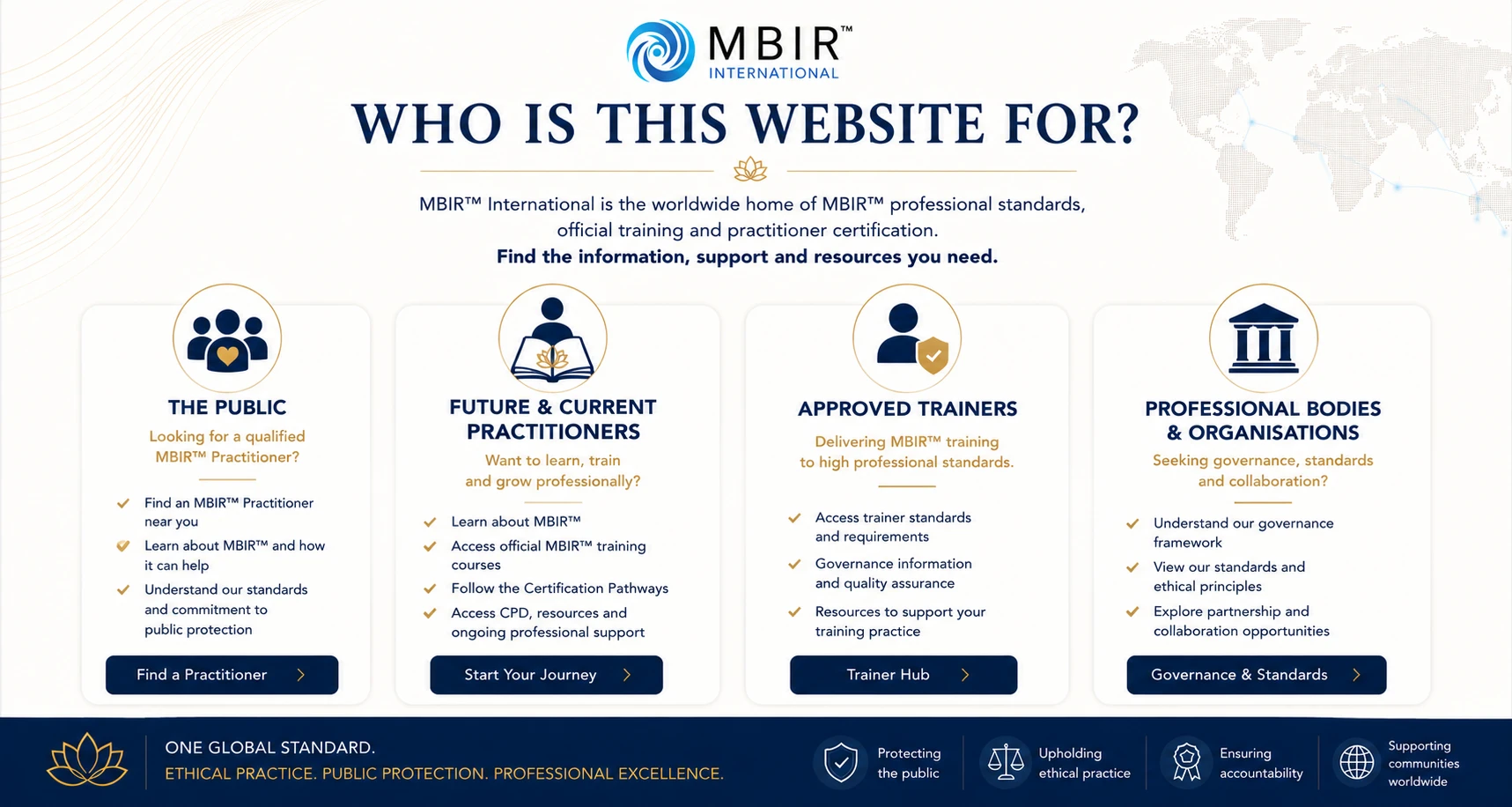
MBIR International™ serves as the official global governance and standards framework for MBIR™.
Governance Purpose

Purpose of MBIR International™

MBIR International™ exists to protect the integrity, safety, ethical delivery, and professional standards of the MBIR™ methodology worldwide.

Its role is to provide governance, professional oversight, and quality assurance for the continued development and responsible application of MBIR™ across clinical, therapeutic, coaching, and educational settings.

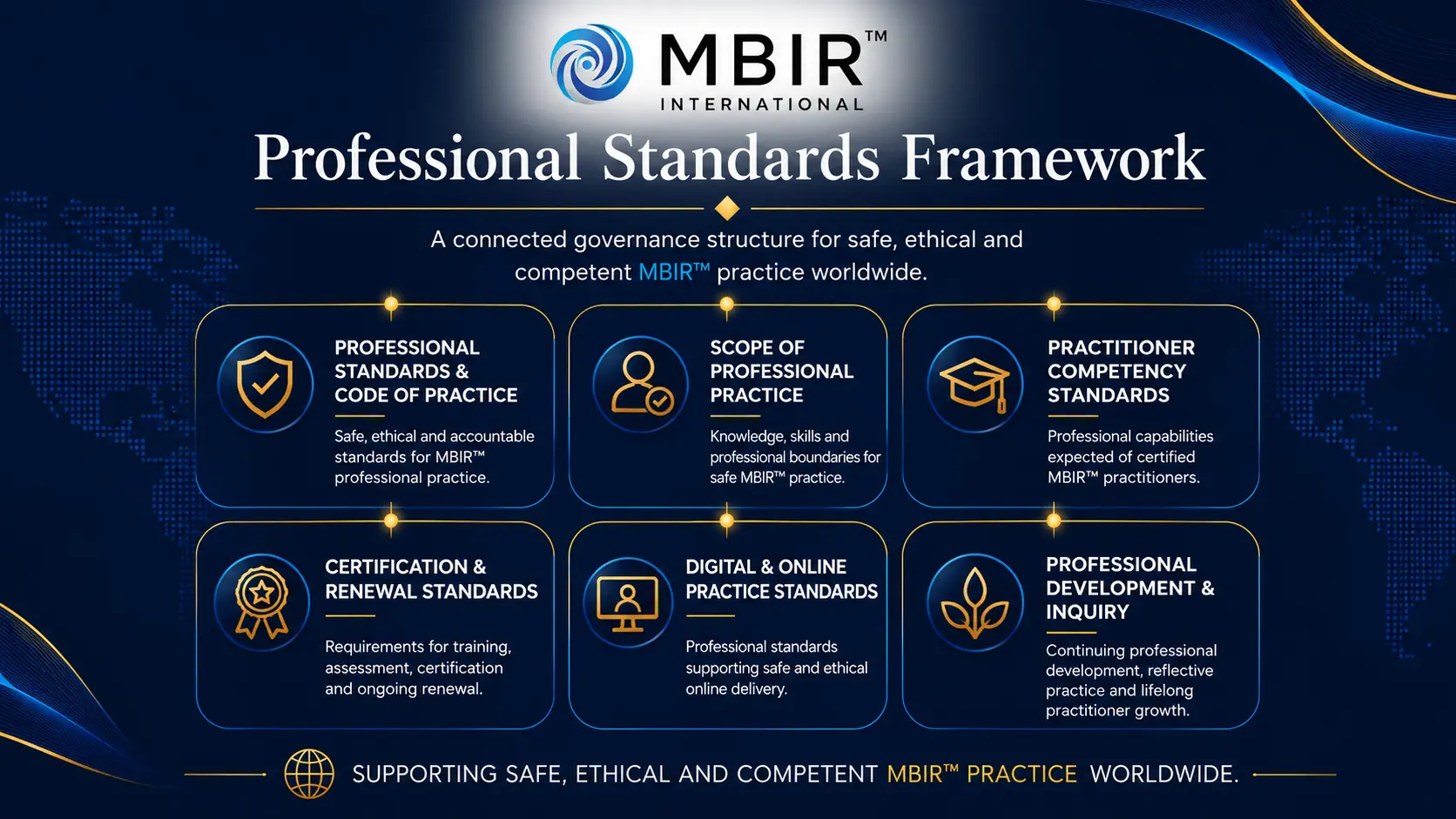
MBIR International™ supports the safe evolution of the methodology by maintaining clear standards of training, certification, competence, ethical practice, and professional accountability.

1
Professional Standards
2
Certification Pathways
3
Practitioner Competencies
4
Methodological Integrity
5
Ethical Practice
6
Public Safety
The Methodology

What Is MBIR™?

MBIR™ — Mindfulness-Based Inner RePatterning™

MBIR™ is a trauma-informed, nervous-system-oriented methodology designed to support safe, gentle, and effective transformational work without requiring extensive analysis or detailed retelling of traumatic experiences.

Rather than focusing primarily on “the story,” MBIR™ works with what is happening within the client’s system in the present moment.

The approach emphasises:

  • nervous system regulation
  • present-state awareness
  • emotional stabilisation
  • co-regulation
  • body-based awareness
  • safety-first facilitation

MBIR™ recognises that many individuals can become overwhelmed, dysregulated, dissociated, or destabilised by approaches that rely heavily on emotional excavation, repeated retelling, or intense analytical processing.

Instead, MBIR™ supports change through:

  • awareness without overwhelm
  • regulation before processing
  • working with the body and nervous system
  • non-analytical facilitation
  • gentle experiential awareness
  • trauma-safe pacing

A Nervous-System-Oriented Approach

MBIR™ is grounded in the understanding that emotional wellbeing is closely connected to nervous system regulation and the body’s sense of safety.

The methodology works with:

  • autonomic regulation
  • grounding and orientation
  • present-state awareness
  • emotional activation and stabilisation
  • co-regulation processes
  • nervous system pacing

This allows practitioners to work in a way that prioritises safety, stabilisation, and regulation throughout the therapeutic process.

Trauma-Informed & Safety-Focused

MBIR™ is designed to minimise unnecessary overwhelm and support clients safely within their capacity.

The methodology emphasises:

  • emotional safety
  • client pacing
  • nervous system awareness
  • stabilisation before deeper processing
  • working without forced disclosure
  • respecting the client’s readiness and boundaries

Clients are not required to relive traumatic events or provide detailed explanations in order to engage with the process.

Non-Analytical & Present-State Focused

MBIR™ differs from approaches that rely heavily on interpretation, analysis, or prolonged exploration of past experiences.

Instead, the focus is placed on:

  • what is happening now
  • how the nervous system is responding in the present moment
  • awareness of internal experience
  • regulation and integration
  • allowing change to emerge naturally without force or over-analysis

This makes MBIR™ particularly suitable for individuals who:

  • become overwhelmed by emotional analysis
  • struggle to verbalise experiences
  • intellectualise emotions
  • dissociate easily
  • fear disclosure
  • feel destabilised by traditional trauma-processing approaches

Regulation-Based Practice

At the heart of MBIR™ is the principle that regulation and safety create the conditions for meaningful change.

Practitioners work to support:

  • nervous system coherence
  • grounding and stabilisation
  • emotional flexibility
  • present-state regulation
  • increased awareness and resilience

The methodology aims to create a safe internal environment from which change can emerge organically and sustainably.

Methodology Origin

Origins of MBIR™

MBIR™ (Mindfulness Based Inner RePatterning™) was developed by Tania A Prince, EFT Founding Master and EFT Master Trainer of Trainers, following decades of clinical observation, therapeutic practice, and practitioner training.

The methodology emerged from the recognition that many transformational approaches lacked sufficient nervous-system-informed structure for working safely with freeze, shutdown, dissociation, overwhelm, and complex trauma.

MBIR™ was developed to support deeper transformational change through a safer, regulation-oriented, non-analytical framework that prioritises nervous system stabilisation before deeper processing.

Founder Credentials

EFT Founding Master
(1 of 29 worldwide)
EFT Master Trainer of Trainers
33+ years clinical experience
26+ years practitioner training
Creator of MBIR™
Professional Governance

Professional Standards

A Standards-Based Professional Methodology

MBIR™ is committed to developing and maintaining high professional, ethical, and practice standards across all areas of training, certification, mentoring, and client work.

As MBIR™ continues to develop internationally, professional standards help ensure:

  • client safety
  • ethical practice
  • practitioner competence
  • consistency of training
  • trauma-informed delivery
  • professional accountability
  • integrity of the methodology

These standards form part of the foundation of MBIR™ as a professional, governance-based methodology rather than simply a collection of techniques.

Evidence-Informed Practice

Scientific & Evidence-Informed Foundations

MBIR™ is informed by interdisciplinary scientific and clinical perspectives relating to nervous system regulation, trauma adaptation, memory reconsolidation, attachment, neuroception, and embodied transformational change.

The framework draws upon established research and evolving professional inquiry to support safe, evidence-informed practice while recognising the complexity of human change processes.

MBIR International™ supports ongoing scientific review, professional development, and evidence-informed inquiry to maintain methodological integrity.

Neuroscience Trauma Research Polyvagal Theory Attachment Science Memory Reconsolidation Clinical Observation
MBIR Professional Pathway certification graphic showing five levels from foundations to certified trainer.
The MBIR Professional Framework graphic showing ethics, certification, competencies, governance, trauma-informed practice, practitioner development, professional standards, and nervous system regulation.

Commitment to Safe & Ethical Practice

All MBIR™ Practitioners, Mentors, and Trainers are expected to practise within clearly defined professional standards and ethical guidelines.

This includes commitments to:

  • trauma-informed practice
  • nervous-system-safe facilitation
  • professional integrity
  • informed consent
  • confidentiality
  • ongoing professional development
  • professional boundaries
  • working within scope of competence
  • appropriate referral where required

MBIR™ places strong emphasis on creating safe, respectful, and non-overwhelming environments for both clients and practitioners.

Safety First

A Safety-First Approach

MBIR™ is grounded in a trauma-informed understanding of the nervous system, emotional regulation, and human experience.

The methodology recognises that many individuals do not respond well to approaches that rely heavily on emotional excavation, repeated retelling of traumatic events, or intense analytical processing.

For some people, these approaches may increase overwhelm, dysregulation, dissociation, shame, or emotional shutdown.

MBIR™ therefore places safety, regulation, and stabilisation at the centre of the process.

MBIR Trauma-Informed Regulation Continuum graphic showing dysregulation, overwhelm, stabilisation, coherence, and integration.

Working With the Nervous System

MBIR™ approaches transformational work through the lens of nervous system regulation and present-state awareness.

Rather than focusing primarily on “what happened,” the methodology works with:

  • what is happening within the client’s system now
  • nervous system responses in the present moment
  • emotional activation and regulation
  • body-based awareness
  • grounding and orientation
  • co-regulation and stabilisation

This creates a gentler and often more manageable pathway for change.

Trauma-Informed Principles

MBIR™ is guided by principles commonly associated with trauma-informed practice, including:

  • emotional and psychological safety
  • respect for pacing and readiness
  • minimising unnecessary overwhelm
  • supporting regulation before deeper processing
  • respecting client autonomy and boundaries
  • avoiding coercive or forceful intervention
  • working within the client’s capacity and window of tolerance

The methodology recognises that safety is not simply emotional comfort, but a nervous system experience.

Non-Analytical & Non-Overwhelming

MBIR™ does not require clients to provide detailed explanations, relive traumatic experiences, or repeatedly revisit distressing memories in order to engage with the process.

The approach is intentionally designed to support individuals who may:

  • become overwhelmed by emotional analysis
  • struggle to verbalise experiences
  • intellectualise emotions
  • dissociate easily
  • fear disclosure
  • experience heightened nervous system activation
  • feel destabilised by traditional trauma-processing approaches

Instead, MBIR™ supports awareness and change through regulation, presence, and gentle experiential processing.

Regulation Before Processing

A central principle within MBIR™ is that meaningful change is more likely to occur when the nervous system experiences sufficient safety and regulation.

Practitioners therefore prioritise:

  • stabilisation
  • grounding
  • nervous system awareness
  • emotional regulation
  • pacing
  • co-regulation
  • present-state orientation

before attempting deeper emotional exploration where appropriate. This helps reduce the likelihood of overwhelm and supports safer transformational work.

International Positioning

Developing an International Professional Methodology

MBIR™ continues to evolve as a standards-based, trauma-informed professional methodology designed to support safe, ethical, nervous-system-oriented transformational work internationally.

The long-term vision includes:

  • professional certification pathways
  • practitioner development
  • mentoring and trainer structures
  • international standards
  • governance frameworks
  • ongoing professional education
  • research and future development

MBIR™ is being developed with a commitment to:

  • safety
  • professionalism
  • ethical practice
  • competency
  • scalability
  • integrity of the methodology

The intention is to support the responsible international growth of MBIR™ as a professional transformational framework.

Protected Professional Area

Practitioner Hub

The MBIR™ Practitioner Hub is a protected professional learning environment designed for practitioners, mentors, trainers, and enrolled students.

It acts as a gateway into the MBIR International™ professional ecosystem, supporting learning, documentation, certification, mentoring, and ongoing development.

Login link to be connected to the New Zenler protected portal.

The Hub will provide access to:

  • governance documents
  • practitioner resources
  • certification guidance
  • mentoring and CPD materials
  • training recordings
  • downloadable forms and templates
  • professional updates
  • practitioner community resources