What Makes a Good EFT Training Course?

If you are looking for EFT training, you may find that courses which appear quite similar on the surface can provide very different learning experiences.
Two courses may both teach Emotional Freedom Techniques (EFT). They may cover similar material, take place over a similar number of days and even lead towards the same level of accreditation. Yet the depth of understanding and practical skill a student develops can be very different.
So, what makes a good EFT training course?
The syllabus matters, but I believe there is much more to good training than covering a syllabus.
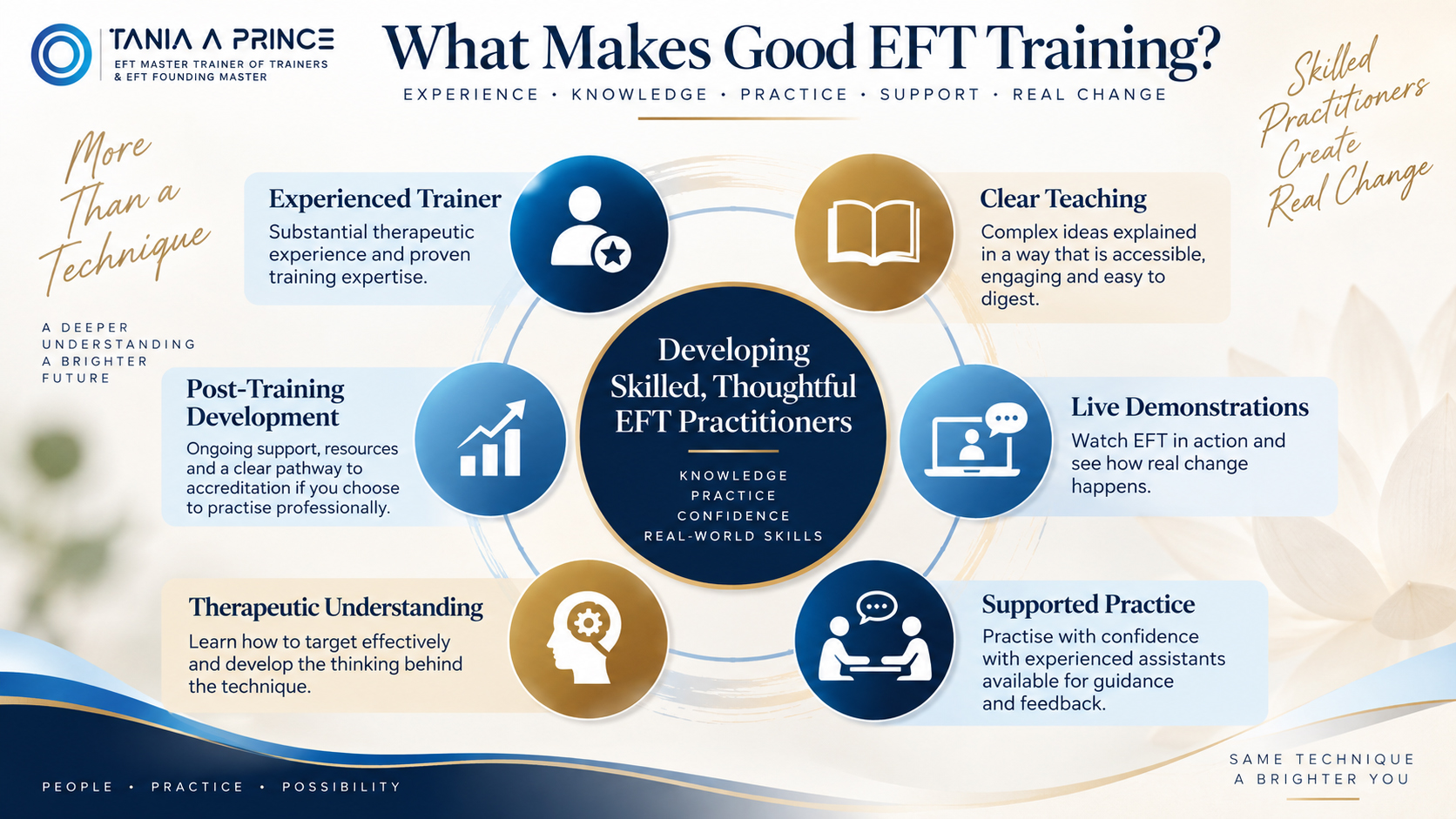
The experience of the trainer matters. The ability to teach matters. The quality of demonstrations matters. Students need opportunities to practise and ask questions, and they need knowledgeable people available to support them while they are learning.
Most importantly, good EFT training should help students understand not only what to do, but why they are doing it.
After 34 years of therapeutic work, working with thousands of clients and 26 years of training EFT, these are the things I believe are particularly important when choosing an EFT training course.
Start With the Standard of the EFT Training
Before comparing trainers, establish what the course is actually designed to teach you.
There is an important difference between learning some EFT for your own personal use and undertaking practitioner-level training.
You don’t necessarily need to want to become a professional practitioner to undertake practitioner training. Some people simply want a much deeper understanding of EFT. However, practitioner-level training should have a clearly defined syllabus, learning outcomes and professional standards.
If accreditation matters to you, find out who the accrediting organisation is and what is required beyond attending the initial course.
My own EFT Practitioner Training follows the standards required for accreditation through EFT International, the worldwide member-led professional organisation that developed from AAMET.
I was involved in the early days of AAMET and served on its original training board, where I was involved in overseeing EFT training syllabuses and standards. That experience has given me a long-term perspective on the importance of maintaining the quality of EFT training as the approach has grown internationally.
The Trainer’s Therapeutic Experience Matters
There is a difference between knowing how to perform EFT and having extensive experience of working therapeutically with people.
Real therapeutic work is rarely neat.
People don’t necessarily arrive knowing exactly what the problem is. They may say they are anxious, overwhelmed, angry, lacking confidence or simply that something doesn’t feel right.
One issue can lead unexpectedly to another. A memory may emerge. An emotion may change. Something apparently insignificant may suddenly become highly relevant.
This is where therapeutic experience becomes important.
I have worked therapeutically for 34 years and have worked with thousands of clients during that time. Inevitably, that experience informs the way I teach.
When a student asks, “What would you do if…?”, I am not answering solely from a training manual. I can draw upon decades of experience of sitting with people, observing what happens and adapting therapeutic work to the individual.
When you are choosing an EFT trainer, therefore, it is worth asking about their experience of actually working therapeutically with people, not simply how long they have known EFT.
Being an Experienced Practitioner Doesn’t Automatically Make Someone an Experienced Trainer
There is another side to this.
Someone can be an excellent practitioner and still not necessarily be an excellent trainer.
Training is a skill in its own right.
A trainer needs to take complex information and make it understandable without oversimplifying it. They need to structure learning, communicate clearly, engage a group, answer questions, recognise when somebody hasn’t understood something and find another way of explaining it.
My own development as a trainer included more than three weeks of intensive NLP Trainer Training in America. An important part of that training was learning the skills involved in training, presenting and communicating effectively.
Before moving into therapeutic work and training, I also spent ten years working in show business. Although that may appear unrelated to EFT, it gave me considerable experience of communicating with audiences, reading a room and holding people’s attention.
I have subsequently spent 26 years training people in EFT and now train EFT Practitioners, Advanced Practitioners and EFT Trainers.
One of my experienced assistants, Amanda Wonderland, has assisted at many EFT trainings. After assisting on my EFT Level 1 and Level 2 training, she wrote:
“Having assisted at many EFT trainings over the years, I can honestly say that I have never seen the material presented with such clarity or made so succinct, accessible, and easy for students to digest.”
— Amanda Wonderland, EFT International Accredited Advanced Practitioner & Trainer-Candidate
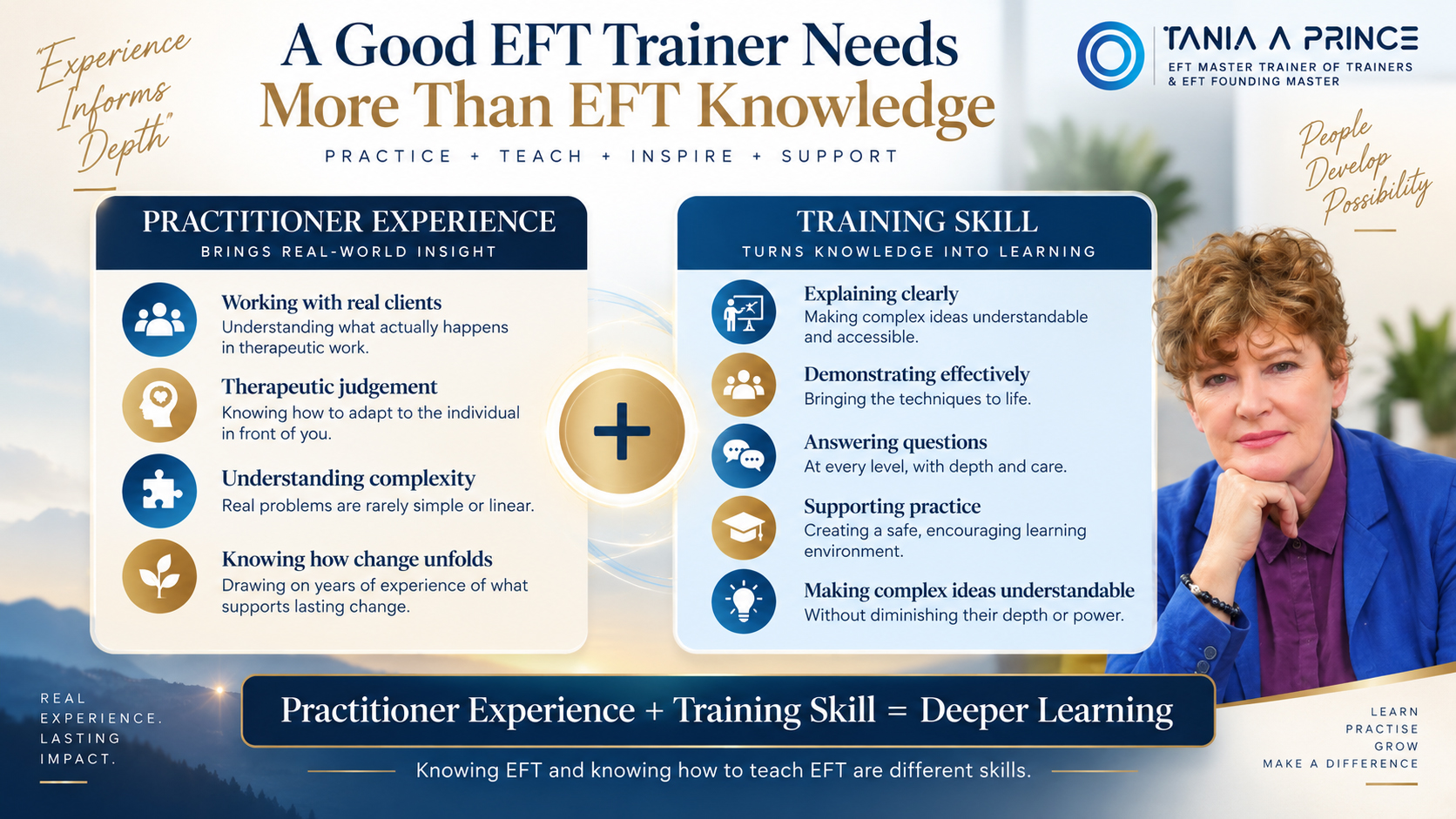
For me, accessibility is important. Sophisticated therapeutic ideas don’t need to be made complicated in order to retain their depth.
Good EFT Training Goes Beyond Learning the Tapping Points
The physical tapping sequence is relatively easy to learn.
One of the more sophisticated skills is knowing what to tap on.
A person may say:
“I have anxiety.”
“I don’t feel good enough.”
“I procrastinate.”
“I hate public speaking.”
“I feel overwhelmed.”
These are useful starting points, but they don’t necessarily identify the aspects of the problem that will be most useful to work with.
Good practitioner training should develop the student’s ability to listen and explore.
What is happening?
When does it happen?
What does the person notice?
Is there a particular memory?
What are they imagining might happen?
What meaning are they giving to the situation?
What happens in their body?
Effective targeting can make a considerable difference to EFT work.
This is why learning EFT is about much more than memorising tapping phrases.
Understanding Change Work Gives EFT Greater Depth
One of the principles underlying the way I teach is that I want students to understand why they are doing something.
My professional background includes extensive training in Neuro-Linguistic Programming (NLP), and I bring relevant elements of that knowledge into my EFT training.
This does not replace or alter the EFT syllabus. Students are learning EFT.
However, understanding aspects of NLP can give students greater insight into change work.
Language, for example, can provide important clues about how somebody is internally organising an experience. The questions we ask can influence what information becomes available. Small distinctions in language can sometimes reveal important differences in how a problem is represented.
This can help students understand why a particular question might be useful, why a practitioner might change direction and why two people presenting with apparently similar problems may require completely different therapeutic conversations.
I don’t want students simply memorising:
“When this happens, do this.”
I want them to begin asking:
“What is happening here?”
That is the beginning of therapeutic thinking.
Demonstrations Are an Essential Part of Learning EFT
There are some things that are difficult to understand fully until you see them happening.
This is why demonstrations are such an important part of EFT training.
Watching an experienced practitioner work allows students to observe how the principles being taught translate into an actual therapeutic interaction.
They can see how questions are asked, how the practitioner listens, how a target is developed, how language is used and how the direction of a session changes in response to the person.
Amanda also commented specifically on this aspect of my training:
“Her demonstrations were exceptional. She brought each technique to life and showed the profound shifts that can happen with EFT… while always working with care, sensitivity, and deep respect for the person in front of her.”
— Amanda Wonderland
On my live online training, students see EFT demonstrated and have opportunities to ask questions about what they have observed.
The main teaching, demonstrations and questions are recorded and made available privately afterwards to students who attended the live training. Students’ private practice sessions are not recorded.
Being able to revisit demonstrations later can be extremely useful because students often notice things on a second viewing that they didn’t have the experience to notice the first time.
Students Need to Practise EFT, Not Just Watch It
Watching an experienced practitioner is valuable, but it is not enough.
Students need to practise.
There is often a fascinating moment in training when somebody has understood everything while watching a demonstration and then sits opposite another student and suddenly thinks:
“What do I do now?”
That isn’t failure. It is an important part of learning.
Knowledge is beginning to become skill.
During my EFT Practitioner Training, students practise privately with each other in breakout rooms. They have an opportunity to apply what they have just learned and experience both sides of the process.
This is also where many of the best questions arise.
Experienced Assistants Add Another Level of Support
I believe the quality of the support surrounding student practice matters enormously.
I have experienced assistants on my training who bring a wealth of their own knowledge and experience.
When students go into breakout rooms, they aren’t simply sent away to work everything out for themselves. My assistants and I move between the rooms, observe the work and provide guidance where needed.
If somebody becomes unsure of what to do next, struggles to identify a useful target or simply wants to check their understanding, experienced support is available.
Michelle CJ came to my training having previously practised EFT at Level 2 elsewhere. She commented:
“Tania and her lovely team were absolutely amazing. The wealth of knowledge was limitless. I felt supported and learning the new skills felt effortless.”
— Michelle CJ
A good practice environment needs to achieve a balance.
Students need enough independence to begin developing their own skills, but enough support that they aren’t left floundering when they encounter something they don’t yet understand.
Good EFT Training Shouldn’t Depend on Scripts
Tapping scripts have their place. They can help demonstrate an idea or give somebody a starting point.
But practitioner-level EFT cannot simply be about learning the right words to say.
People are too individual for that.
A phrase that is deeply meaningful to one person may have no emotional relevance whatsoever to another.
A script cannot notice that somebody’s facial expression has suddenly changed. It cannot hear an unexpected word in their answer. It cannot recognise that something important may have just happened and decide to explore it.
That requires a practitioner who is listening and observing.
Good EFT training should therefore develop flexibility, curiosity and responsiveness rather than dependence upon pre-written tapping statements.
Students Need to Feel Comfortable Asking Questions
A training course can contain excellent information but still provide a poor learning environment.
Students need to feel able to ask questions.
They need to be able to say:
“I don’t understand.”
“Why did you do that?”
“What did you notice?”
“Could you explain that again?”
“What would happen if the client said something different?”
These are valuable questions.
They are part of the process through which understanding develops.
I also believe learning can be enjoyable without sacrificing professional standards.
Natasha M., one of my students, described the training this way:
“Tania brings such a wealth of experience to her work, both as a trainer and a practitioner. What I especially loved about the training was how joyful and full of humor it was, while at the same time creating a really safe space to learn, explore, and ask questions.”
She also wrote:
“She’s incredibly thorough and generous with her knowledge. She takes the time to respond to questions with care and depth, and you can really feel how much experience and understanding she brings to what she teaches.”
— Natasha M.
I think good training can be rigorous, sophisticated and thorough while still being warm and enjoyable.
In fact, that can help people learn.
Live Online Training Should Still Feel Live
Online EFT training does not need to mean passive learning.
There is an important difference between live online EFT training and watching a collection of pre-recorded videos.
My EFT Practitioner Training is taught live online.
Students can interact with me, ask questions, watch demonstrations and practise with each other. My assistants and I can move into breakout rooms and support that practice.
Afterwards, students who attended the live course receive access to a private training platform containing the relevant recordings, additional demonstrations and learning resources to support consolidation.
The recordings supplement the live training.
They don’t replace it.
This is important because watching random EFT videos online can sometimes be confusing. People practise EFT in many different ways, some of which may be effective and some of which may not represent the approach being taught within a professional training programme.
Structured training gives students a framework for understanding what they are doing and why.
Ethics, Safety and Professional Boundaries Should Be Part of Practitioner Training
Learning a therapeutic approach carries responsibility.
If students intend to use EFT with other people, practitioner training should include appropriate consideration of ethics, safety, professional boundaries and scope of practice.
It should also encourage students to recognise the limits of their competence.
Completing a few days of training does not suddenly give somebody years of therapeutic experience.
A good training course should be the beginning of professional development rather than presented as the end of it.
Competence develops through practice, reflection, consolidation, mentoring and experience.
Find Out What Happens After the Training
This is one of the questions I would strongly recommend asking before booking an EFT Practitioner course:
What happens after the live training finishes?
For students pursuing EFT International accreditation through my training, attending the live course is followed by a period of consolidation and assessment.
Students have time to practise, integrate what they have learned and demonstrate their developing competence.
The fastest I have seen students complete the accreditation process is approximately three to four months after attending the training, although people progress at different rates.
Students are expected to complete the post-training consolidation and testing phase within one year. If they do not complete it within that period, they are required by the accreditation requirements to re-attend the EFT Level 2 element before continuing. I offer that re-attendance at a discounted rate.
The purpose is not to rush people through accreditation.
It is to maintain a high standard of Accredited EFT Practitioners.
The Same EFT Level Doesn’t Necessarily Mean the Same Learning Experience
It is easy to assume that two courses teaching the same EFT level will provide essentially the same experience.
That isn’t necessarily the case.
Michelle CJ had previously practised EFT at Level 2 elsewhere before attending my training. Afterwards, she wrote:
“I have previously practiced EFT at level 2. This course was amazing, I have new skills and a completely new way of looking at EFT. I’m feeling passionate about my future practice.”
— Michelle CJ
Her experience illustrates why I think it is important to look beyond the title of a course.
Look at the person teaching it.
Look at their therapeutic experience.
Look at their training experience.
Find out whether you will see demonstrations, how much practice you will get, whether experienced support will be available and whether the trainer teaches you to understand the process rather than simply follow it.
Questions to Ask When Choosing an EFT Training Course
Before enrolling, I would consider asking:
- Does the course follow recognised EFT training standards?
- Is the training delivered live?
- What therapeutic experience does the trainer have?
- How much experience do they have actually training EFT?
- Have they undertaken professional training in how to teach or train?
- Will I see EFT demonstrated?
- Will I have opportunities to practise?
- Will experienced trainers or assistants support that practice?
- Will I learn how to identify and refine EFT targets?
- Does the course develop therapeutic understanding rather than rely heavily on scripts?
- Can I ask questions and receive meaningful answers?
- Are ethics, safety and professional boundaries included?
- What resources will I have after the live course?
- What happens after training?
- Is there a structured pathway to accreditation if I want to become an Accredited EFT Practitioner?
Price and convenience naturally matter, but I would not make either the sole basis for choosing practitioner training.
You are investing in the foundation of your understanding and potentially in skills you will later use with other people.
So, What Makes a Good EFT Training Course?
For me, the answer is not one single thing.
It is the combination of high training standards, substantial practitioner experience, genuine teaching skill, clear explanations, high-quality demonstrations, plenty of practice, experienced support, professional boundaries and continued learning after the course itself.
Most importantly, good EFT training should begin moving you beyond simply knowing a tapping procedure.
It should help you develop the ability to observe, listen, question, think and respond to the individual person in front of you.
After 34 years of therapeutic work, thousands of clients and 26 years training EFT, this is still one of the things I consider most important in practitioner development.
A student needs to know:
What do I do?
But as their skill develops, they also need to understand:
Why am I doing it? What am I noticing? And what is happening for this particular person?
That is where learning EFT begins to become the development of practitioner skill.
Interested in EFT Practitioner Training?
I teach live online EFT Practitioner Training for students in the UK and internationally.
You do not have to intend to become a professional practitioner to undertake practitioner-level training. Some students want a deeper understanding of EFT for themselves or to complement their existing professional skills.
For those who do want to practise professionally, the training provides a pathway towards EFT International accreditation.
The live training includes teaching, demonstrations, supported practice, experienced assistants and opportunities to ask questions, with additional private resources available afterwards to support consolidation.
As Michelle CJ wrote:
“If you’re considering learning EFT, I would wholeheartedly recommend this course. It’s been a really positive, empowering and worthwhile experience, and I’m so grateful I took part.”
— Michelle CJ
If you are considering EFT training, you can explore my upcoming Accredited EFT Practitioner Training and decide whether it is the right next step for you.