
What Is EFT Training?

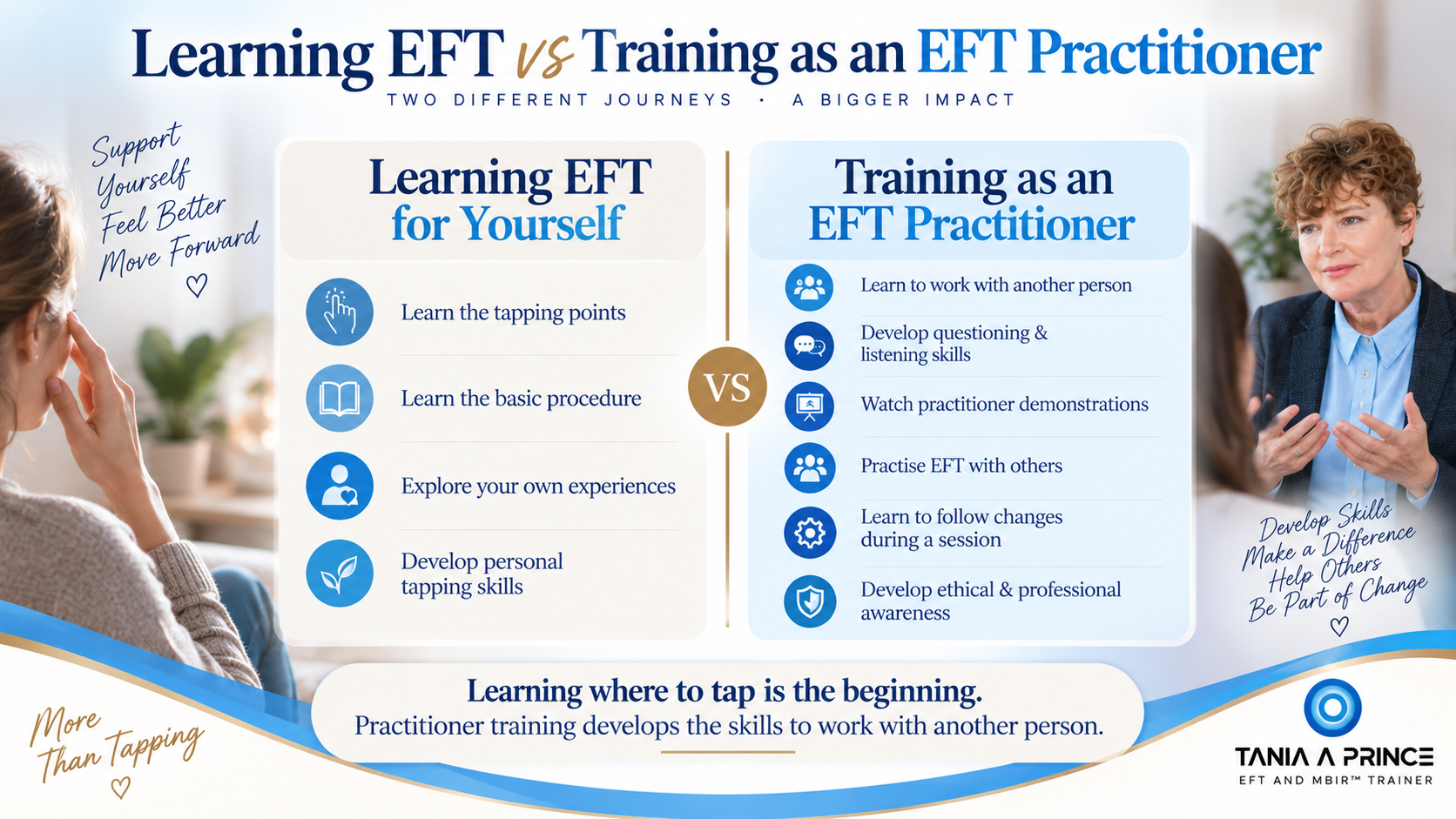
EFT training teaches you how to use Emotional Freedom Techniques (EFT), commonly known as tapping, both for yourself and, at practitioner level, when working with other people.
At first glance, EFT can appear relatively simple. You focus on a problem while tapping on a sequence of points on the face and upper body.
But professional EFT training involves considerably more than learning where to tap or memorising a tapping script.
You learn how to identify what to work on, ask useful questions, recognise changes in a person’s experience, work with emotions and memories, structure an EFT session and adapt what you are doing according to what happens during that session.
If you are considering learning EFT professionally, understanding this distinction is important.
Learning how to tap is relatively straightforward. Learning how to use EFT skilfully with another person is where practitioner training begins.
What Is EFT?
EFT stands for Emotional Freedom Techniques. It is often referred to simply as EFT tapping or tapping.
The approach combines focused attention on an emotional, cognitive or physical experience with tapping on a sequence of points, primarily on the face and upper body.
During EFT, a person might focus on something such as:
- anxiety about an upcoming event
- an upsetting memory
- a fear or phobia
- anger about something that happened
- an uncomfortable feeling in the body
- a belief about themselves
- a stressful situation
- an emotional response they do not fully understand
The person taps while remaining connected, at an appropriate level, to what they are experiencing.
As the process develops, thoughts, feelings, physical sensations or memories may change.
This is where EFT becomes much more than simply following a tapping routine.
A practitioner needs to be able to recognise these changes and know what to do next.
So, What Is EFT Training?
EFT training is structured teaching in the principles and practical application of Emotional Freedom Techniques.
Introductory EFT training teaches the foundations of the method.
Practitioner-level EFT training develops your ability to use EFT when working with another person.
That requires a different level of skill.
When you tap for yourself, you already have access to your thoughts, feelings and memories.
When you work with somebody else, you don’t.
You need to listen.
You need to observe.
You need to ask appropriate questions.
You need to recognise what may be important without imposing your own interpretation on the person’s experience.
And you need to know how to respond when something unexpected emerges.
These are practitioner skills, and they develop through good-quality teaching, demonstrations, practice, feedback and experience.
What Do You Learn in EFT Training?
The exact syllabus will depend on the training organisation and course you choose.
However, comprehensive EFT practitioner training should give you both an understanding of EFT and opportunities to develop practical skills.
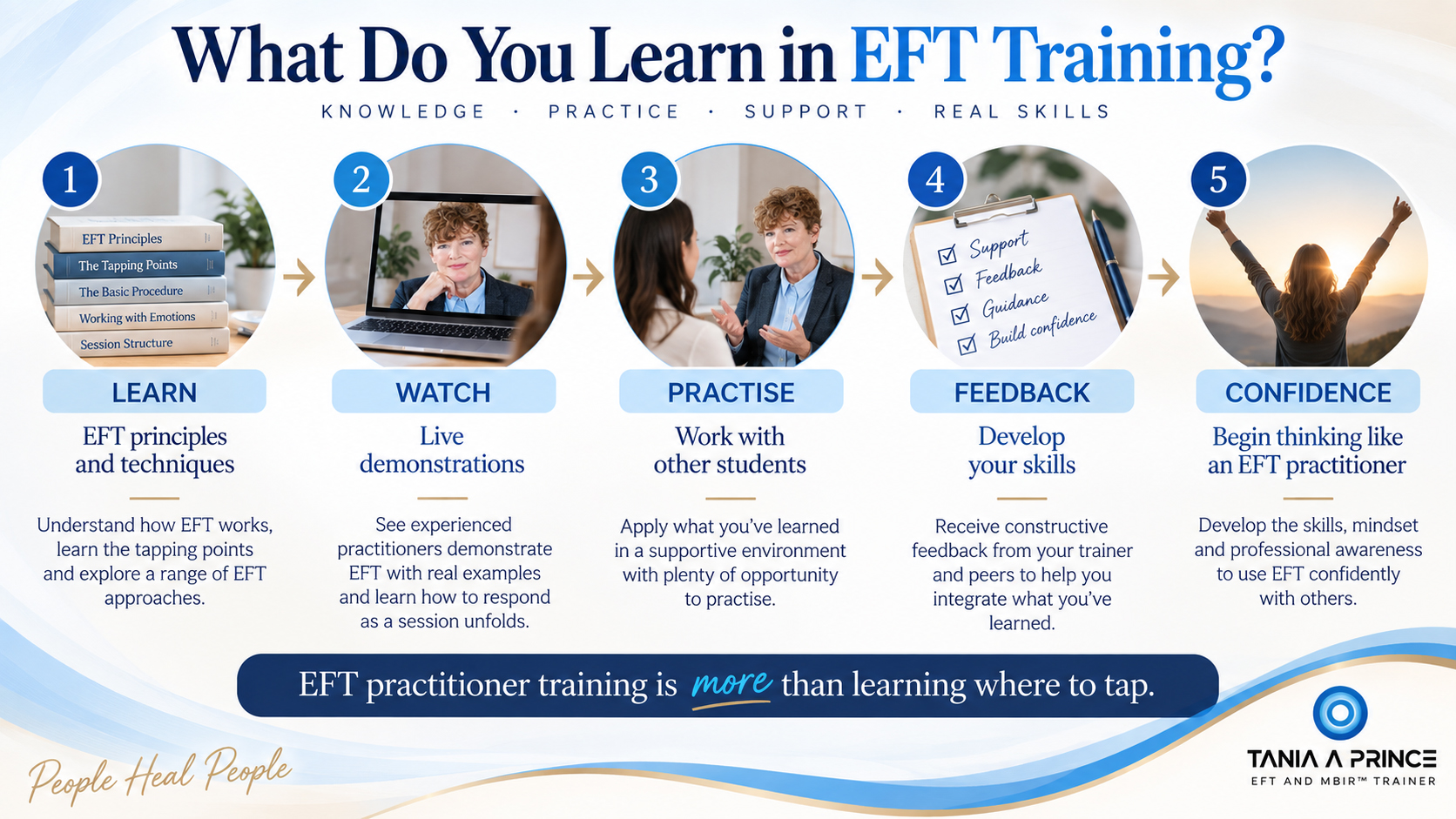
This may include learning:
- the EFT tapping points
- the basic EFT procedure
- how to identify a problem to work on
- how to assess the intensity or impact of an issue
- how to formulate appropriate tapping language
- how to work with emotions
- how to identify specific events and memories
- how to recognise different aspects of a problem
- what to do when the focus of a session changes
- questioning and listening skills
- ways of approaching emotionally intense material carefully
- how to structure an EFT session
- practitioner boundaries and ethics
- how to practise EFT with another person
Most importantly, you begin learning how to think as an EFT practitioner rather than simply how to perform a technique.
EFT Training Is Not About Memorising Scripts
This is one of the most important distinctions to understand if you are considering professional EFT training.
You may have encountered EFT through a book, YouTube video, tapping meditation or downloadable script.
These can provide an introduction to tapping and may be useful for personal use.
Practitioner work is different.
Imagine somebody starts an EFT session saying:
“I’m anxious about going to work.”
As you explore the anxiety, the person remembers being criticised by their manager during a meeting several months earlier.
They suddenly notice that their anxiety becomes stronger when they think about that meeting.
That information matters.
A practitioner needs to recognise that the focus of the work may have changed.
Simply continuing to repeat:
“This anxiety about work…”
could mean missing something potentially significant that has emerged.
Good EFT training teaches you to pay attention to the person’s responses and allow the session to develop from the information they give you.
There isn’t always a predetermined script.
What Happens During an EFT Training Course?
EFT is experiential.
For that reason, practitioner training shouldn’t consist solely of somebody talking to you about EFT for several days.
There should be opportunities to see EFT being demonstrated and to practise what you are learning.
A live EFT practitioner training course will typically combine teaching, trainer demonstrations, discussion, practical exercises and opportunities to work with other participants.
This is important because there is a considerable difference between understanding a technique intellectually and actually trying to use it with another person.
One participant on my EFT Level 1 & 2 training, Vanita, particularly commented on this practical aspect:
“I enjoyed the training, we got to practice and there were different types of sessions…”
She also highlighted something particularly relevant to people considering online training:
“I don’t think I’ve attended a zoom 3 days training, where I felt so engaged.”
Practical experience during training allows you to start integrating what you are learning rather than simply trying to remember information.
The Importance of EFT Demonstrations
Watching an experienced EFT practitioner demonstrate the techniques can be one of the most useful parts of training.
A demonstration allows you to see not only what the practitioner does, but also how they respond to the person in front of them.
You can observe how questions are asked, how the focus of the session develops and how the practitioner responds when new information emerges.
Amanda Wonderland, an EFT International Accredited Advanced Practitioner & Trainer-Candidate, assisted during one of my EFT Level 1 & 2 workshops.
Having previously assisted at many EFT trainings, she commented:
“I have never seen the material presented with such clarity or made so succinct, accessible, and easy for students to digest.”
She also described the demonstrations as:
“exceptional.”
Amanda’s perspective is particularly valuable because she was observing the training as an experienced EFT professional as well as supporting the students.
Do I Need Experience Before Starting EFT Training?
People arrive at EFT training from very different backgrounds.
Some are already:
- counsellors
- psychotherapists
- coaches
- complementary therapists
- healthcare professionals
- wellbeing practitioners
Others have no previous professional therapy experience at all.
They may have experienced EFT themselves, become interested in tapping and decided they would like to learn more.
Previous professional qualifications are not necessarily required simply to begin learning EFT.
However, there is an important distinction between attending EFT training and becoming competent to work professionally with clients.
If professional practice is your goal, you need to consider the complete practitioner pathway, including any practice, mentoring, assessment, ethical and accreditation requirements associated with the route you choose.
What Is EFT Level 1?
EFT Level 1 provides the foundations.
It introduces you to EFT and teaches the core principles and techniques needed to begin understanding and using the approach.
For some people, Level 1 is primarily about learning EFT for personal development.
For others, it is the first step towards professional practitioner training.
Level 1 should give you a solid foundation on which more advanced EFT skills can be developed.
What Is EFT Level 2?
EFT Level 2 builds upon the foundations established at Level 1.
At this stage, the focus increasingly moves towards developing the skills needed to work more effectively and flexibly with other people.
You begin expanding your range of EFT approaches and developing a deeper understanding of how sessions can unfold.
If your goal is professional EFT practice, Level 2 is an important part of practitioner development.
Interestingly, people who have previously completed Level 2 elsewhere sometimes choose to retrain or refresh their skills.
Michelle Carsley-Jones came to my training having previously practised EFT at Level 2. Afterwards she wrote:
“I have new skills and a completely new way of looking at EFT. I’m feeling passionate about my future practice.”
She also commented that:
“I felt supported and learning the new skills felt effortless.”
You can explore this distinction in more detail in EFT Level 1 vs Level 2: What’s the Difference?
Can You Learn EFT Online?
Yes.
EFT training can be delivered effectively through live, interactive online training.
This is different from purchasing a collection of prerecorded videos and watching them independently.
Live online practitioner training can include:
- real-time teaching
- EFT demonstrations
- questions and discussion
- breakout-room exercises
- paired practice
- feedback
- interaction with other students
The ability to interact matters.
Students need opportunities to ask questions when something doesn’t make sense and to practise what they have learned.
The group itself can also contribute considerably to the learning experience.
Manasi D described this aspect of my training:
“It was also beautiful to hear the different experiences and perspectives of the other participants, which added so much depth to the experience.”
She described the workshop as having:
“warmth, humour and lightness”
while still creating an environment that felt:
“thoughtful, engaging and safe.”
For people considering online training, the question therefore shouldn’t simply be:
“Is the course online?”
A better question is:
“How interactive is the online training?”
Read more in Can You Learn EFT Online?
How Long Does It Take to Become an EFT Practitioner?
This is another area where it is important to distinguish between training and professional practitioner status.
Initial EFT Level 1 & 2 training may be delivered over a relatively small number of intensive training days.
That doesn’t necessarily mean somebody becomes a fully accredited professional practitioner at the end of the final training day.
Depending on the professional pathway, additional requirements may include things such as practice, case studies, mentoring, assessment and demonstration of competence.
Becoming a practitioner is therefore better viewed as a process of professional development rather than simply attending a course and receiving a certificate.
Read more in How Long Does It Take to Become an EFT Practitioner?
EFT Certification vs Accreditation
Before choosing EFT training, find out exactly what the course leads to.
The words certificate, certification and accreditation can sometimes create confusion.
A certificate may simply confirm that you attended or completed a training course.
Professional accreditation generally involves meeting the requirements of a particular professional organisation or accrediting body.
If your intention is to practise professionally, ask:
What professional status will I have after completing this pathway?
Also ask what you need to complete after the initial training course.
Read more in EFT Certification vs Accreditation: What’s the Difference?
Can You Work Professionally After EFT Training?
Potentially, yes, but completing the initial training days and being ready for independent professional practice are not necessarily the same thing.
Competence develops through training and experience.
Your professional route may involve additional practice, mentoring, assessment and other requirements before full practitioner status or accreditation is achieved.
You will also need to consider appropriate professional insurance, ethical standards, scope of practice and any legal or professional requirements relevant to the country in which you work.
Read more in What Can You Do After EFT Practitioner Training?
Can EFT Practitioners Charge Clients?
Professional EFT practitioners can charge for their services, subject to the relevant legal, insurance, ethical and professional requirements.
The position can be different while somebody is still completing their practitioner requirements.
If you are training towards professional status, check the specific rules that apply to students within your training and accreditation pathway before charging for practice sessions.
Read more in Can EFT Practitioners Charge Clients?
What Makes a Good EFT Training Course?
If you search online for EFT training, you will find considerable variation.
That means it is worth looking beyond the course title and price.
Consider:
- the trainer’s EFT experience
- their professional credentials
- how long they have been practising
- how long they have been training practitioners
- whether the training is live
- whether you will see demonstrations
- how much practical work is included
- whether you can ask questions
- whether feedback is available
- what happens after the initial training
- whether mentoring is available
- what certification or accreditation pathway the training supports
One of the most useful questions you can ask is:
Will this course simply teach me EFT techniques, or will it help me develop the skills to use EFT with another person?
The distinction is important.
Choosing an EFT Trainer
The person teaching you can have a significant influence on the way you understand EFT.
An experienced trainer isn’t simply delivering information from a manual.
They should be able to demonstrate EFT, explain the reasoning behind what they are doing, answer questions and help students understand how principles apply in real situations.
Amanda Wonderland described my approach to teaching in this way:
“Tania has an incredible ability to explain EFT in language that anyone can understand, whether they are already an experienced psychotherapist or completely new to the practice.”
This is something I consider particularly important.
EFT training should be accessible enough for somebody at the beginning of their journey to understand, while retaining the depth required for professional practice.
EFT Practitioner Training With Tania A Prince
I have worked with EFT for more than two decades and was one of the original 29 EFT Founding Masters appointed following the development of EFT by Gary Craig.
I am also an EFT International Accredited Master Trainer of Trainers and have trained EFT practitioners internationally for many years.
My EFT Level 1 & 2 Practitioner Training is delivered live online.
The aim isn’t simply to teach you a collection of techniques.
I want students to understand what they are doing, why they are doing it and how to respond to the person sitting in front of them.
Training therefore combines teaching with demonstrations, discussion and practical experience.
Students come from a wide range of backgrounds. Some are established therapists wanting to integrate EFT into their existing work. Others are beginning an entirely new professional journey.
The training is designed to make EFT understandable without oversimplifying it.
What Is It Like to Attend EFT Training?
Learning effectively isn’t only about the syllabus.
The environment in which people learn matters too.
Students need to feel able to ask questions, experiment, make mistakes and develop their skills.
Manasi described her experience of the training as:
“a space that felt thoughtful, engaging and safe.”
She went on to say:
“Tania has a wonderful way of making the learning feel accessible and enjoyable.”
Vanita similarly described the training as being delivered:
“in a high quality way”
and emphasised how engaged she remained throughout the three days online.
For me, that combination is important: high-quality professional training should also be an enjoyable and supportive learning experience.
Is EFT Training Right for You?
EFT training attracts people for many different reasons.
Perhaps you have experienced tapping yourself and want to understand it more deeply.
Perhaps you already work therapeutically and want another approach to integrate into your existing professional practice.
Or perhaps you are considering becoming an EFT practitioner and beginning a completely new career.
Whatever brings you to EFT, start by thinking about where you ultimately want the training to take you.
If you simply want to learn tapping for yourself, introductory training may be enough.
If you want to work professionally with clients, look for a practitioner pathway that develops practical competence rather than simply giving you information.
Because ultimately:
Learning where to tap is only the beginning.
Professional EFT training is about learning how to use EFT skilfully, responsively, ethically and confidently with another human being.
Continue Exploring EFT Practitioner Training
If you are considering becoming an EFT practitioner, this article is the starting point for my complete EFT Training guide.
You can continue with:
- How Do I Become an EFT Practitioner in the UK?
- EFT Level 1 vs Level 2
- What Happens on an EFT Practitioner Training Course?
- Can You Learn EFT Online?
- How Long Does It Take to Become an EFT Practitioner?
- Do You Need Qualifications to Train in EFT?
- EFT Certification vs Accreditation
- What Can You Do After EFT Practitioner Training?
- Can EFT Practitioners Charge Clients?
- What Makes a Good EFT Training Course?
- Questions to Ask Before Choosing an EFT Trainer
You can also view my upcoming EFT Level 1 & 2 Practitioner Training if you are ready to explore training dates and the practitioner pathway.
