What Happens on an EFT Practitioner Training Course?

If you are thinking about training in Emotional Freedom Techniques (EFT), you may be wondering what actually happens during an EFT practitioner training course.
Do you spend the whole course tapping? Do you practise with other people? Is there a lot of theory? And what happens if you want to learn EFT properly but are not yet sure whether you want to work professionally with clients?
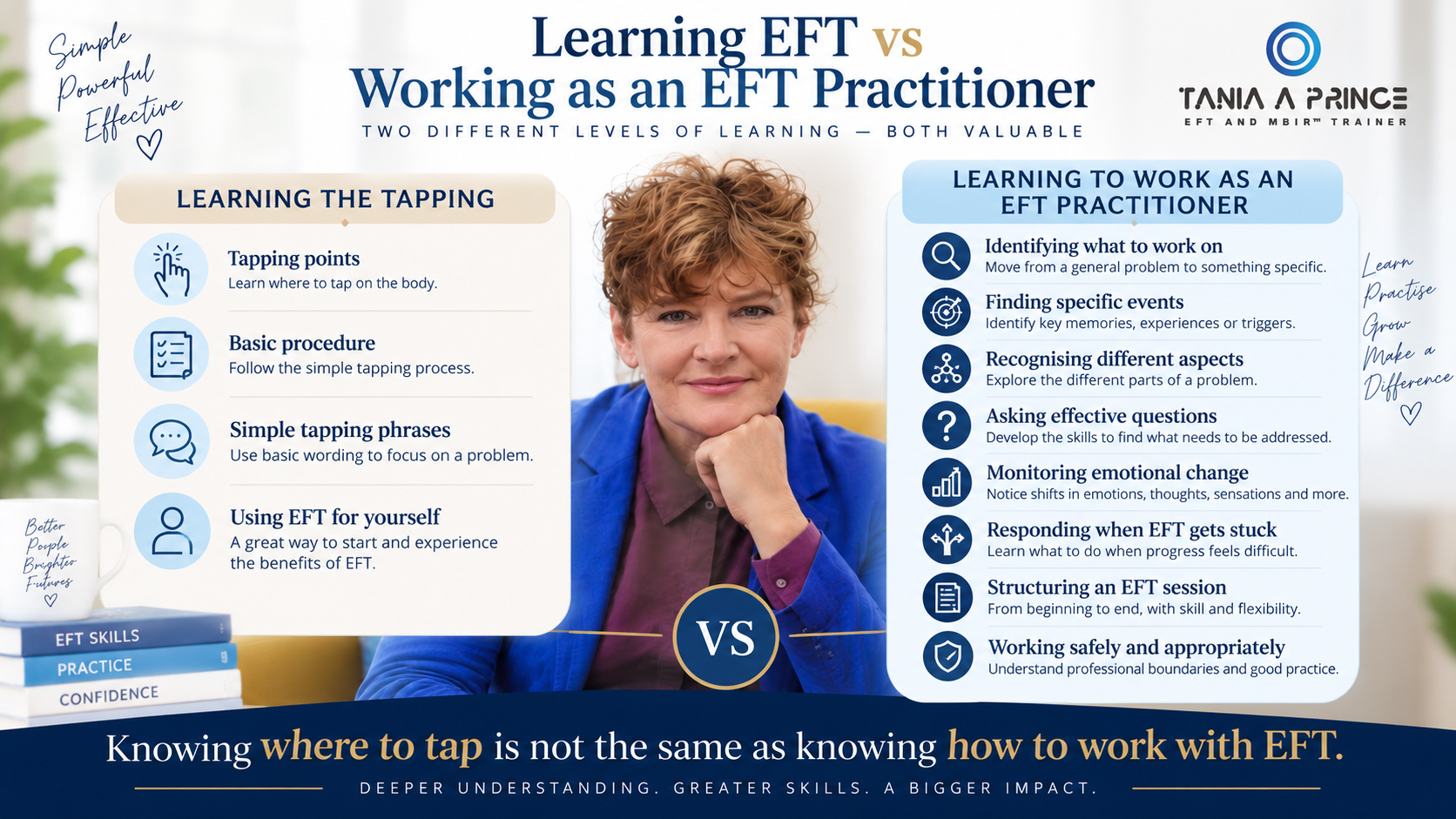
A good EFT practitioner training course should take you considerably further than simply learning the EFT tapping points.
You should learn how to use EFT systematically, how to identify what to work on, how to structure an EFT session and how to respond when the process does not unfold exactly as expected.
Just as importantly, you should have opportunities to experience EFT yourself and practise using it with other people.
As an EFT trainer, I have been teaching EFT for more than 25 years. I was also a member of the original training board of AAMET — the organisation that later became EFT International — where I was involved in overseeing EFT training syllabuses and standards. I was the third therapist in the world to be awarded trainer status by AAMET and now train both EFT practitioners and trainers.
One thing that experience has repeatedly shown me is that EFT is best learned through a combination of understanding, demonstration, experience and supervised practice.
What Is EFT Practitioner Training?
EFT practitioner training teaches you how to use Emotional Freedom Techniques beyond the level of simply following a tapping routine.
You learn the basic EFT process, but you also begin developing the skills needed to decide:
- what to focus on
- what questions to ask
- how to identify specific events
- how to work with emotional intensity
- how to recognise different aspects of a problem
- how to follow changes that occur during tapping
- how to work safely and appropriately
- how to structure an EFT session
This is an important distinction.
Knowing where to tap is not the same as knowing how to work with EFT.
The tapping points themselves can be learned relatively quickly. Developing skill in using EFT with the complexity of real human experience takes considerably more understanding and practice.
What Usually Happens at the Beginning of the Training?
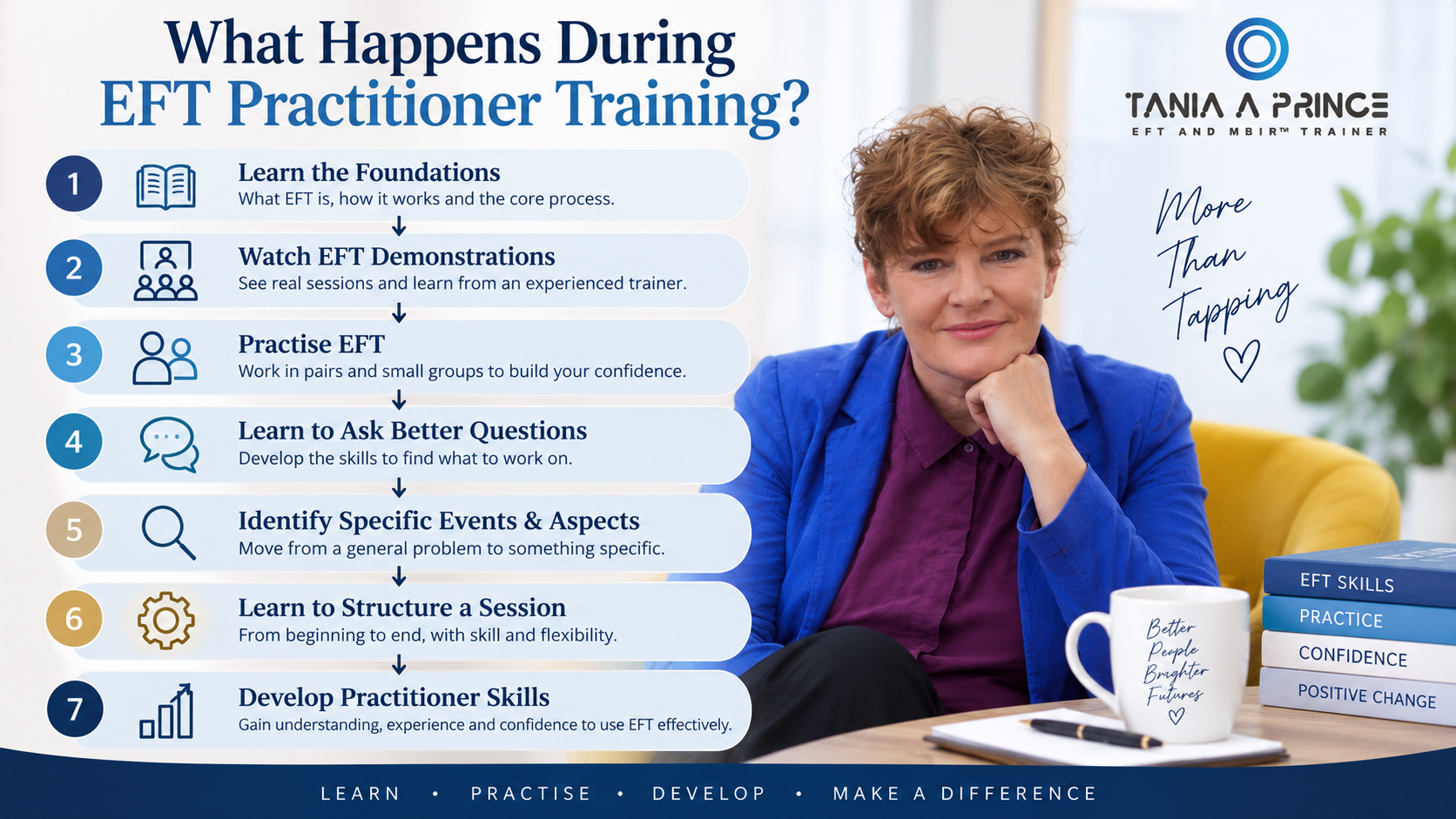
EFT practitioner training normally begins by establishing a strong foundation.
You will typically learn what EFT is, how the basic tapping process is structured and how to begin using it.
This includes learning the EFT tapping points and the core elements of the EFT process.
However, practitioner training should not stop there.
You also need to understand what you are actually asking someone to focus on while they tap.
That is where much of the skill in EFT begins.
Rather than tapping vaguely on a large problem such as:
“My anxiety.”
“My childhood.”
“My confidence.”
“My relationship.”
you learn how to begin breaking the problem down into something that can be worked with more precisely.
You Learn How to Identify Specific Events
One of the most important skills taught during EFT practitioner training is how to move from a broad problem towards specific experiences.
For example, someone may initially say:
“I have no confidence.”
That is a very large issue.
Through careful questioning, you might discover a particular memory:
“I was eight years old and the teacher asked me to read aloud. I made a mistake and everyone laughed.”
Now there is something much more specific to work with.
This ability to move from a global problem to a specific event or emotional target is one of the skills that differentiates practitioner-level EFT from simply tapping along with a general script.
You Learn How to Measure What Is Happening
EFT training also teaches you how to monitor change.
You may learn to use a simple 0–10 scale to assess emotional intensity before, during and after tapping.
But measurement is not limited to numbers.
People may notice changes in:
- physical sensations
- emotional intensity
- thoughts
- memories
- images
- beliefs
- breathing
- posture
- perspective
Part of becoming skilled with EFT is learning to observe these changes rather than assuming that a session must follow a predetermined path.
You Learn That Problems Can Have Different Aspects
An emotional experience is rarely one-dimensional.
Imagine someone who is anxious about giving a presentation.
Initially, the fear might appear to be:
“I’m frightened of speaking in front of everyone.”
But during the EFT process, several different aspects might emerge:
“I’m afraid my mind will go blank.”
“I can see everyone looking at me.”
“I’m frightened somebody will ask a question I can’t answer.”
“I remember being laughed at when I spoke in class.”
“I’ll look incompetent.”
Each of these may carry its own emotional response.
Practitioner training teaches you to recognise these different aspects and follow what emerges rather than repeatedly tapping on the original description of the problem.
You Watch EFT Demonstrations
Demonstrations are an important part of high-quality EFT training.
Watching an experienced trainer work gives you the opportunity to see how EFT operates in a real interaction.
You can observe how the practitioner:
- asks questions
- chooses what to focus on
- uses the person’s own words
- notices changes
- responds when new information appears
- changes direction when necessary
- manages emotional intensity
- brings the work towards an appropriate conclusion
This can teach something that is difficult to communicate through written instructions alone.
You are seeing the decision-making process behind EFT.
You Practise EFT Yourself
Practitioner training should be experiential.
You should not spend the entire course watching somebody else use EFT.
You need opportunities to practise.
Depending on the structure of the training, this may involve working in pairs, small groups or breakout rooms during online training.
You may alternate between different roles — practitioner, client and sometimes observer.
This gives you experience of EFT from several perspectives.
Being the practitioner helps you develop your questioning and session skills.
Being the client helps you understand what the process feels like from the other side.
Observing can help you notice patterns and skills that are more difficult to see when you are actively involved in the session.
You Learn How to Ask Better Questions
EFT is sometimes presented online as though the practitioner simply supplies a series of tapping statements.
That is a very limited view of the process.
Good EFT work frequently depends upon good questions.
For example:
“What happens when you think about it?”
“Where do you feel that in your body?”
“What specifically are you afraid might happen?”
“What part of that memory feels worst?”
“What does that remind you of?”
“What happened just before you started feeling that way?”
These are not questions designed to interrogate someone.
They help bring greater precision to the experience being worked with.
As your EFT skills develop, you begin learning not only what to say while tapping, but also how to listen carefully enough to recognise where the work may need to go next.
You Learn How to Work With Emotional Intensity
Practitioner training should also teach you that more emotional intensity is not necessarily better.
People sometimes assume that effective emotional work requires someone to become highly distressed.
It doesn’t.
There are ways of approaching emotionally charged material more gently.
You may learn strategies that allow someone to work at a greater psychological distance rather than immediately entering the most distressing part of an experience.
This becomes particularly important when working with difficult memories or complex emotional histories.
A skilled EFT practitioner learns to pay attention not only to what is being worked on, but also to how the person is responding while working on it.
You Learn What to Do When EFT Appears Not to Be Working
Real EFT sessions do not always produce an immediate change.
Someone may say:
“Nothing is happening.”
“It is still an eight.”
“I can’t feel anything.”
“I don’t know what I’m feeling.”
Or the original emotion may disappear and another one may suddenly emerge.
Practitioner training gives you a framework for thinking about what may be happening rather than simply tapping harder or repeating the same phrases.
For example, you may need to consider whether:
- the target is too broad
- another aspect has appeared
- the person has changed focus
- there is a more significant underlying event
- the wording does not match the person’s experience
- the person is becoming overwhelmed
- the emotional response has changed in a way that has not yet been recognised
Learning how to respond when the process does not go according to plan is an important part of developing practitioner skill.
You Learn How to Structure an EFT Session
Using EFT professionally involves more than knowing an individual tapping technique.
You also need to understand the broader structure of a session.
That can include:
Beginning the session
Establishing what the person wants help with and clarifying the focus of the work.
Exploring the problem
Gathering enough information to understand what is happening without unnecessarily encouraging someone to tell their entire life story.
Identifying a useful starting point
Deciding what to target with EFT.
Applying EFT
Using tapping while monitoring the person’s responses.
Following changes
Noticing new emotions, memories, thoughts, sensations or aspects as they arise.
Checking the work
Returning to the original target to assess what has changed.
Closing appropriately
Making sure there is enough time to finish the work safely rather than simply stopping when the appointment time expires.
This session-level thinking is one of the major differences between learning an EFT exercise and learning to work as an EFT practitioner.
You Learn About Practitioner Responsibility and Boundaries
If you intend to work professionally with EFT, technical skill is only part of what you need.
Practitioner training should also address professional considerations such as:
- appropriate boundaries
- confidentiality
- ethical practice
- working within your competence
- recognising when something is outside your scope
- appropriate referral
- practitioner self-awareness
- continuing professional development
- mentoring and support
Knowing when not to work with something can be every bit as important as knowing an EFT technique.
Is EFT Practitioner Training Only for People Who Want to Become Therapists?
No.
This is an important distinction.
Some people attend EFT practitioner-level training because they want to establish a professional EFT practice or integrate EFT into work they already do.
Others want a much deeper understanding of EFT without any intention of becoming professional practitioners.
They may want to use EFT for their own personal development, within their family, or simply because they want practitioner-level knowledge and skill.
Both are perfectly legitimate reasons to train.
You do not have to decide that you want a professional EFT practice simply because you want to learn EFT to practitioner level.
What Is the Difference Between EFT Level 1 and Level 2?
EFT Level 1 provides the foundation.
It introduces the core EFT process and gives you an opportunity to begin experiencing and practising the method.
Level 2 develops the work further.
You begin building a broader range of practitioner skills and a deeper understanding of how to work with the different situations that can emerge during EFT sessions.
For some people, Level 1 is enough for what they want.
Others discover that once they understand the basics, they want to continue into Level 2 even if they have no intention of practising professionally.
You can read more in my guide to EFT Level 1 vs Level 2.
Can EFT Practitioner Training Be Done Online?
Yes.
EFT practitioner training can work extremely well online when the course has been designed to be interactive.
Online training should not mean sitting passively in front of a screen watching hours of lectures.
Students can watch demonstrations, ask questions, participate in discussions and move into breakout rooms to practise EFT with each other.
For EFT in particular, this can provide a very effective learning environment because the method itself can also be used successfully online.
You can read more in Can You Learn EFT Online?
What Happens After the Training Course?
Completing the live training is an important stage, but practitioner development does not necessarily end when the course finishes.
If you want to work professionally, there may be additional requirements relating to practice, case work, mentoring, assessment or accreditation depending upon the training route you choose.
You should therefore understand the complete pathway before enrolling.
Ask what the course qualifies you to do, what further requirements exist and whether training, certification and accreditation are separate stages.
My guide EFT Certification vs Accreditation explains this distinction in more detail.
What Should You Expect From a Good EFT Practitioner Training Course?
By the end of good practitioner training, you should have gained far more than a collection of tapping phrases.
You should have a framework for understanding how to approach EFT work.
You should understand how to identify useful targets, work with specific events, recognise aspects, monitor change, ask appropriate questions and structure an EFT session.
You should also have had substantial opportunities to see EFT demonstrated and practise using it yourself.
No training course can instantly give somebody years of clinical experience.
What it can do is provide a strong foundation from which genuine skill can develop.
Choosing Your EFT Practitioner Training
Before booking a course, look beyond the certificate.
Find out:
- who will actually teach you
- how experienced the trainer is
- whether the course includes live demonstrations
- how much opportunity you will have to practise
- whether you can ask questions
- whether the training covers session structure and professional practice
- what support is available afterwards
- what certification or accreditation pathway the training leads into
The quality of the learning experience matters.
EFT can look deceptively simple from the outside because the physical tapping procedure is easy to learn.
The real skill lies in learning how to use it well.
EFT Practitioner Training With Tania A. Prince
I offer live online EFT training for people who want to develop a thorough understanding of EFT — whether they intend to become professional practitioners, integrate EFT into existing therapeutic or coaching work, or simply want practitioner-level knowledge for their own development.
My training draws upon more than 25 years of teaching EFT and more than three decades of therapeutic experience.
As one of the original EFT Founding Masters, a former member of the original AAMET training board and an EFT Master Trainer of Trainers, I have been involved with EFT education from the early development of professional training standards through to training practitioners and trainers today.
The emphasis is not simply on memorising a procedure.
It is on helping you understand how to think and work with EFT.
Continue Exploring EFT Training
If you are researching EFT training, you may also find these guides useful:
- What Is EFT Training?
- How Do I Become an EFT Practitioner in the UK?
- EFT Level 1 vs Level 2
- Can You Learn EFT Online?
- How Long Does It Take to Become an EFT Practitioner?
- Do You Need Qualifications to Train in EFT?
- EFT Certification vs Accreditation
- What Can You Do After EFT Practitioner Training?
- Can EFT Practitioners Charge Clients?
- What Makes a Good EFT Training Course?
- Questions to Ask Before Choosing an EFT Trainer
If you are ready to learn EFT in depth, you can also view my EFT Practitioner Training courses and upcoming training dates.