
How Do I Become an EFT Practitioner?
How Do I Become an EFT Practitioner?
If you have experienced EFT tapping and become interested in learning how to use it professionally, one of the first questions you are likely to ask is:How do I become an EFT practitioner?
The process involves considerably more than learning the tapping points or memorising a tapping script.
Professional EFT training is about developing the knowledge, practical skills and experience needed to work safely and effectively with other people.
If you want to become an EFT practitioner, the usual starting point is EFT Level 1 and Level 2 training with an accredited EFT trainer, followed by practice, mentoring and assessment as you work towards professional practitioner status.
My own EFT Practitioner Training is accredited by EFT International, the international professional organisation formerly known as AAMET (Association for the Advancement of Meridian Energy Techniques).
I have been involved in EFT training since the early development of professional EFT training standards. I was the third therapist in the world to be awarded Trainer status by AAMET, later served on the original AAMET Training Board overseeing training syllabuses and standards, and today hold EFT International Accredited Certified Master Trainer of Trainers status.
In this guide, I will explain the pathway to becoming an EFT practitioner, what professional training involves and what to look for when choosing your training.

What Is an EFT Practitioner?
An EFT practitioner is someone professionally trained to use Emotional Freedom Techniques (EFT), commonly known as tapping, with other people.
EFT involves bringing focused attention to an emotional, cognitive or physical experience while tapping on a sequence of acupressure points.
The basic procedure can appear deceptively simple.
You may watch someone tapping and think:
Is that really all there is to it?
It isn’t.
There is an enormous difference between learning EFT for your own use and developing the skills required to facilitate EFT professionally.
A practitioner needs to know how to listen carefully, identify appropriate targets for tapping, recognise changes as they occur and adapt the session according to the information the client provides.
You also need to understand professional boundaries, confidentiality, emotional safety and the limits of your competence.
Professional EFT practitioner training therefore goes considerably beyond simply learning where to tap.
Do I Need Qualifications to Train as an EFT Practitioner?
You do not necessarily need to be an existing counsellor, psychotherapist or healthcare professional before beginning EFT training.
People come into EFT from many different backgrounds.
Some are already therapists, counsellors, coaches, hypnotherapists, complementary practitioners or healthcare professionals who want to integrate EFT into their existing work.
Others discover EFT through their own personal development and decide they would like to learn how to use it professionally.
Good practitioner training should help you develop the skills required to begin working appropriately with other people rather than assuming that you already possess them.
Your existing professional background may influence how you ultimately use EFT, but it does not necessarily determine whether you can begin learning it.
Step 1: Complete EFT Level 1 Training
EFT Level 1 provides the foundation.
This is where you learn the fundamental principles and structure of Emotional Freedom Techniques.
You begin learning the tapping sequence and how to focus the process on a particular problem or experience.
You may learn about areas such as:
- the EFT tapping points
- setup statements
- measuring emotional intensity
- identifying specific issues
- recognising different aspects of a problem
- working with emotional experiences
- introducing EFT safely and appropriately
Importantly, you begin experiencing EFT from both sides of the process.
You experience what it is like to tap yourself, while also beginning to develop the skills involved in facilitating the process for somebody else.
Level 1 can be extremely valuable for personal development.
However, Level 1 alone is not practitioner training.
If your intention is to use EFT professionally, you will need to continue developing your skills.
Step 2: Complete EFT Level 2 Training
EFT Level 2 develops the foundations established at Level 1 and moves further into practitioner-level work.
This is where your understanding of EFT becomes more sophisticated.
Instead of simply knowing a tapping sequence, you begin developing the ability to decide:
What should we actually tap on?
And then:
Where do we go next?
Those are very different skills.
You learn to work more precisely with the information another person gives you.
You develop your ability to identify specific events, recognise different aspects of an experience, notice emotional and cognitive shifts and adapt what you are doing accordingly.
Most importantly, you practise.
EFT is an experiential skill.
You cannot become a competent practitioner simply by reading about EFT, watching videos or memorising scripts.
You have to use it.
Can I Complete EFT Level 1 and Level 2 Together?
Yes.
Many people who know that they want to develop their EFT skills choose a combined EFT Level 1 and Level 2 Practitioner Training programme.
I teach EFT Level 1 and Level 2 together as an intensive live training programme.
There is an important advantage to this approach.
Students can build their knowledge progressively and repeatedly put what they are learning into practice.
Instead of experiencing EFT as a collection of separate techniques, you begin understanding how the different components fit together within an actual EFT session.
You can observe demonstrations, ask questions and practise with other students while having access to an experienced trainer.
Do You Have to Want to Become a Professional Practitioner?
No.
Although EFT Level 1 provides an excellent foundation, not everyone who attends my Level 1 and Level 2 training intends to become a professional EFT practitioner.
Over the years, I have trained many people who simply wanted to become highly skilled in EFT so they could use it for themselves and, where appropriate, support family and friends.
I welcome people who want to train for this reason.
I believe knowledge is priceless.
There are times in life when we may find ourselves in situations where having good skills and a deeper understanding can make an enormous difference. Someone we love may be struggling. A family member may be going through a difficult period. Or we may want better tools for navigating our own emotional challenges.
Sometimes, because of the relationship, trust and circumstances, we may be particularly well placed to support the people around us.
That doesn’t mean taking on the role of therapist or working beyond our competence. It means having useful skills, understanding their boundaries and knowing how to use them appropriately.
For some people, Level 1 gives them everything they were looking for.
Others want to go much further.
They want to understand EFT at a deeper level. They want more practice. They want to become more confident in knowing what to do when tapping doesn’t follow a straightforward path. And they want the additional knowledge and skills taught at Level 2, even though they have no intention of establishing a professional practice.
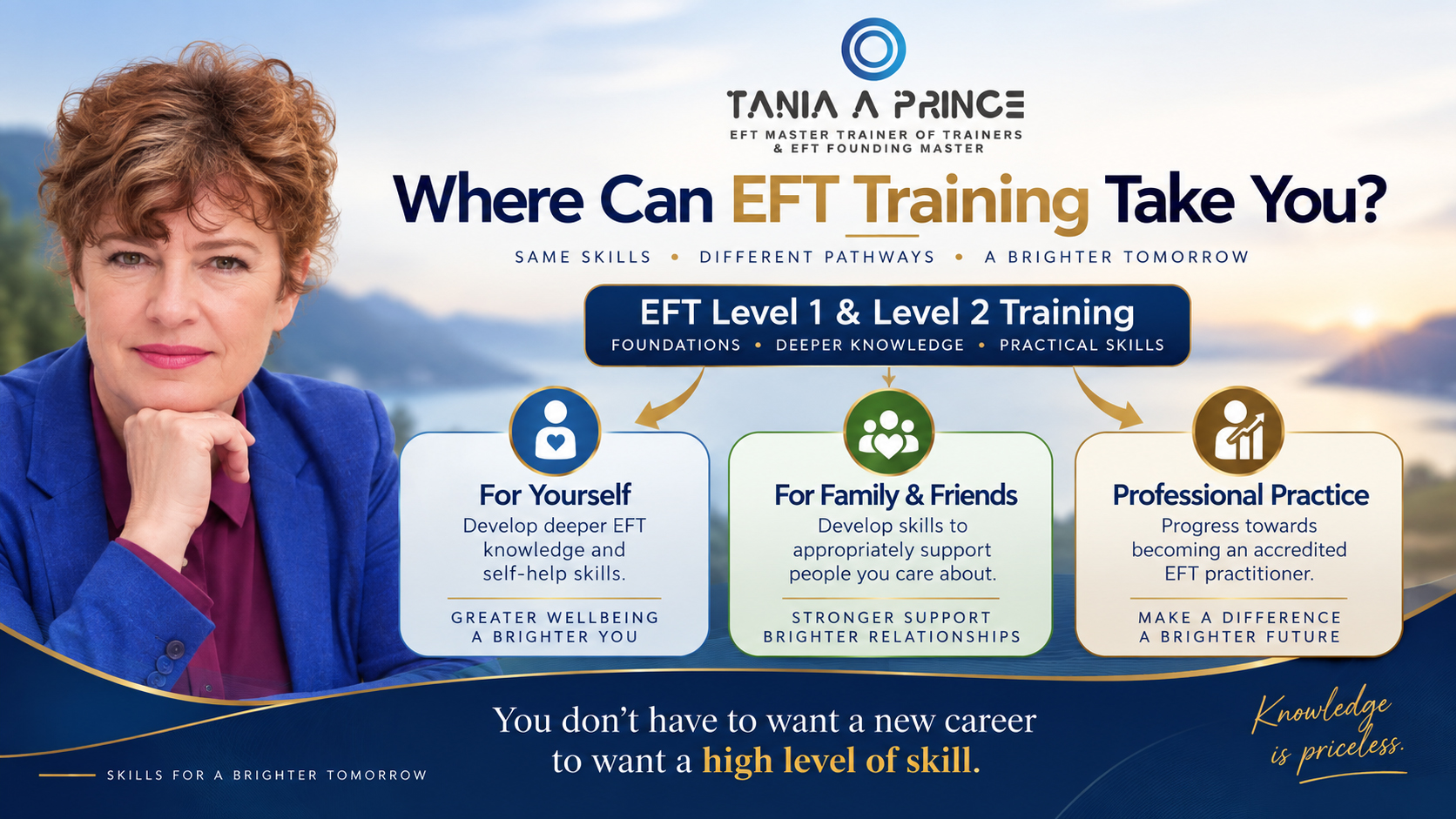
You do not have to want a new career to want a high level of skill.
In fact, I think there is enormous value in ordinary people having effective emotional self-help skills available to them.
EFT Level 1 vs Level 2
This is why I prefer not to describe Level 1 simply as being “for personal use” and Level 2 as being “for professionals.”
The distinction is more nuanced.
Level 1 gives you the foundations of EFT.
Level 2 takes your understanding and practical ability considerably further.
If you want to work professionally as an EFT practitioner, Level 2 forms an important part of that pathway.
But you may also choose Level 1 and Level 2 simply because you want a much deeper understanding of EFT and the ability to use what you learn in your own life.
Both are perfectly valid reasons for training.
Some of my students arrive knowing that they want to become practitioners.
Some are already therapists, coaches or other professionals who want to add EFT to their existing work.
Some want to help themselves and the people they care about.
And occasionally someone arrives with absolutely no intention of becoming a practitioner, discovers an unexpected passion for the work and eventually chooses to take it further.
You don’t have to make that decision before you begin.
You can learn because the knowledge itself has value.
Step 3: Practise EFT With Other People
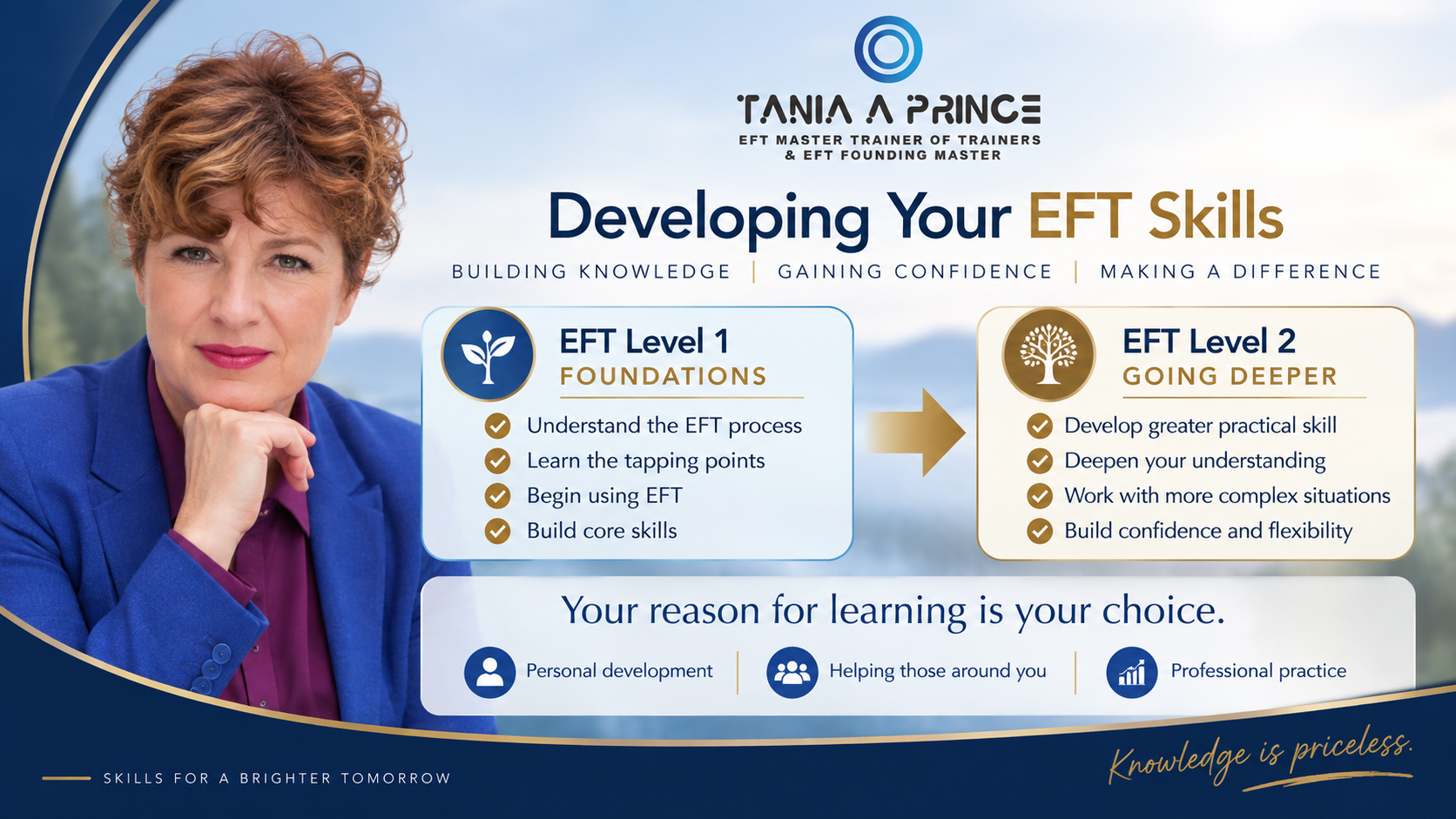
Completing your Level 1 and Level 2 training is an important milestone.
But it is not the end of your practitioner development.
In many ways, it is where another important stage begins.
You need to practise.
There is a considerable difference between understanding EFT intellectually and sitting with another person and deciding what to do next.
Real people do not follow scripts.
One person may immediately know exactly what they are feeling.
Another may simply say:
“I don’t know.”
One person’s emotional intensity may fall quickly.
Another person’s experience may suddenly change direction.
A different emotion may emerge.
A memory may appear.
Something that initially seemed extremely important may suddenly become irrelevant.
Or the words somebody uses may give you an important clue about what is actually driving the problem.
Developing as an EFT practitioner means learning how to notice and respond to these changes rather than trying to force someone through a predetermined tapping process.
That ability develops through practice.
Step 4: Complete Mentoring and Case Studies
Mentoring is an important part of professional practitioner development.
It gives you somewhere to discuss your developing work with an experienced EFT practitioner or trainer.
You might find yourself wondering:
- Why didn’t the intensity change?
- Was I working with the right target?
- Did I move too quickly?
- Was there another aspect I missed?
- What could I have done differently?
- What do I do when the client suddenly changes direction?
- How might I approach something like this next time?
These conversations are enormously valuable.
They help transform theoretical understanding into professional judgement.
Case studies are also important because they encourage you to reflect on your work.
The purpose is not to demonstrate that every EFT session produces a perfect result.
Therapeutic work rarely happens that way.
Instead, case studies demonstrate your ability to consider what happened, understand the choices you made and learn from the process.
Step 5: Complete Your Practitioner Requirements
There is an important distinction between attending EFT training and becoming an accredited practitioner.
Completing Level 1 and Level 2 does not automatically mean that someone becomes an EFT International Accredited Certified Practitioner.
Professional practitioner development continues after the initial training.
If you are following the EFT International pathway, you will need to complete the relevant practitioner requirements, which include practice, mentoring and assessment.
The purpose of this process is important.
It creates a structured route towards professional practice rather than a situation where somebody attends a short tapping workshop and immediately begins presenting themselves as a professionally trained EFT practitioner.
Certification and Accreditation: What’s the Difference?
The words certification and accreditation are sometimes used as though they mean exactly the same thing.
They don’t necessarily.
Completing a training course demonstrates that you have undertaken a particular programme.
Professional accreditation involves meeting the standards and requirements established by the relevant professional organisation.
If professional practice is your goal, this is something worth investigating before you choose your training.
Ask:
What does this course actually lead to?
A reputable trainer should be able to explain the pathway clearly.
Who Is EFT International?
EFT International is an international professional organisation for Emotional Freedom Techniques.
It establishes standards relating to EFT training, practitioner accreditation, ethics and ongoing professional development.
EFT International was previously known as AAMET — the Association for the Advancement of Meridian Energy Techniques.
This history is particularly relevant to my own EFT training because my involvement goes back to those earlier years.
I was the third therapist in the world to be awarded EFT Trainer status by AAMET.
I later served on the original AAMET Training Board, where I was involved in overseeing EFT training syllabuses and standards.
AAMET subsequently became EFT International.
Today, my EFT Practitioner Training is accredited by EFT International, providing students with a pathway through an organisation with an international practitioner and trainer community.
Why Does Accredited EFT Training Matter?
Search online for EFT training and you will find an enormous range of courses.
They are not necessarily equivalent.
Some may be excellent programmes designed for personal development.
Others may teach a basic tapping process.
But that does not necessarily mean they provide a recognised route towards professional EFT practitioner status.
If your intention is to work professionally, investigate the training carefully.
Find out:
- who accredits the training
- whether the trainer is appropriately accredited
- what syllabus is being taught
- how much live practical experience is included
- whether you receive feedback
- what happens after the initial training
- whether mentoring is available
- how competence is assessed
- whether there is an established practitioner pathway
- what ethical and professional standards apply
These questions are much more important than simply asking how quickly you can obtain a certificate.
Can I Train as an EFT Practitioner Online?
Yes.
Professional EFT training can be delivered live online.
My EFT Level 1 and Level 2 Practitioner Training is taught live online.
That is different from purchasing a collection of prerecorded videos and working through them alone.
Professional EFT training is experiential.
During live training, you can observe demonstrations, participate in exercises, practise with other students, ask questions and receive feedback.
Students can work together in breakout rooms while still having access to the trainer and the wider training group.
This allows people from different geographical locations to train together without needing to travel.
How Long Does It Take to Become an EFT Practitioner?
The initial Level 1 and Level 2 training can be completed relatively quickly.
Developing professional competence takes longer.
After the formal training, you need time to practise, consolidate your learning, undertake mentoring and complete the relevant practitioner requirements.
I encourage students not to think of practitioner development as a race.
The objective is not to acquire a certificate as quickly as possible.
The objective is to develop the confidence, awareness and flexibility required to sit with another human being and work appropriately with whatever emerges.
That requires experience.
What Makes Someone a Good EFT Practitioner?
Technical knowledge matters.
You need to understand the EFT process and know how to use the techniques you have been taught.
But good practitioners develop something beyond technical knowledge.
They learn to pay attention.
They listen carefully to the language their clients use.
They notice changes.
They become curious.
They recognise when something significant has just happened.
They learn when to ask another question and when not to.
They recognise when they need to slow the process down.
And rather than imposing a predetermined tapping script, they learn to respond to the individual person sitting in front of them.
Those abilities develop through good training, practice, mentoring and experience.
My Experience Training EFT Practitioners and Trainers
My involvement with EFT goes back to the early development of the method and the emergence of professional EFT training.
I was the third therapist in the world to be awarded EFT Trainer status by AAMET, the organisation that subsequently became EFT International.
I later served on the original AAMET Training Board, where I was involved in overseeing EFT training syllabuses and standards.
I was also one of the original 29 EFT Founding Masters, personally invited by EFT founder Gary Craig.
Today, I am an EFT International Accredited Certified Master Trainer of Trainers.
Over more than two decades of teaching EFT, I have trained EFT practitioners, therapists and EFT trainers.
My work therefore spans different levels of professional EFT development — from people taking their first steps into EFT practitioner training, through to experienced professionals developing their therapeutic skills and experienced EFT practitioners progressing towards becoming trainers themselves.
That breadth of experience influences the way I teach.
I do not believe people become excellent EFT practitioners simply by accumulating more and more techniques.
They develop through learning how to observe, listen, remain curious and respond appropriately to the person sitting in front of them.
That principle is central to the way I train both EFT practitioners and trainers.
Can EFT Become a New Career?
For some people, yes.
Some students undertake EFT practitioner training specifically because they want to establish an EFT practice.
Others already work as therapists, counsellors, coaches, hypnotherapists, complementary practitioners or healthcare professionals and want to integrate EFT into their existing work.
For others, EFT begins as a personal interest.
They may initially attend training because they want to understand EFT more deeply or learn how to use it for themselves.
Only later do they decide they would like to continue towards professional practice.
You do not necessarily have to know exactly where EFT will take you before you begin.
Can I Charge Clients After EFT Training?
This is an important question, and the answer depends on where you are within your practitioner pathway, the professional requirements that apply to you and whether you have appropriate insurance and other arrangements in place.
Simply attending an EFT workshop should not be viewed as automatic permission to begin practising professionally.
If you intend to charge clients, make sure you understand your training status, professional responsibilities, insurance requirements and the rules of any professional organisation with which you are registered.
I explore this in more detail in my guide:
Can EFT Practitioners Charge Clients?
Do I Need to Become Accredited?
If you want to learn EFT purely for yourself, you may not need to follow a complete professional practitioner pathway.
If you intend to use EFT professionally, however, I strongly recommend undertaking properly accredited practitioner training and completing the associated requirements.
Accreditation provides evidence that you have done considerably more than attend a short tapping workshop.
It demonstrates a commitment to professional training, competence, ethics and continuing development.
What Happens After I Become an EFT Practitioner?
Professional development does not stop when you achieve practitioner status.
Practitioners continue developing through experience, mentoring and Continuing Professional Development.
This matters because EFT practitioners work with human beings, not textbook problems.
Every person brings a different history, nervous system, way of communicating and way of experiencing their problem.
Your learning therefore continues throughout your professional life.
Some practitioners eventually decide to develop their work further.
They may specialise in particular areas, undertake advanced EFT training or, with sufficient experience and the appropriate training pathway, progress towards becoming EFT trainers themselves.
How Do I Choose an EFT Trainer?
Your choice of trainer matters enormously.
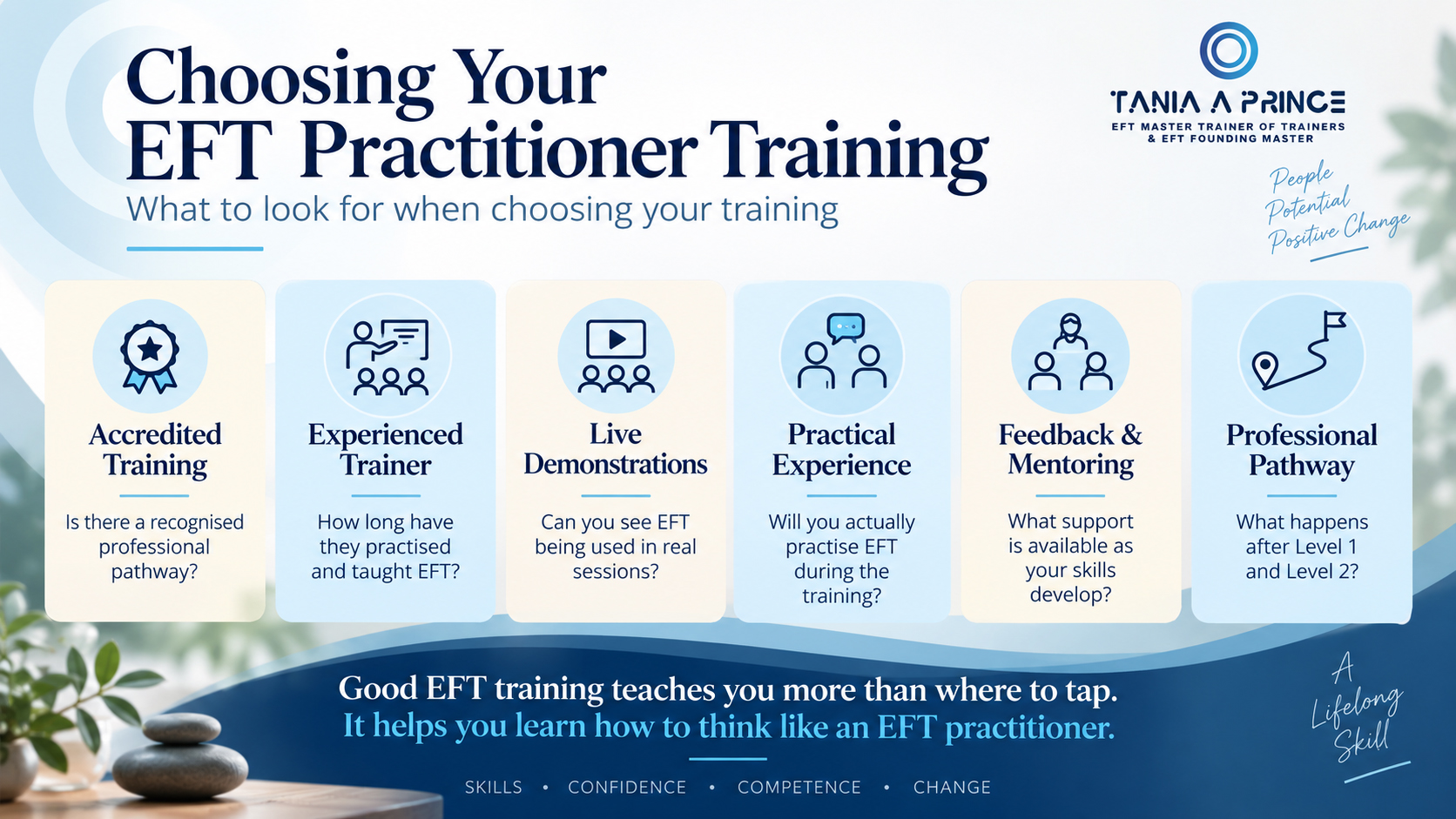
Don’t simply compare courses according to price, convenience or the number of techniques listed on the sales page.
Look at the person who will actually be teaching you.
- How long have they been practising EFT?
- How long have they been training practitioners?
- What level of accreditation do they hold?
- What is their professional background?
- How much practical experience will you receive?
- Will you see live demonstrations?
- Can you ask questions?
- Will you receive feedback on your EFT work?
- What happens after the initial training?
- Does the course lead towards a recognised practitioner pathway?
And importantly:
Does the trainer have substantial experience actually training EFT practitioners?
A good EFT training course should teach you considerably more than where to tap.
It should begin teaching you how to think like an EFT practitioner.
So, How Do I Become an EFT Practitioner?
The professional journey can be summarised as:
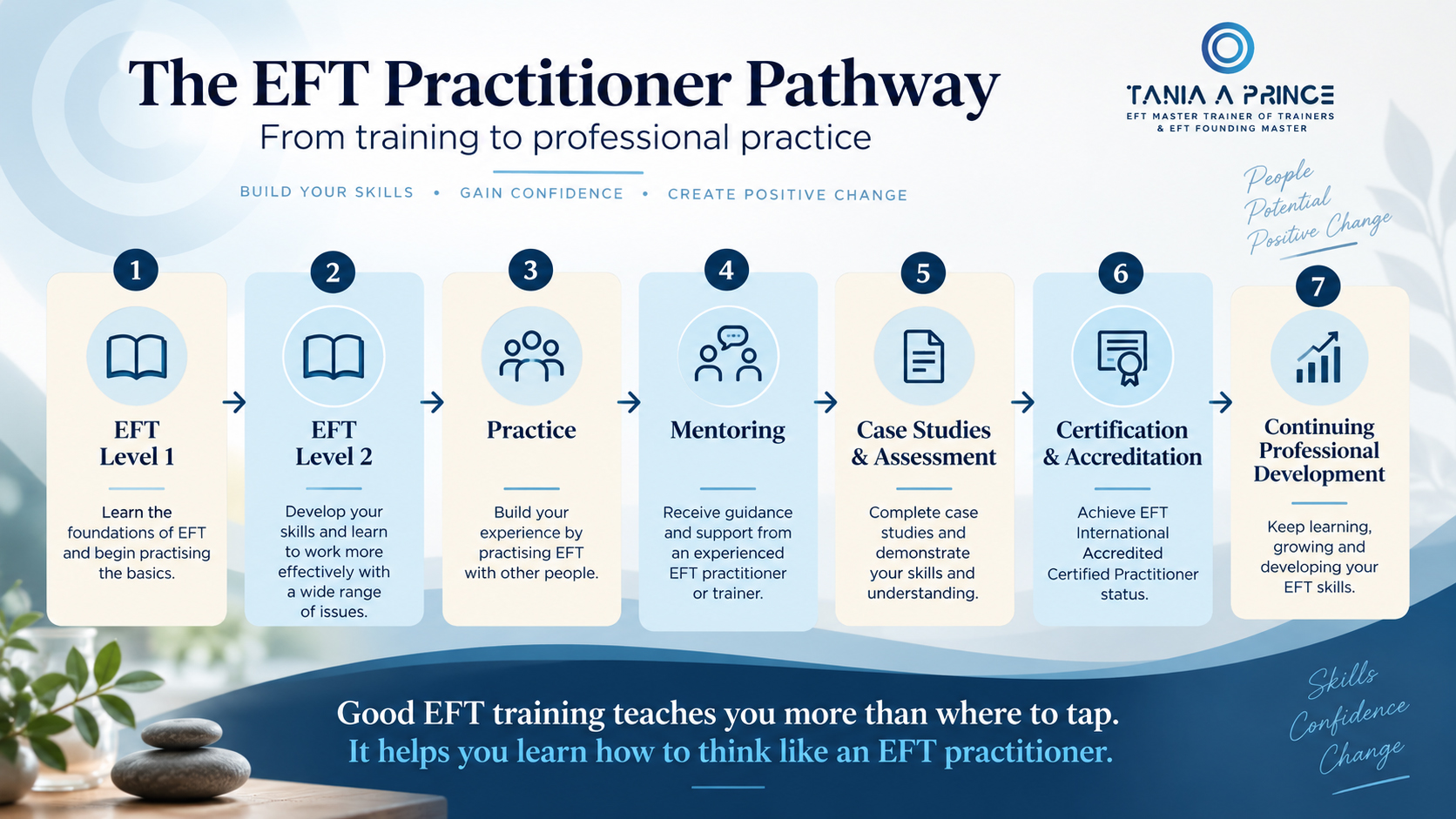
EFT Level 1 Training → EFT Level 2 Training → Practice → Mentoring → Case Studies and Assessment → Practitioner Certification and Accreditation → Continuing Professional Development
But the most important part of that pathway is what happens to your skills along the way.
You are learning how to work with another person.
That requires knowledge.
It requires practice.
It requires reflection.
And it requires experience.
If you want to become an EFT practitioner, begin by choosing a high-quality accredited EFT Level 1 and Level 2 training programme with an experienced trainer.
Then give yourself the opportunity to practise and develop what you learn.
Begin Your EFT Practitioner Training
My EFT Level 1 & Level 2 Practitioner Training is delivered live online and is accredited by EFT International, the international professional organisation formerly known as AAMET.
My involvement with professional EFT training goes back to the early days of AAMET.
I was the third therapist in the world to be awarded AAMET Trainer status, later served on the original AAMET Training Board overseeing EFT training syllabuses and standards, and was one of Gary Craig’s original 29 EFT Founding Masters.
Today, as an EFT International Accredited Certified Master Trainer of Trainers, I train EFT practitioners, therapists and EFT trainers.
That depth of experience informs the way I teach EFT today.
My practitioner training combines structured teaching, live demonstrations and extensive practical experience.
The objective is not simply to teach you how to tap.
It is to help you begin developing the skills to work with EFT confidently, flexibly and professionally.
Continue Exploring EFT Training
If you are considering becoming an EFT practitioner, these guides will help you explore the different stages and options:
- What Is EFT Training?
- EFT Level 1 vs Level 2
- What Happens on an EFT Practitioner Training Course?
- Can You Learn EFT Online?
- How Long Does It Take to Become an EFT Practitioner?
- Do You Need Qualifications to Train in EFT?
- EFT Certification vs Accreditation
- What Can You Do After EFT Practitioner Training?
- Can EFT Practitioners Charge Clients?
- What Makes a Good EFT Training Course?
- Questions to Ask Before Choosing an EFT Trainer
