Questions to Ask Before Choosing an EFT Trainer

Choosing an EFT trainer is an important decision. The person you train with can influence not only how well you understand Emotional Freedom Techniques (EFT), but how you eventually think and work as an EFT practitioner.
It can be tempting to compare courses primarily by price, dates, duration or whether they are available online. These are all practical considerations, but they tell you relatively little about the quality and depth of the training you are likely to receive.
EFT can appear deceptively simple. The tapping points themselves can be learned relatively quickly. Learning how to work effectively with another person is much more sophisticated. You need to know what to target, what questions to ask, what to notice, when something important has changed, how to respond when the work takes an unexpected direction and when not to proceed.
Good EFT practitioner training should therefore teach you much more than how to tap.
Here are some of the questions I believe are worth asking before choosing an EFT trainer.
1. How Much Experience Does the Trainer Actually Have Using EFT?
One of the first things to establish is how much practical EFT experience the trainer has.
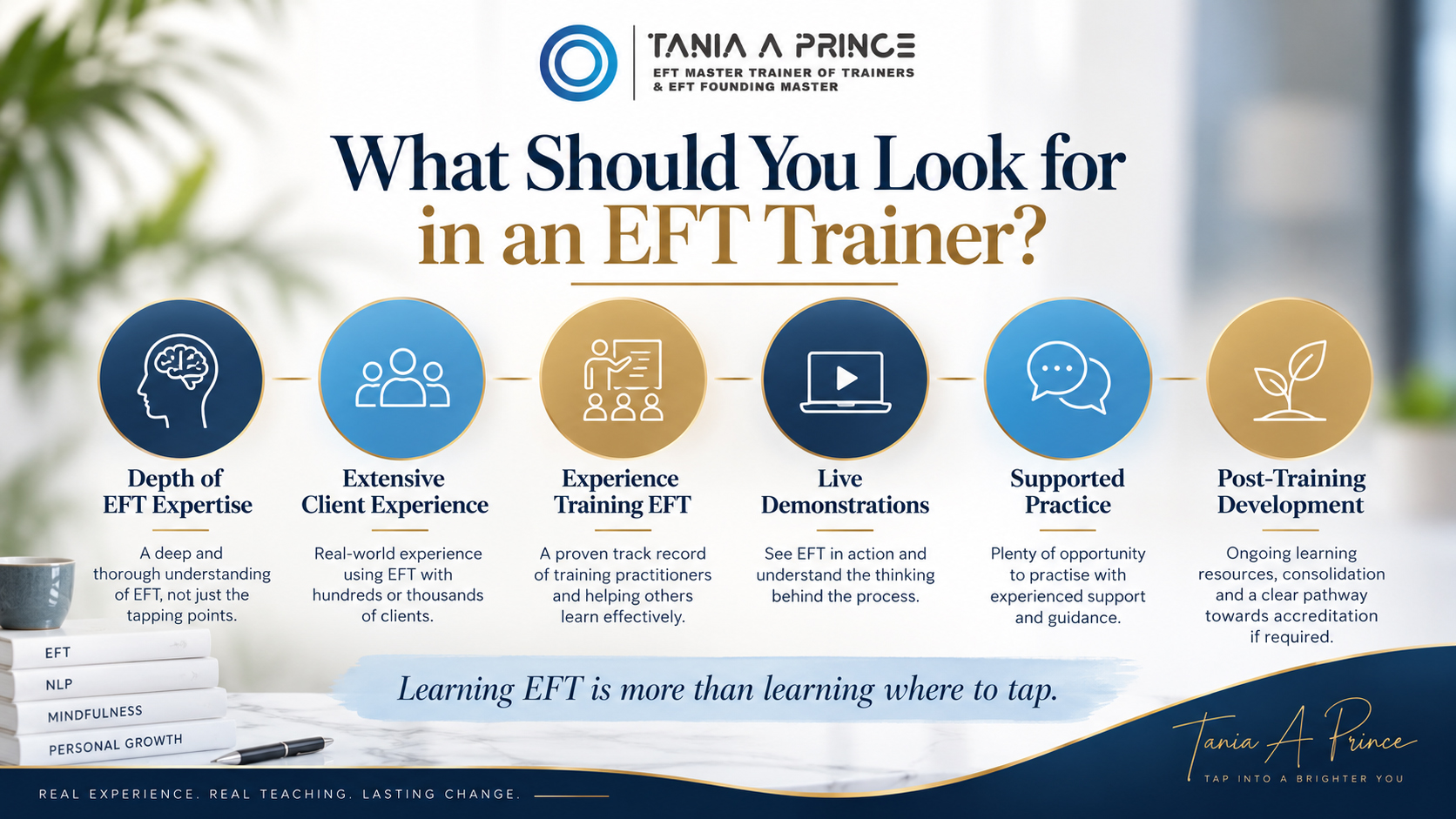
There is a considerable difference between knowing the mechanics of EFT and having used it repeatedly with hundreds or thousands of clients.
By 2005, when I went through the original EFT Masters assessment process, I had already worked with hundreds of clients using EFT. I have now worked therapeutically for more than 34 years and have worked with thousands of clients.
That experience inevitably influences the way I train.
Real client sessions rarely unfold like textbook examples. People become stuck. They change direction. They may not know what they feel. They can intellectualise, disconnect from emotion or suddenly access something completely unexpected. What initially appears to be the problem may not be the most useful thing to work on.
Extensive client experience gives a trainer a large body of practical knowledge to draw upon when teaching students how to navigate these situations.
So don’t simply ask how long somebody has known EFT.
Ask how extensively they have actually used it.
2. How Deep Is the Trainer’s Knowledge of EFT?
Qualifications are useful, but it is worth understanding what those qualifications and professional designations actually represent.
I am one of the original 29 EFT Founding Masters worldwide.
The designation was originally known as EFT Master and came from the Masters programme established by EFT founder Gary Craig.
Understanding why the programme was created is important.
As EFT became increasingly popular, many people began describing themselves as EFT therapists or practitioners. However, there was considerable variation in what was being delivered as EFT. Some people had relatively limited knowledge of the method. Others might begin using EFT but move into different techniques when they did not know how to progress the work using EFT itself.
The Masters programme was established to identify people who could demonstrate genuine, in-depth expertise in EFT.
It wasn’t simply another course that somebody attended and automatically received a qualification from.
Candidates were expected to have extensive practical experience using EFT with clients and were rigorously tested to establish their knowledge and practical ability.
By 2005, when I undertook the original Masters assessment process, I had already worked with hundreds of clients specifically using EFT. My knowledge and practical skills were then extensively assessed.
I successfully completed that process and became one of only 29 people internationally to receive the original EFT Master designation. Those original Masters subsequently became known as the EFT Founding Masters.
For someone considering EFT training today, the broader principle remains relevant.
Don’t simply ask what certificates a trainer holds.
Ask what depth of EFT experience lies behind them.
3. What Professional EFT Standing Does the Trainer Have Today?
Historical experience is valuable, but current professional standards matter too.
I am an EFT International Accredited Master Trainer of Trainers. I train EFT Practitioners, Advanced Practitioners and EFT Trainers.
My involvement in EFT standards also goes back to the early days of AAMET, the organisation that later became EFT International. I served on its original training board and was involved in overseeing EFT training syllabuses and standards.
If your goal is professional practice, check whether your chosen training provides an appropriate pathway towards accreditation.
Training and accreditation are not necessarily the same thing.
You should understand what you receive from the initial course, what further consolidation or assessment is required and which professional organisation ultimately accredits you.
4. How Experienced Is the Trainer at Actually Training EFT?
Being highly skilled at EFT does not automatically make someone highly skilled at teaching EFT.
Training is a skill in its own right.
I have been training people in EFT for more than 26 years and have personally run over 230 EFT training courses.
Over that time, I have trained people at many different stages of development, from those encountering EFT for the first time through to Practitioners, Advanced Practitioners and Trainers.
Running that many courses gives you a different kind of experience.
You begin to recognise where students commonly become confused, which concepts need to be taught differently, what people tend to miss, which questions repeatedly arise and where students need more practice.
You also learn to recognise the difference between somebody being able to repeat information and somebody genuinely understanding it.
My training background extends beyond EFT. I undertook more than three weeks of intensive NLP Trainer Training in America, specifically developing skills in training, communication, presentation and facilitating learning.
Earlier in my career, I also spent approximately ten years working in show business. That gave me extensive experience of presenting to audiences, communicating clearly and maintaining the engagement of a group.
All of these experiences influence the way I teach today.
When choosing an EFT trainer, therefore, ask two separate questions:
How experienced are they at EFT?
And:
How experienced are they at helping other people learn EFT?
They are not necessarily the same skill.
5. Does the Trainer Understand How Change Happens?
EFT did not emerge completely independently of other approaches to therapeutic change. Gary Craig himself had an extensive background in NLP, and NLP influenced aspects of the development of EFT.
Language matters in EFT.
The way someone internally represents an experience matters.
The meaning attached to an event can matter.
The questions a practitioner asks can change what becomes available to work with.
My own extensive background in NLP adds another dimension to the way I teach EFT. I incorporate relevant elements of NLP where they help students develop a deeper understanding of communication and change work.
This isn’t about replacing EFT with NLP.
It is about giving students a richer understanding of what may be happening during therapeutic work and helping them become more sophisticated in how they listen, question and respond.
Having knowledge of other therapeutic approaches isn’t a problem. It can be enormously valuable.
The important question is whether the person teaching EFT also possesses genuine depth and flexibility in EFT itself.
6. Will You Learn EFT or Simply Learn Where to Tap?
Knowing the tapping points is not the same as knowing how to use EFT.
A client may arrive saying:
“I’m anxious.”
“I don’t feel good enough.”
“I’m overwhelmed.”
“I have no confidence.”
These are descriptions of problems, but they may not yet give you an effective therapeutic target.
Practitioner-level EFT requires you to develop the ability to explore what is happening and identify what may be useful to work with.
That might involve a specific event, an emotion, a physical sensation, a belief, an internal image, someone’s words or one particular aspect of a larger experience.
This is one of the areas where practitioner training should differ significantly from simply following tapping videos or scripts.
I want students to understand why they are doing something, rather than merely memorising what to do.
7. Will You See the Trainer Actually Demonstrate EFT?
Watching an experienced practitioner work can be one of the most valuable parts of EFT training.
A live demonstration allows you to observe things that are difficult to communicate through written material alone.
You can see how the practitioner listens, what they notice, how they formulate questions, how they pace the work and how they respond when something unexpected emerges.
But watching isn’t enough.
Students should also be helped to understand the thinking behind what they have observed.
Why did the practitioner ask that question?
Why did they follow that particular piece of information?
Why did they change direction?
What else could they have done?
Demonstration combined with explanation helps students begin developing therapeutic judgement rather than simply copying a trainer’s words.
8. Will You Have Plenty of Opportunity to Practise?
Practitioner skills cannot be developed entirely through observation.
You need to practise.
On my live online EFT Practitioner Training, students work in private practice rooms where they can begin applying what they have learned.
Importantly, students’ private practice sessions are not recorded.
This gives students an appropriate environment in which to practise, make mistakes, ask questions and develop their skills.
They are also not simply sent into breakout rooms and left unsupported.
My experienced assistants and I are available during practice sessions to provide guidance where needed.
9. Who Else Will Be Supporting You?
Ask whether the trainer works entirely alone or whether experienced assistants are present.
I have experienced EFT assistants supporting my training courses. They bring a wealth of their own experience and are able to move between students’ practice rooms, observe what is happening and provide guidance when required.
This becomes particularly valuable during live online training.
Students can practise in small groups while still having access to experienced support.
A good training environment shouldn’t require you to pretend that you already know what you are doing.
You are there to learn.
10. Are Questions Welcomed?
Questions are an important part of practitioner development.
“What would you do if…?”
“Why did you ask that?”
“Why did you follow that rather than something else?”
“What if the client doesn’t know?”
“What happens if the tapping doesn’t appear to be working?”
These are not interruptions to training. They are often where some of the most valuable learning happens.
A trainer with substantial practical experience can usually draw on many different examples when answering these questions.
This is another reason client experience matters.
The answer isn’t simply theoretical. It can be informed by having encountered similar situations repeatedly in real therapeutic work.
11. Does the Training Develop Independent Thinking?
Good EFT training should not produce practitioners who can only work when the client behaves exactly like the examples in their training manual.
Nor should it create practitioners who need to remember exactly what their trainer said before they can decide what to do next.
I want students to understand principles.
When you understand why you are doing something, you become better able to recognise when it is appropriate, when something isn’t working and when another direction might be more useful.
Over time, this develops into therapeutic judgement.
That is one of the important transitions from learning EFT to becoming an EFT practitioner.
12. What Happens After the Live Training?
A practitioner training course can provide an intensive period of learning, but competence develops through consolidation and practice afterwards.
Ask what happens when the live training finishes.
Are recordings available?
Are there additional demonstrations?
Are there structured learning resources?
Is there a clear pathway towards accreditation?
Students attending my live online practitioner training receive access to a private online training platform.
The main teaching elements, demonstrations and questions from the live course are recorded and made available privately to the students who attended. Students’ private practice sessions are not recorded.
The platform also contains additional demonstrations and learning resources designed to help students consolidate what they have learned.
For those progressing towards EFT International accreditation, there is then a structured post-training consolidation, practice and assessment process.
Attending the training is therefore an important stage of practitioner development rather than the end of it.
13. What Professional Standards Are Taught?
If you intend to work professionally with clients, EFT practitioner training should cover more than technique.
Professional practice also involves ethics, confidentiality, boundaries, scope of practice and understanding the limits of your competence.
Knowing when not to proceed can be just as important as knowing what to do.
A competent practitioner doesn’t assume they should work with absolutely everything that comes through the door.
Professional judgement includes recognising when you need additional knowledge or support and when another practitioner or professional may be more appropriate.
14. What Do Previous Students Say?
Testimonials can provide useful insight into a training course, but look beyond simple comments such as “I loved the course.”
Read what students actually say about their experience.
Do they mention the trainer’s depth of knowledge?
Do they talk about the quality of the teaching?
Did they feel supported while practising?
Were their questions answered?
Do they describe developing confidence or a deeper understanding of EFT?
Detailed reviews can tell you much more about the experience of being trained by someone than a course description alone.
15. Does the Trainer Feel Like the Right Fit for You?
Finally, there is a personal element to choosing a trainer.
Different trainers inevitably bring different backgrounds, experiences and teaching styles to EFT.
Read their website. Watch them teaching if videos are available. Read their articles. Look at their professional background and student feedback.
Find out how they think about EFT.
You are not simply buying information.
You are choosing someone who may have a significant influence on how you understand EFT and how you eventually work with other people.

Questions to Ask an EFT Trainer Before You Enrol
Before booking EFT training, you may want to find answers to the following questions:
- How long has the trainer been using EFT?
- How extensively have they actually used EFT with clients?
- What EFT qualifications and professional accreditation do they hold?
- How was their own expertise assessed?
- How long have they been training EFT?
- Approximately how many EFT training courses have they delivered?
- Have they received professional training in how to teach or train?
- Is the course professionally accredited?
- Is there a clear route towards practitioner accreditation?
- Will you see the trainer demonstrate EFT?
- Will they explain the thinking behind their demonstrations?
- Will you have opportunities to practise?
- Will experienced people support you during practice?
- Are private student practice sessions kept private?
- Does the training teach you how to identify effective EFT targets?
- Does it teach therapeutic thinking rather than dependence on scripts?
- Does it cover ethics, boundaries and scope of practice?
- What learning and support are available after the live course?
- What do previous students say about their experience?
You don’t necessarily need to ask every question directly. A good trainer’s website and course information should answer many of them.
Choosing the Right EFT Trainer
There are now many ways to learn about EFT. You can watch demonstrations online, read books, download tapping scripts and follow EFT content on social media.
Professional EFT Practitioner Training has a different purpose.
It should help you develop the skills to work appropriately and effectively with another person.
My own perspective on this has developed through more than 34 years of therapeutic work, more than 26 years training EFT, over 230 EFT training courses, working with thousands of clients, involvement in developing professional EFT training standards, and being assessed as one of the original 29 EFT Founding Masters worldwide.
What all of that experience has reinforced for me is that good practitioner training isn’t simply about transferring information.
It is about developing judgement.
A practitioner needs to know how to listen, what to notice, what to explore, how to identify useful EFT targets, when to change direction and when not to proceed.
Those abilities develop through good teaching, demonstration, supported practice, feedback, experience and continued learning.
So when you are comparing EFT training courses, don’t base your decision solely on:
“How much does the course cost?”
Ask a much more important question:
“What kind of EFT practitioner will this trainer help me become?”
That is ultimately what you are investing in.