
EFT for Trauma Triggers: Why the Nervous System Reacts Before You Can Think
A trauma trigger can produce a reaction that seems completely out of proportion to what is happening in the present moment.
It might be a look on someone’s face. A particular tone of voice. A smell. A sound. Someone not replying to a message. Walking into a particular environment. Being criticised. Feeling trapped. Someone moving too close.
Suddenly, something changes.
Your heart may race. Your stomach may tighten. You might feel anxious, angry, panicked or overwhelmed. You may have a powerful urge to escape.
Or the opposite may happen.
You might freeze, go blank, become very still, feel numb or disconnected, or suddenly find it difficult to think or speak.
Part of you may know that the situation doesn’t warrant such a powerful response.
Yet knowing that doesn’t necessarily stop it.
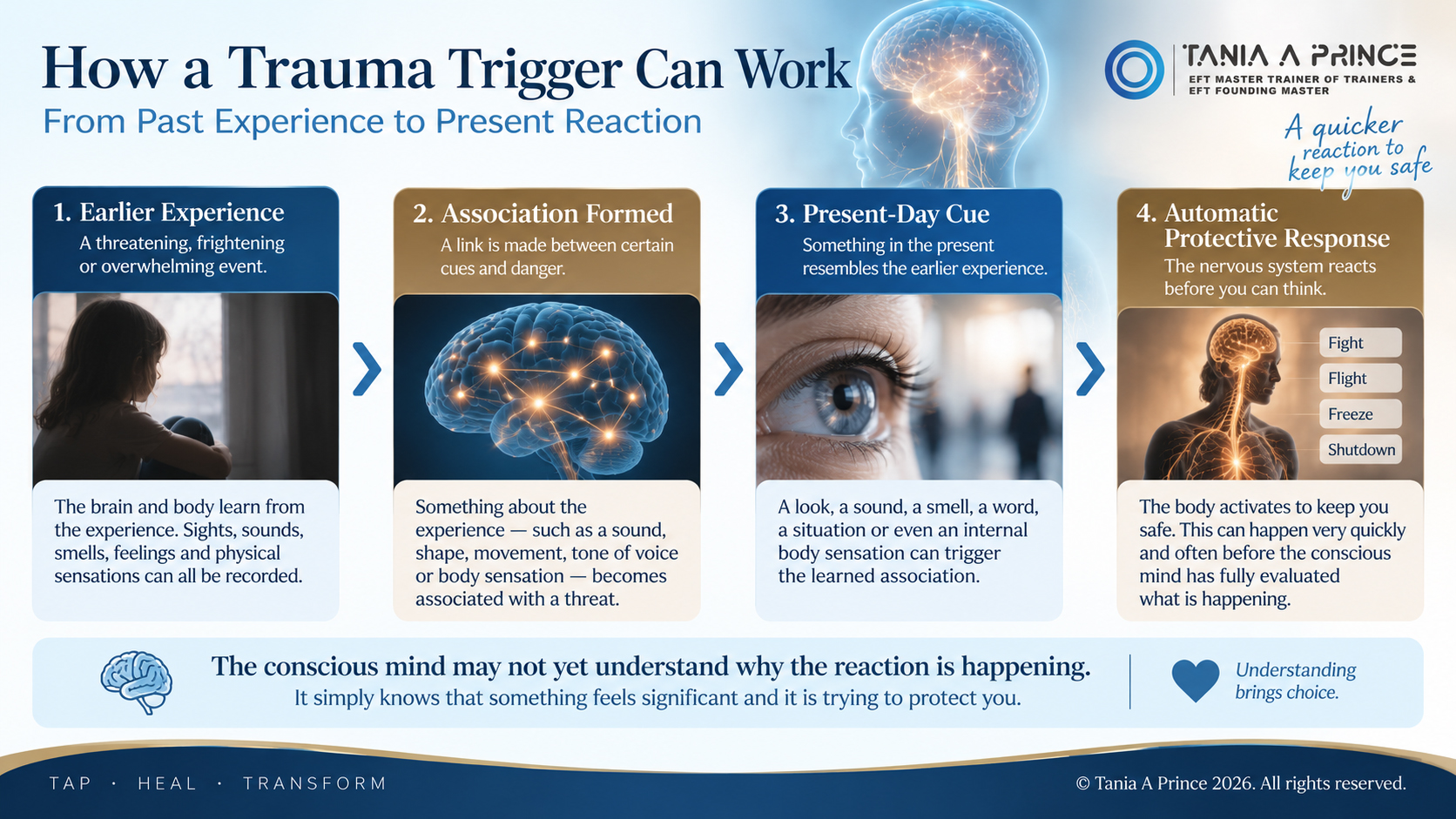
This is because a trauma trigger is not simply a conscious thought.
It can involve an automatic protective response that begins before you have had time to consciously evaluate what is happening.
Understanding this is particularly important when using Emotional Freedom Techniques (EFT or tapping) for trauma triggers.
Rather than treating the reaction as irrational or something that simply needs to be controlled, EFT gives us a way of becoming curious about what the system is responding to and working with that response carefully.
What Is a Trauma Trigger?
A trauma trigger is something in the present that has become associated with an earlier threatening, frightening or overwhelming experience and activates a protective response.
The trigger itself doesn’t necessarily have to be dangerous.
It may simply share some characteristic with an earlier experience.
For example, someone who experienced repeated criticism or humiliation when young might find that a particular tone of voice from their partner or manager immediately produces anxiety, defensiveness, anger or an urge to withdraw.
Another person may become intensely uncomfortable when someone stands too close.
Someone else may panic when they feel unable to leave a situation.
Sometimes the connection is obvious.
At other times, it isn’t.
In fact, the person may have absolutely no conscious idea why they are reacting.
Survival Requires Speed
There is a good reason why protective responses can happen so quickly.
Survival requires speed.
Imagine having to consciously analyse every piece of information before responding to genuine danger.
Is that movement dangerous?
Should I run?
Should I defend myself?
Should I stay still?
By the time you had finished analysing the situation, it could be too late.
The brain and nervous system therefore have mechanisms capable of responding rapidly to potential threat.
When something has previously been associated with danger, something resembling that experience can activate a response before the conscious mind has fully evaluated what is happening.
That is extremely useful when the danger is real.
It becomes more problematic when something harmless in the present has characteristics associated with an earlier threatening experience.
The system can react as though:
“This is happening again.”
Meanwhile, the conscious mind may be saying:
“This doesn’t make any sense.”
Both experiences can exist at the same time.
Triggers Are Not Always Obvious
When people hear the term “trauma trigger”, they often imagine something that clearly resembles the original traumatic event.
Sometimes it does.
But triggers can be surprisingly subtle.
They might include:
- a facial expression
- a particular tone of voice
- a word or phrase
- someone’s posture
- a smell
- music
- a location
- a time of year
- being touched in a particular way
- someone walking away
- silence
- receiving a message
- not receiving a message
- feeling watched
- feeling ignored
- criticism
- conflict
- closeness or intimacy
- a particular movement
- a physical sensation inside the body
Sometimes the trigger isn’t external at all.
An increased heartbeat, dizziness, tightness in the chest, feeling hot or another internal sensation can itself become associated with danger.
The person then becomes frightened by the sensation.
That fear can increase the physiological response, which creates more frightening sensations, potentially producing a self-reinforcing cycle.
Why Can a Small Trigger Produce Such a Big Reaction?
Imagine someone who was repeatedly shouted at when they were young.
Years later, their partner raises their voice slightly during an ordinary disagreement.
Consciously, the person knows that their partner is not the person from their childhood.
But their system may detect characteristics associated with those earlier experiences — the volume of the voice, facial expression, posture, proximity or perhaps the feeling of being unable to respond.
Their physiology changes.
They may feel frightened.
They may become angry and fight back.
They may want to leave.
Or they might suddenly become quiet, blank or unable to speak.
To someone observing the interaction, the response may appear excessive.
But the system isn’t necessarily responding only to what is happening now.
It may also be responding to what the present situation has come to represent.
When the Trigger and the Original Experience Don’t Seem Connected
Sometimes the connection is much less obvious.
I remember working with a student who had a phobia of snakes.
During the EFT work, an experience emerged of her being in hospital as a baby with tubes coming from her body.
We tapped on the hospital experience that had emerged.
On the surface, a hospital experience and a snake phobia might appear to have very little in common.
But there was a possible sensory connection.
The tubes and snakes shared certain physical characteristics: long, flexible, tube-like forms.
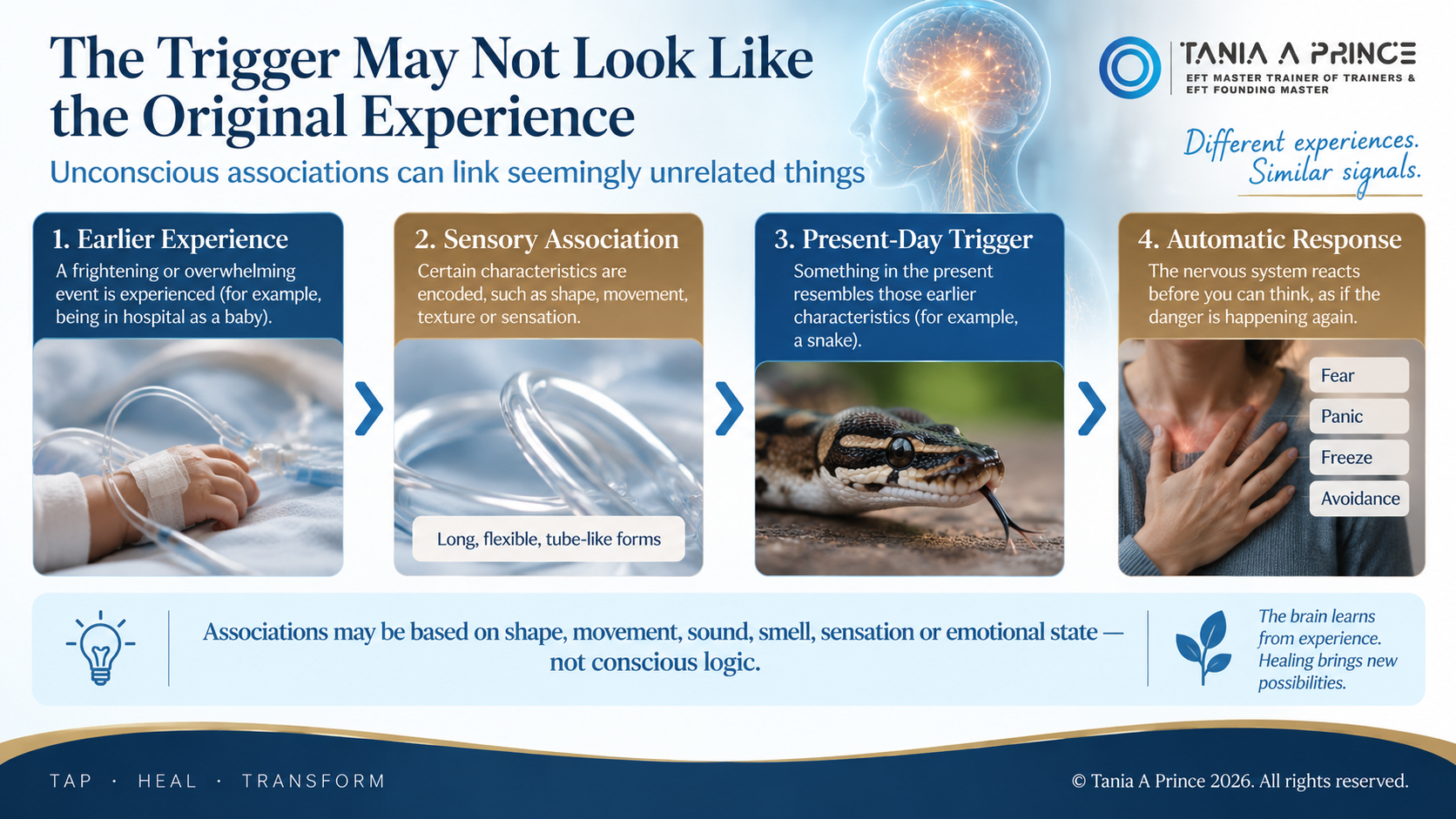
If the hospital experience had been frightening or overwhelming, characteristics associated with that experience could potentially have acquired a threat meaning.
The important point wasn’t for me to decide that the tubes caused her snake phobia.
We followed what emerged for her and tapped on that experience.
This distinction matters.
A memory, image, sensation or impression that emerges during therapeutic work — particularly something attributed to very early infancy — should not automatically be regarded as an exact historical recording of what happened.
Human memory is reconstructive.
We don’t need to prove that every detail occurred exactly as experienced in order to work therapeutically with what has arisen for the person.
The snake example illustrates something important about triggers:
The association doesn’t necessarily have to make conscious, logical sense.
The connection may be sensory.
It could involve shape, movement, sound, smell, touch, physical sensation or emotional state.
This is one reason I don’t believe therapists should decide in advance what a client’s problem “must” be about.
We follow the client’s experience.
The Trigger and the Original Experience Are Not the Same Thing
This distinction is particularly important in trauma work.
The trigger is what is happening now.
The earlier experience may be where some of the association originated.
They can be connected without being identical.
This means we don’t necessarily have to immediately access the original traumatic event to begin therapeutic work.
In fact, when someone becomes highly activated or overwhelmed, going directly into the most traumatic material may not be the best place to start.
We can begin with what is happening now.
For example:
“When he used that tone of voice, I felt this tightness in my stomach.”
“When she didn’t reply to my message, I immediately thought I’d done something wrong.”
“When I walked into that room, I suddenly wanted to leave.”
“When I think about going back there, my chest tightens.”
These present-moment reactions provide useful information.
What Happens in the Body When You Are Triggered?
Different people can have very different responses to triggers.
There may initially be mobilisation — the system preparing for action.
This can involve increased heart rate, changes in breathing, muscle tension, agitation, fear, anxiety, anger or an urge to escape or defend yourself.
For other people, or sometimes following intense mobilisation, the system may move towards immobilisation or shutdown.
The person may experience freezing, difficulty speaking, mental blankness, heaviness, numbness, disconnection or extreme tiredness.
People don’t necessarily remain in one state.
They can move between them.
This is one reason it can be misleading to think about trauma purely as a difficult memory.
Trauma can also involve learned patterns of physiological protection.
“I Know I’m Safe, but My Body Doesn’t”
This is something people experiencing trauma triggers often find particularly frustrating.
Intellectually, they know they are safe.
They might tell themselves:
“There’s nothing to worry about.”
“This is ridiculous.”
“Just calm down.”
“That happened years ago.”
But the physical reaction continues.
That doesn’t necessarily mean the person needs more logical arguments.
Their conscious mind may already understand perfectly well that the present situation isn’t the original danger.
The automatic protective response is operating differently.
This is one reason approaches that include attention to physical and emotional experience can be useful alongside cognitive understanding.
How Might EFT Help With Trauma Triggers?
EFT combines focused attention with tapping on a sequence of acupressure points.
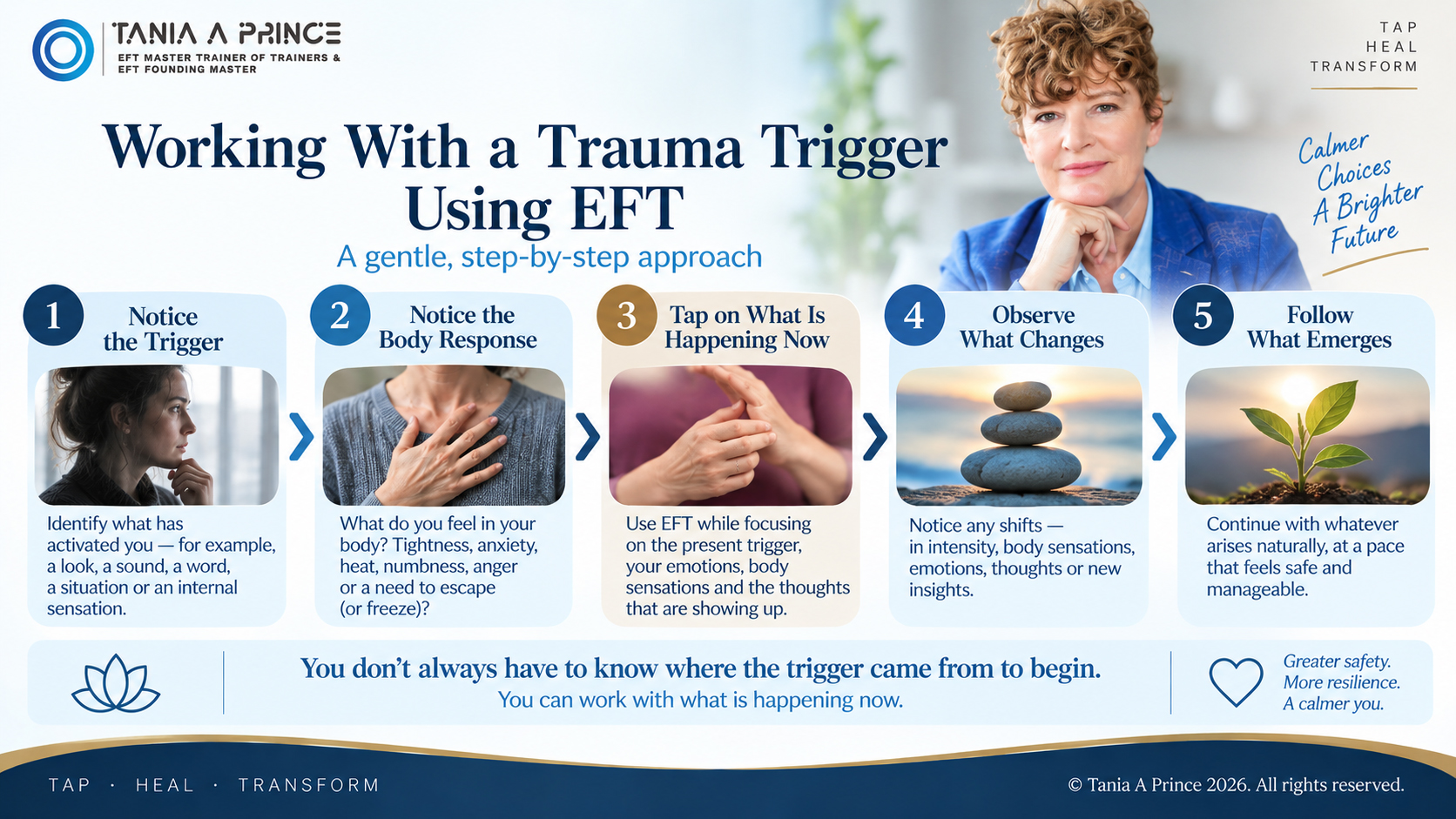
When working with triggers, we can begin with what the person notices right now rather than immediately attempting to uncover the deepest trauma.
For example:
“Even though my chest tightens when I think about that conversation…”
“Even though I feel this fear when I remember his expression…”
“Even though part of me wants to get away…”
“Even though my stomach tightens when I imagine going back there…”
We aren’t telling the nervous system that its response is stupid or wrong.
We are acknowledging what is happening and tapping while observing the response.
As the person taps, things may begin to change.
The intensity may reduce.
A physical sensation might change in quality or location.
A different emotion may appear.
A thought or belief may become apparent.
An earlier experience might come to mind.
Or the person may simply begin to feel calmer and more present.
What happens next helps guide the work.
You Don’t Have to Know Why You Are Triggered
People sometimes believe they need to understand exactly where their reaction came from before EFT can help.
That isn’t always necessary.
A client might simply say:
“I don’t know why this affects me.”
We can start there.
For example:
“Even though I don’t know why I react like this…”
Or we can work with what they can observe:
“This tight feeling in my chest.”
“This urge to get away.”
“This feeling that something bad is going to happen.”
“This blank feeling when he raises his voice.”
As the intensity changes, other information may emerge naturally.
It is generally more useful to allow the person’s own material to emerge than to impose an explanation on them.
Getting Specific With EFT
Specificity is extremely useful in EFT.
Rather than attempting to tap on:
“All my trauma…”
we can identify a particular moment.
For example:
“When I saw that expression on her face…”
or:
“When I heard him say those words…”
We can then explore what happens when the person briefly brings that particular moment to mind.
What emotion appears?
Where do they experience it in their body?
What thought accompanies it?
What do they expect is going to happen?
What aspect of the situation feels most threatening?
The seemingly large problem can begin to separate into smaller components.
Those individual components can then be worked with.
A Trigger Can Lead to an Earlier Experience
Sometimes tapping on a present-day trigger naturally brings up an earlier experience.
A person might suddenly say:
“I’ve felt this before.”
Or:
“This reminds me of something that happened when I was young.”
This can be valuable information.
It may reveal an association that wasn’t consciously available before.
But discovering earlier material doesn’t mean we have to immediately intensify the work.
The person’s ability to remain present matters.
If somebody is becoming increasingly overwhelmed, dissociated or unable to stay connected with the therapeutic process, that is information too.
Sometimes the appropriate therapeutic response is to slow down.
EFT Doesn’t Require Repeated Retelling of the Trauma
A common misconception about trauma therapy is that people necessarily need to repeatedly tell the entire story of what happened.
With EFT, it is possible to work much more gently.
We can work with an emotion.
A body sensation.
One small part of an event.
The thought of approaching the memory.
Or even the fear of what might happen if the person were to think about it.
This can be particularly important when working with significant trauma.
The objective isn’t to make somebody endure the maximum amount of emotional intensity they can tolerate.
The objective is therapeutic change.
Why Trauma-Informed EFT Matters
The tapping procedure itself is relatively straightforward to learn.
Working therapeutically with significant trauma requires considerably more skill.
A practitioner needs to recognise when someone is becoming highly activated, frozen, overwhelmed or dissociated.
More tapping is not automatically better.
Neither is pushing someone to describe traumatic material in greater detail.
Good trauma work involves pacing.
It involves observing not only what the person says but changes in breathing, voice, facial expression, posture, responsiveness and their ability to remain connected to the present.
Sometimes you continue.
Sometimes you slow down.
Sometimes you move away from the material and help the person stabilise.
The aim isn’t to force somebody through their trauma.
What If the Trigger Seems Completely Irrational?
A trigger doesn’t have to make logical sense to contain useful information.
Imagine someone becomes intensely anxious whenever their partner takes longer than usual to answer a message.
Their conscious mind may know there are dozens of innocent explanations.
But internally, the silence might mean:
“I’ve done something wrong.”
“They’re leaving me.”
“I’m going to be rejected.”
“Something bad has happened.”
Arguing with these thoughts may not necessarily change the underlying reaction.
Instead, we can become curious.
What happens when they see there is no reply?
Where do they feel it?
What do they imagine is happening?
What feels most threatening?
What do they fear will happen next?
Does the feeling seem familiar?
Those questions can help reveal the structure of the trigger.
The Aim Isn’t to Remove Your Ability to Detect Danger
Protective responses are necessary.
Fear can protect us.
Anger can mobilise us.
The urge to leave can be entirely appropriate.
The goal of trauma work isn’t to make somebody incapable of recognising genuine danger.
The question is whether the system can respond flexibly to what is actually happening now, rather than automatically responding according to an earlier pattern.
A person may still recognise that something is unpleasant, inappropriate or potentially dangerous.
But they may be able to respond from the present rather than being automatically pulled into the intensity of an earlier protective response.
Can You Use EFT on Trauma Triggers Yourself?
For relatively mild everyday triggers, someone already familiar with EFT may find self-tapping helpful.
A useful starting point is the immediate experience rather than searching for the deepest possible trauma.
For example:
“Even though I’m noticing this anxiety…”
“Even though my stomach tightened when that happened…”
“Even though part of me expects something bad to happen…”
Notice what happens as you tap.
If you become significantly more distressed, feel disconnected or overwhelmed, or severe traumatic material begins to emerge, don’t keep pushing further into it simply because you have started tapping.
Significant trauma is generally better worked with alongside an appropriately trained practitioner.
Can Trauma Triggers Change?
A trigger can feel permanent because the response happens so automatically.
But automatic doesn’t necessarily mean unchangeable.
The brain and nervous system learn from experience.
Associations can change.
Through appropriate therapeutic work, something that once automatically produced intense fear, anger, panic, freezing or shutdown may gradually lose some or all of its emotional intensity.
That doesn’t necessarily mean forgetting what happened.
Nor does it mean losing the ability to recognise genuine danger.
It means the past no longer has to organise the present in quite the same way.
EFT for Trauma Triggers: Understanding the Reaction Differently
Trauma triggers can be confusing because the reaction can occur so quickly and may seem to have little relationship to what is happening now.
But once we understand that protective systems need to operate rapidly, these responses begin to make more sense.
Something has been recognised as potentially significant.
Sometimes we know why.
Sometimes we don’t.
And sometimes, as with my student’s snake phobia, the association that emerges may be completely unexpected.
Rather than asking:
“Why am I being so irrational?”
we can ask:
“What is happening in me right now?”
What am I feeling?
What happens in my body?
What am I expecting?
What does this remind me of?
EFT gives us a way of working with those responses while tapping, without assuming that we already know what they mean.
The trigger becomes information rather than something to fight against.
And from there, we can begin carefully working with the sensations, emotions, thoughts and associations connected with it — while helping the person remain oriented to the reality of the present.
About Tania A Prince
Tania A Prince is an EFT Founding Master and EFT International Accredited Master Trainer of Trainers, with more than three decades of therapeutic experience.
She has trained EFT practitioners for over 26 years and has delivered more than 150 EFT training courses. She was an original member of the AAMET training board, involved in developing and maintaining training standards before AAMET became EFT International.
Tania is also the creator of Mindfulness-Based Inner RePatterning™️ (MBIR™️) and Deep State RePatterning (DSR).
Her work places particular emphasis on working safely with emotional responses, unconscious patterns and nervous-system states.