
EFT and the Nervous System: How Tapping May Help Calm the Stress Response
If you have ever known that you were safe but your body seemed to be telling you otherwise, you have experienced something important about the nervous system.
Your conscious mind can recognise that there is no immediate danger, while your body is still tense, your heart is racing, your breathing has changed or you feel an overwhelming urge to escape.
At other times, instead of feeling highly activated, you may feel numb, exhausted, disconnected or unable to act.
These reactions are not necessarily deliberate choices.
The nervous system is designed to respond rapidly to potential threat, often before we have had time to consciously think about what is happening.
This is one reason Emotional Freedom Techniques (EFT), commonly known as tapping, can be particularly interesting when working with stress, anxiety and trauma-related reactions.
Rather than working only with what a person thinks about an experience, EFT combines attention to an emotional or physical experience with tapping on specific points on the face and upper body.
Understanding the nervous system can help explain why this approach may be useful.
What Does the Nervous System Do?
The nervous system is an extraordinarily complex communication network.
It continually receives information from both inside and outside the body and helps coordinate appropriate responses.
Much of this happens without conscious awareness.
The autonomic nervous system is particularly important when we are talking about stress and trauma because it regulates many processes that do not require conscious control, including heart rate, breathing, digestion and aspects of the body’s stress response.
When the brain detects something potentially threatening, survival systems can be mobilised extremely quickly.
That speed is important.
If you were genuinely in danger, having to consciously analyse every piece of information before responding could reduce your chances of survival.
The problem is that the system can also react to something that resembles or has become associated with an earlier threat.
You may consciously know:
“I am safe.”
And yet your nervous system may still be responding:
“Danger.”
Fight, Flight and Other Survival Responses
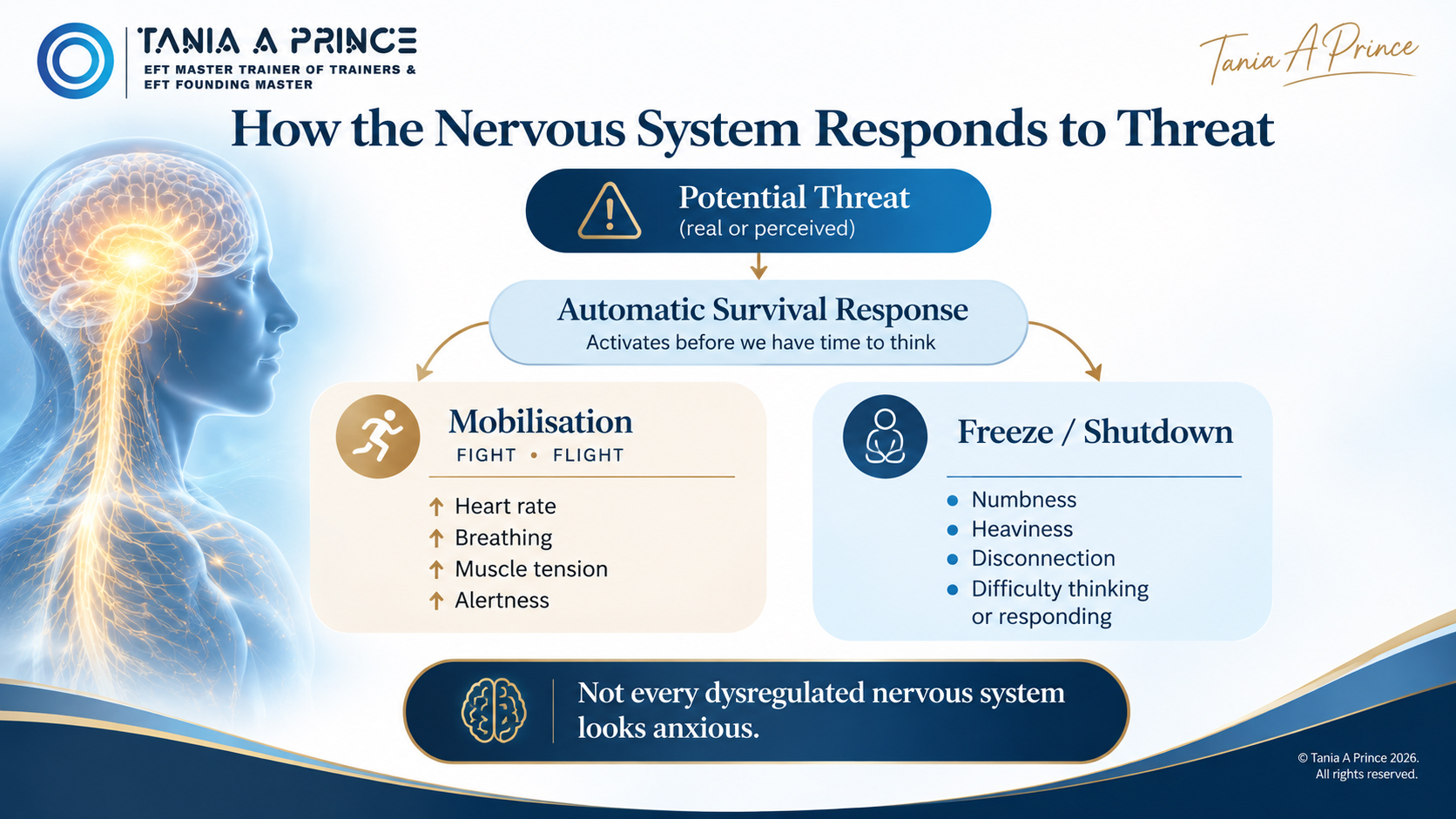
Fight and flight are probably the best-known survival responses.
When mobilisation is required, the body can rapidly prepare for action. Heart rate may increase. Breathing can change. Muscles may tense. Attention may narrow towards potential danger.
Energy and resources are prioritised towards what is immediately required for survival.
But mobilisation is not the only possible response to overwhelming threat.
A person may freeze or move towards a shutdown or collapse response.
Instead of feeling highly anxious and energised, someone may experience numbness, extreme tiredness, heaviness, difficulty thinking, disconnection or an inability to respond.
This is important therapeutically because not every dysregulated nervous system looks anxious.
Someone who appears extremely calm may not necessarily be in a regulated state.
They may be shut down.
The Nervous System Learns From Experience
The nervous system is constantly learning.
Imagine that you are walking down a road and a dog suddenly lunges at you.
Your survival response activates.
Later, another dog may trigger anxiety even though that particular dog is perfectly safe.
Over time, the reaction could potentially become associated with increasingly subtle cues: barking, a particular breed, the sound of claws on a floor or even the location where the original incident happened.
The conscious mind might say:
“This dog isn’t going to hurt me.”
But survival responses are designed for speed.
They do not necessarily wait for conscious logic.
Something that the brain has associated with the original threat can activate an automatic response before the conscious mind has fully evaluated what is happening.
This helps explain why people sometimes become frustrated with themselves.
They may say:
“I know this is irrational. Why am I still reacting?”
The fact that someone understands intellectually that they are safe does not automatically mean that their nervous system has stopped responding to the trigger.
What Happens During a Traumatic Experience?
Under ordinary circumstances, experiences can be integrated into our ongoing understanding of ourselves and the world.
We notice what happened, interpret it, respond and eventually recognise that the event is over.
During overwhelming threat, priorities can change.
Survival takes precedence.
The nervous system may mobilise the body for fighting or escaping. If these options are unavailable or ineffective, other defensive responses may occur, including freezing or shutdown.
As a consequence, aspects of the experience may not be processed and integrated in the same way as an ordinary event.
Later, something associated with the original experience can trigger an automatic response.
This does not mean that trauma is simply a physical substance trapped somewhere inside the body waiting to be released.
It is more useful to think in terms of patterns of response involving the brain, nervous system, body, memory, perception and meaning.
The Nervous System Also Has Natural Reset Mechanisms
After a stressful or threatening event, the nervous system needs to move away from the survival response and towards greater regulation.
You may have noticed spontaneous changes after an intense emotional experience.
People may sigh deeply, yawn, cry, laugh, burp, experience changes in breathing or feel their muscles soften.
In my therapeutic work, I often observe these types of responses while people are tapping.
They can be useful signs that something is changing, but they should not automatically be interpreted as evidence that a particular emotion or trauma has literally been “released from the body.”
Human physiology is more complex than that.
Where Does EFT Fit In?
EFT combines several elements.
The person brings some aspect of an experience into awareness while tapping on a sequence of acupoints, usually on the face and upper body.
This means we are not necessarily trying to reason the nervous system out of its response.
Instead, the person can notice what is happening while tapping.
For example:
“When I think about tomorrow’s meeting, I can feel this tightness in my chest.”
The focus is specific.
The person is not simply repeating positive statements or trying to convince themselves that everything is fine.
They are acknowledging their present experience.
As tapping continues, the intensity of the emotional or physical response may change.
What Does Research Tell Us About EFT and the Nervous System?
Research into EFT has increasingly moved beyond asking people whether they simply feel better after tapping.
Researchers have also measured physiological changes associated with the body’s stress response.
The findings are interesting, although they need to be interpreted carefully.
Research does not currently establish that EFT works through one single nervous-system mechanism. Claims that tapping simply “switches off the amygdala” or “activates the vagus nerve”, for example, go beyond what the evidence currently demonstrates.
What research does show is that measurable physiological changes can occur following EFT.
EFT and Cortisol
Cortisol is one of the hormones involved in the body’s stress response.
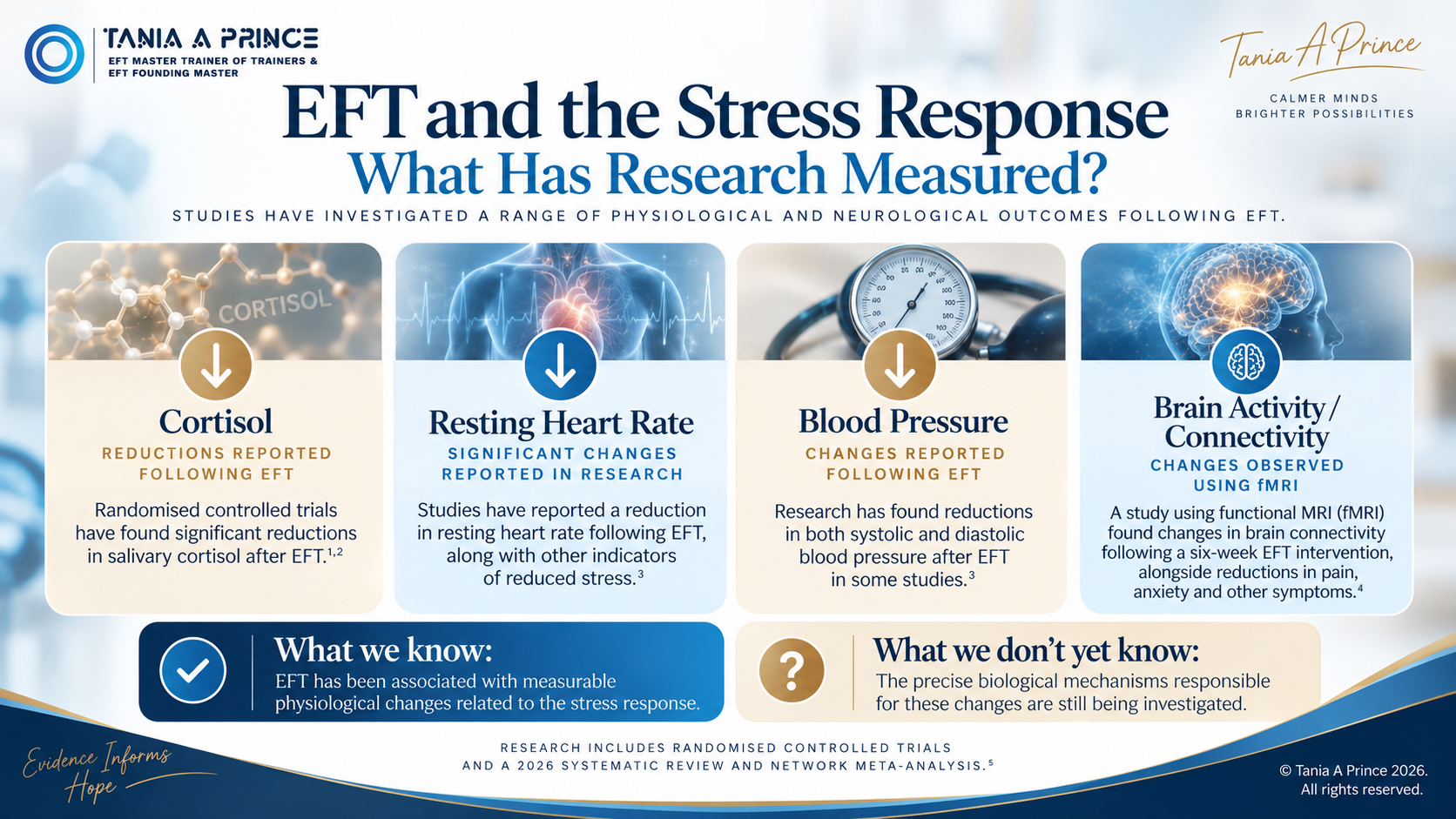
In a 2012 randomised controlled trial involving 83 participants, researchers compared one hour of EFT with supportive psychotherapy and a no-treatment condition.
Salivary cortisol was measured before and after the intervention.
The EFT group experienced an average 24.39% reduction in cortisol, compared with reductions of approximately 14% in the other two groups. The EFT participants also showed reductions in psychological distress.1
A later randomised controlled trial re-examined the cortisol finding.
In that study, cortisol fell by 43.24% in the EFT group, significantly more than in the psychoeducation comparison group. Interestingly, the physiological changes were not mirrored consistently across the subjective psychological measures, illustrating why biological measures can provide an additional perspective when researching EFT.2
Research:
Church D, Yount G, Brooks AJ. The Effect of Emotional Freedom Techniques on Stress Biochemistry: A Randomized Controlled Trial. Journal of Nervous and Mental Disease, 2012.
Read the cortisol study on PubMed
Replication study:
Stapleton P et al. Reexamining the Effect of Emotional Freedom Techniques on Stress Biochemistry: A Randomized Controlled Trial.
Read the replication study on PubMed
Heart Rate, Blood Pressure and Other Physiological Measures
Another study examined several physiological measures before and after EFT.
Researchers assessed resting heart rate, blood pressure, cortisol, heart-rate variability (HRV), heart coherence and salivary immunoglobulin A.
Within the smaller group receiving physiological testing, significant changes included reductions in resting heart rate, blood pressure and cortisol. Changes in HRV and heart coherence did not reach statistical significance.3
This distinction is important.
It would therefore be premature to claim that research has established that EFT increases vagal tone on the basis of HRV.
What we can say is that measurable changes have been observed in several physiological markers associated with stress.
Research:
Bach D et al. Clinical EFT (Emotional Freedom Techniques) Improves Multiple Physiological Markers of Health.
Read the full study on PubMed Central
What Happens in the Brain?
Researchers have also begun using brain imaging to investigate changes following EFT.
A 2022 study used functional magnetic resonance imaging (fMRI) to investigate adults with chronic pain before and after a six-week EFT intervention.
Following EFT, researchers reported changes in functional connectivity involving the medial prefrontal cortex, posterior cingulate cortex and thalamus, brain regions involved in processes relevant to pain and its modulation.
Participants also reported reductions in pain severity, pain interference, anxiety and other symptoms.4
This does not mean that EFT has been shown simply to “turn off” a particular part of the brain.
The brain functions through interconnected networks, and the mechanisms responsible for the effects observed following EFT are still being investigated.
Research:
Stapleton P et al. Neural Changes After Emotional Freedom Techniques Treatment for Chronic Pain Sufferers. Complementary Therapies in Clinical Practice, 2022.
What Does the Latest Research Say?
A particularly useful development is a 2026 systematic review and network meta-analysis examining Clinical EFT for psychological and physiological stress.
Rather than looking at a single EFT experiment, researchers brought together the available randomised controlled trials.
Seventeen RCTs met the inclusion criteria.
Six studies, involving 399 participants, included physiological stress outcomes. Across these studies, Clinical EFT was associated with a statistically significant small-to-moderate reduction in physiological stress compared with control conditions.
Fourteen studies involving 1,051 participants contributed psychological stress outcomes, where the analysis also found reductions associated with EFT.
However, the authors were appropriately cautious. Most of the included studies were assessed as having either some concerns or a high risk of bias, and they called for further high-quality trials incorporating biological as well as self-report measures.5
This is important.
The research provides evidence that EFT is associated with measurable changes in physiological stress, but it does not mean that every detail of how EFT produces those changes has been established.
Research:
Stapleton P, van Elst A. Clinical Emotional Freedom Techniques for Psychological and Physiological Stress Reduction: A Systematic Review and Network Meta-Analysis. Explore, 2026.
Read the 2026 systematic review on PubMed
What Can We Reasonably Say About EFT and the Nervous System?
Taken together, this research suggests that EFT may influence physiological processes involved in the stress response.
Studies have reported changes in:
- cortisol
- resting heart rate
- blood pressure
- psychological distress
- aspects of brain functional connectivity
This gives us considerably more information than simply knowing that people report feeling calmer after tapping.
At the same time, it is important to separate observed effects from proposed mechanisms.
We can measure cortisol.
We can measure heart rate and blood pressure.
We can use fMRI to investigate changes in patterns of brain connectivity.
But explaining precisely why those changes occur is another question.
Research into the mechanisms of EFT is continuing.
EFT Is Not Simply About Relaxation
EFT can be calming, but the objective is not always simply to make someone relaxed.
Sometimes a person needs greater regulation.
Sometimes they need access to more energy.
Someone in a highly activated state may benefit from becoming calmer.
Someone in a shutdown state may need something quite different.
The aim is not to force everyone towards the lowest possible level of activation.
A healthy nervous system needs flexibility.
We need to be able to mobilise when action is required and settle when the danger or challenge has passed.
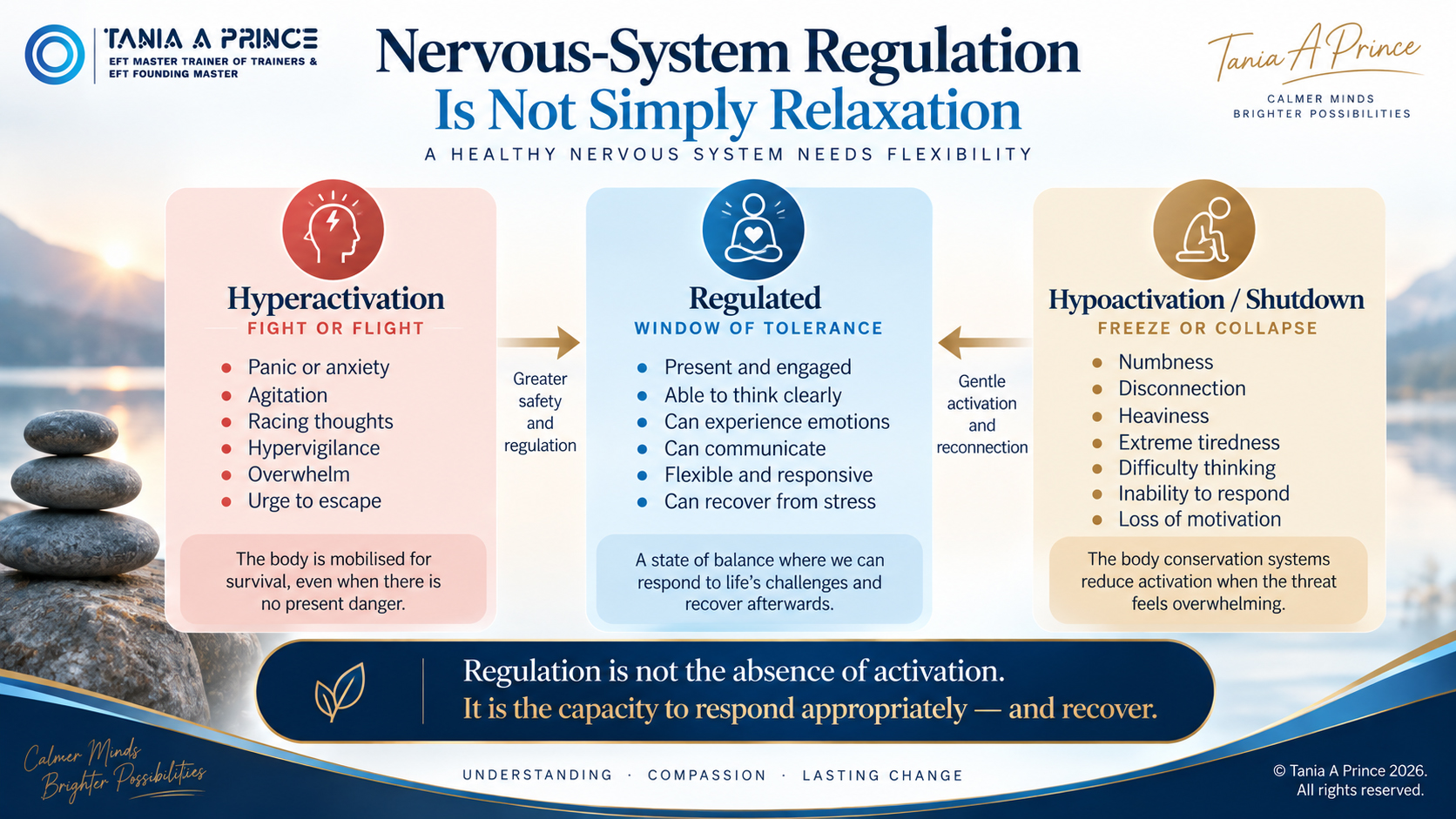
Regulation is not the absence of activation. It is the capacity to respond appropriately and recover.
The Window of Tolerance
One useful way of thinking about nervous-system regulation is the window of tolerance.
Within this window, a person can generally remain present and engaged while experiencing emotion.
They may be upset, angry or anxious, but they can still think, communicate and process what is happening.
Above this manageable range, someone may become hyperactivated.
They might experience panic, agitation, racing thoughts, hypervigilance or an overwhelming urge to escape.
Below it, they may move towards hypoactivation or shutdown.
They might become numb, disconnected, exhausted or unable to think clearly.
Good trauma work is not about pushing somebody as deeply as possible into distress.
It is about helping them work at a level their system can manage.
Why Going Straight to the Worst Trauma May Not Be Helpful
This is particularly important when using EFT with trauma.
There can be an assumption that if tapping is helpful, the quickest approach must be to identify the most traumatic experience and immediately start tapping on it.
That is not necessarily appropriate.
If focusing directly on an experience overwhelms the person’s capacity to remain present, the work can become counterproductive.
With complex trauma especially, stabilisation and establishing sufficient internal resources may need to come first.
A skilled practitioner can use EFT in ways that allow the person to approach difficult material more gradually.
You do not have to flood the nervous system in order to create change.
In fact, less can sometimes achieve more.
Working With What Is Happening Now
One of the most useful aspects of EFT is that you do not necessarily need to begin with a detailed account of everything that happened.
You can work with what is present now.
For example:
“When I think about talking about this, my stomach tightens.”
Or:
“Part of me doesn’t want to go anywhere near this memory.”
Or even:
“I don’t know what I feel. I just feel numb.”
These are all experiences that can potentially become the focus of tapping.
This can be particularly useful when somebody does not yet feel able to talk about the underlying experience.
Why Specificity Matters
The nervous system does not respond only to broad diagnostic labels such as “anxiety” or “trauma.”
It responds within particular contexts.
That is why EFT practitioners frequently become more specific.
Instead of tapping broadly on:
“My anxiety.”
we might explore:
“That feeling in my stomach when I imagine walking into the room.”
Or instead of:
“My childhood trauma.”
we might work carefully with:
“That look on his face when he walked through the door.”
Specific triggers can provide access to the patterns maintaining a response.
With trauma, however, specificity should be balanced with safety. There is no benefit in pushing somebody into a level of detail that overwhelms them.
Signs the Nervous System May Be Shifting During EFT
During tapping, people often notice changes.
The original feeling may become less intense.
A sensation may move or change quality.
Breathing may become easier.
The person’s perspective on the situation may spontaneously alter.
A previously inaccessible thought or memory may emerge.
They may yawn, sigh or feel their muscles soften.
Sometimes the most significant change is simply:
“It doesn’t bother me in the same way now.”
These shifts can help guide the next stage of the work.
EFT, Trauma and Safety
EFT can look deceptively simple.
You tap on some points and talk about a problem.
But working effectively with trauma requires much more than knowing the tapping sequence.
A trauma-informed practitioner needs to recognise activation, shutdown, dissociation and overwhelm. They need to know when to continue, when to slow down and when not to pursue traumatic material.
The goal should never be to prove that somebody can tolerate more distress.
The goal is therapeutic change within an appropriate level of safety.
This becomes particularly important when working with PTSD, complex trauma, significant dissociation or a history of overwhelming experiences.
The Nervous System Is Not the Enemy
Perhaps one of the most important things to understand is that many reactions people dislike about themselves originally developed for a reason.
The nervous system is attempting to protect us.
The problem occurs when an old protective response continues to activate in circumstances where it is no longer required.
A racing heart, freezing, avoidance or shutting down can feel like evidence that something is wrong with us.
But viewed through the lens of survival, these responses can begin to make more sense.
The therapeutic question then changes.
Instead of:
“How do I get rid of this ridiculous reaction?”
we can begin asking:
“What is my system responding to, and what does it need in order to recognise that the situation is different now?”
That is a very different starting point for change.
Final Thoughts
EFT provides an interesting bridge between psychological experience and the body’s response to that experience.
Tapping does not require us to pretend that distress is not there.
Nor does it require us to believe that trauma is a substance physically trapped inside the body.
Instead, EFT allows us to bring attention to thoughts, emotions, sensations, memories and triggers while simultaneously introducing the tapping process.
Research now suggests that the effects of EFT are not necessarily limited to people’s subjective experience. Changes have been measured in cortisol, resting heart rate, blood pressure and brain functional connectivity, and a 2026 systematic review found an overall effect on physiological measures of stress. At the same time, the precise biological mechanisms underlying these changes remain an active area of research.
For many people, tapping is accompanied by a change in the intensity or meaning of an experience.
And when working with trauma, the aim is not simply relaxation.
It is greater flexibility.
A well-regulated nervous system can activate when necessary, settle when the challenge has passed and recognise when the present is different from the past.
That capacity to respond to what is happening now, rather than continually reacting as though an earlier threat is still occurring, is an important part of recovery.
Research References
- Church D, Yount G, Brooks AJ. The Effect of Emotional Freedom Techniques on Stress Biochemistry: A Randomized Controlled Trial. Journal of Nervous and Mental Disease. 2012;200(10):891–896.
- Stapleton P et al. Reexamining the Effect of Emotional Freedom Techniques on Stress Biochemistry: A Randomized Controlled Trial.
- Bach D et al. Clinical EFT (Emotional Freedom Techniques) Improves Multiple Physiological Markers of Health. 2019.
- Stapleton P et al. Neural Changes After Emotional Freedom Techniques Treatment for Chronic Pain Sufferers. Complementary Therapies in Clinical Practice. 2022.
- Stapleton P, van Elst A. Clinical Emotional Freedom Techniques for Psychological and Physiological Stress Reduction: A Systematic Review and Network Meta-Analysis. Explore. 2026.
Tania A Prince is an EFT Founding Master and EFT International Accredited Master Trainer of Trainers. She has worked therapeutically for more than three decades and has trained EFT practitioners internationally.
This article is for educational purposes and is not a substitute for individual medical or psychological advice. If you are experiencing significant trauma-related symptoms, PTSD, dissociation or mental-health difficulties, seek appropriately qualified professional support.