
EFT Certification vs Accreditation: What’s the Difference

EFT Certification vs Accreditation: What’s the Difference?
If you are considering training in Emotional Freedom Techniques (EFT), you may have come across the terms EFT certification and EFT accreditation.
They are sometimes used as though they mean the same thing, but there is an important distinction between them.
You may see courses advertising EFT certification, practitioner certificates, accredited training or accredited practitioner status. Unless you already understand how professional EFT training works, it can be difficult to know what these terms actually mean — and, more importantly, what you will be qualified to do at the end of a course.
This distinction is particularly important if you intend to work professionally with EFT.
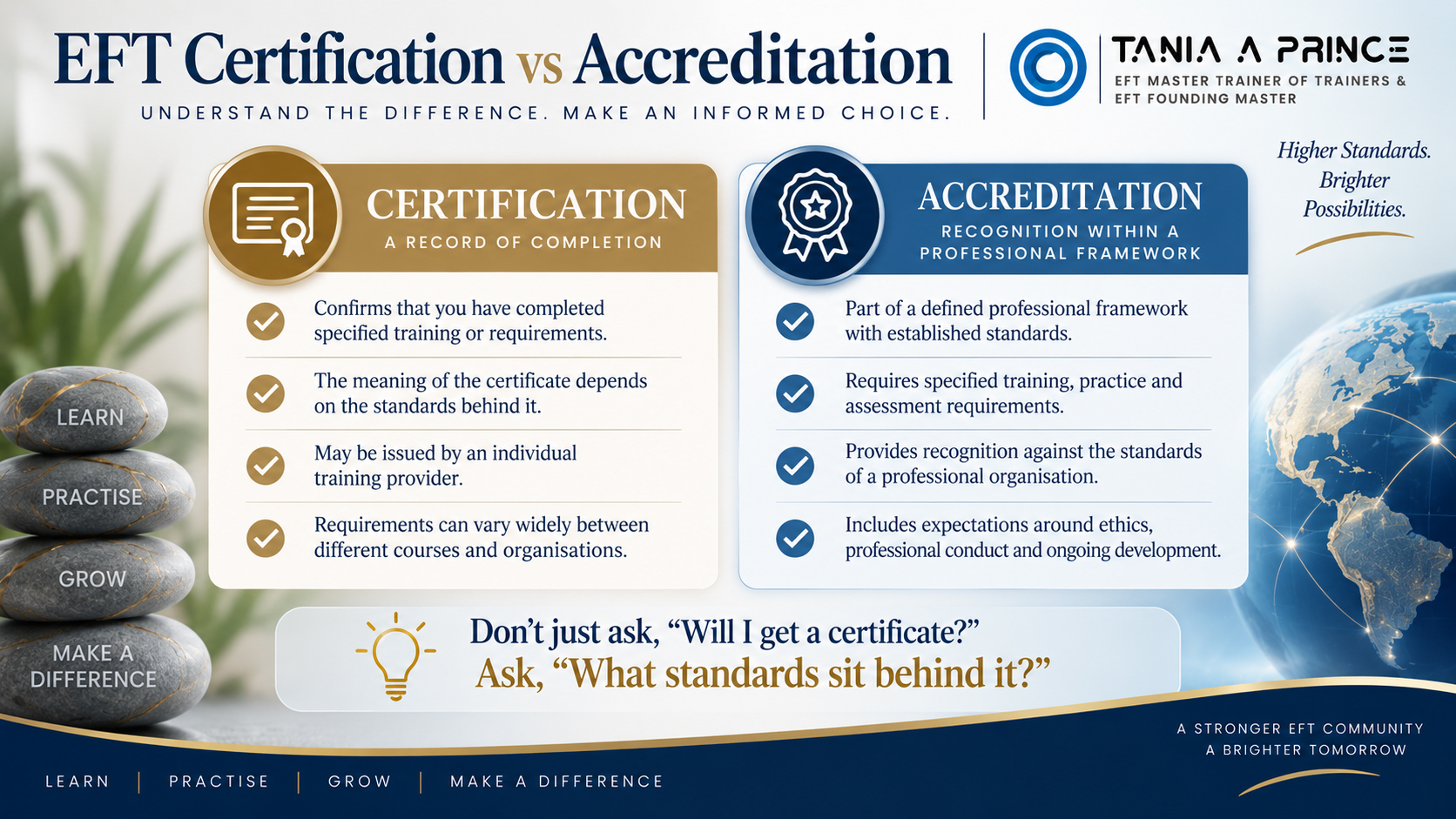
A certificate can demonstrate that you have completed a particular course or set of requirements. Accreditation goes further by placing that training and assessment within the standards of a recognised professional organisation.
Understanding what sits behind the qualification is therefore just as important as the name written on the certificate.
What Is EFT Certification?
In its broadest sense, certification means that somebody has formally recognised that you have completed specified training or met particular requirements.
The difficulty is that the word certification does not, by itself, tell you very much about what was required to obtain it.
A certificate could be awarded simply for attending a course. Another certificate might only be awarded after extensive practitioner training, practice, mentoring, assessment and demonstration of competence.
Both may contain the word certificate, but they do not necessarily represent equivalent levels of training.
This is particularly relevant in EFT because courses are offered by many different individuals and organisations around the world.
If you see a course advertising EFT Certification, one of the most useful questions you can ask is:
Who is issuing the certification, what do I have to do to obtain it, and what professional standards sit behind it?
What Is EFT Accreditation?
Accreditation is different because it involves meeting standards established within a professional framework.
In the case of my EFT Practitioner Training, that professional organisation is EFT International, formerly known as AAMET.
EFT International is a worldwide professional EFT organisation with practitioners, trainers and members in many countries. It establishes standards relating to EFT training, practitioner accreditation, ethics and professional practice.
This is particularly relevant to my own training because my students come from around the world. My EFT courses are delivered live online, allowing people from different countries and professional backgrounds to train together.
Students who want to progress to EFT International Accredited Practitioner status follow the required training, consolidation and assessment pathway.
The important distinction is that attending an EFT training course and becoming an Accredited EFT Practitioner are not the same event.
Training is part of the pathway. Accreditation comes after the required standards have been met.
What Is EFT International?
EFT International developed from AAMET — the Association for the Advancement of Meridian Energy Techniques — which was established during the early development of EFT as a professional field.
The organisation subsequently became AAMET International, reflecting its increasingly international membership, and later became known as EFT International.
Today, EFT International is a UK-registered charity and not-for-profit professional membership organisation with an international reach.
That distinction matters.
It is not simply a privately owned training company awarding its own qualifications to people who purchase its courses. It operates within a charitable and professional governance structure, with trustees, members and volunteers contributing to the organisation and its standards.
Its role includes establishing and maintaining standards around EFT training, accreditation, ethics and professional conduct.
For somebody considering professional EFT training, it is useful to understand the difference between a certificate created and issued solely by an individual training provider and an accreditation pathway operating within the standards of a wider professional organisation.
Certification and Accreditation Are Not the Same as Training
There are really three separate concepts here:
Training is the process through which you acquire knowledge, understanding and practical skills.
Certification provides formal recognition that particular training or requirements have been completed. The significance of that certification depends upon the standards behind it.
Accreditation recognises that you have met requirements established within a defined professional framework.
There is then another factor that I consider even more important:
Competence.
Becoming skilled in EFT involves considerably more than learning where the tapping points are or memorising a tapping sequence.
A practitioner needs to develop the ability to listen, observe, recognise useful therapeutic targets, understand what is happening within a session and adapt appropriately to the person in front of them.
Those abilities develop through good training, practice, feedback, consolidation and experience.
Completing EFT Practitioner Training Does Not Automatically Make You Accredited
This is one of the most important things for prospective EFT students to understand.
Completing EFT practitioner-level training does not automatically mean that you have become an EFT International Accredited Practitioner.
My EFT Level 1 and Level 2 Practitioner Training provides the live practitioner training component of that journey.
Students learn the principles and practical application of EFT, observe demonstrations, ask questions and practise working with the approach themselves.
Because the training is live, I can also observe how students are understanding the material and respond to questions as they arise.
During private student practice sessions, students work with one another. These private practice sessions are not recorded. My assistants can enter the practice rooms to observe, support students and provide guidance where appropriate.
Students who attend the live training also receive access to a private online learning platform. This contains recordings of the main teaching, demonstrations and questions from the training, together with additional demonstrations and learning resources to help consolidate what they have learned.
For students seeking accreditation, however, completing the live training is not the end of the process.
It is the beginning of the next stage.
What Happens After EFT Practitioner Training?
Students who want to become Accredited EFT Practitioners move into a post-training consolidation and assessment phase.
This is an important part of practitioner development.
When you first learn a therapeutic approach, there can be a considerable difference between understanding something intellectually and being able to use it confidently and appropriately with another person.
Consolidation allows students to practise what they have learned, deepen their understanding and develop greater fluency in using EFT.
The post-training requirements provide a framework through which that developing competence can be supported and assessed.
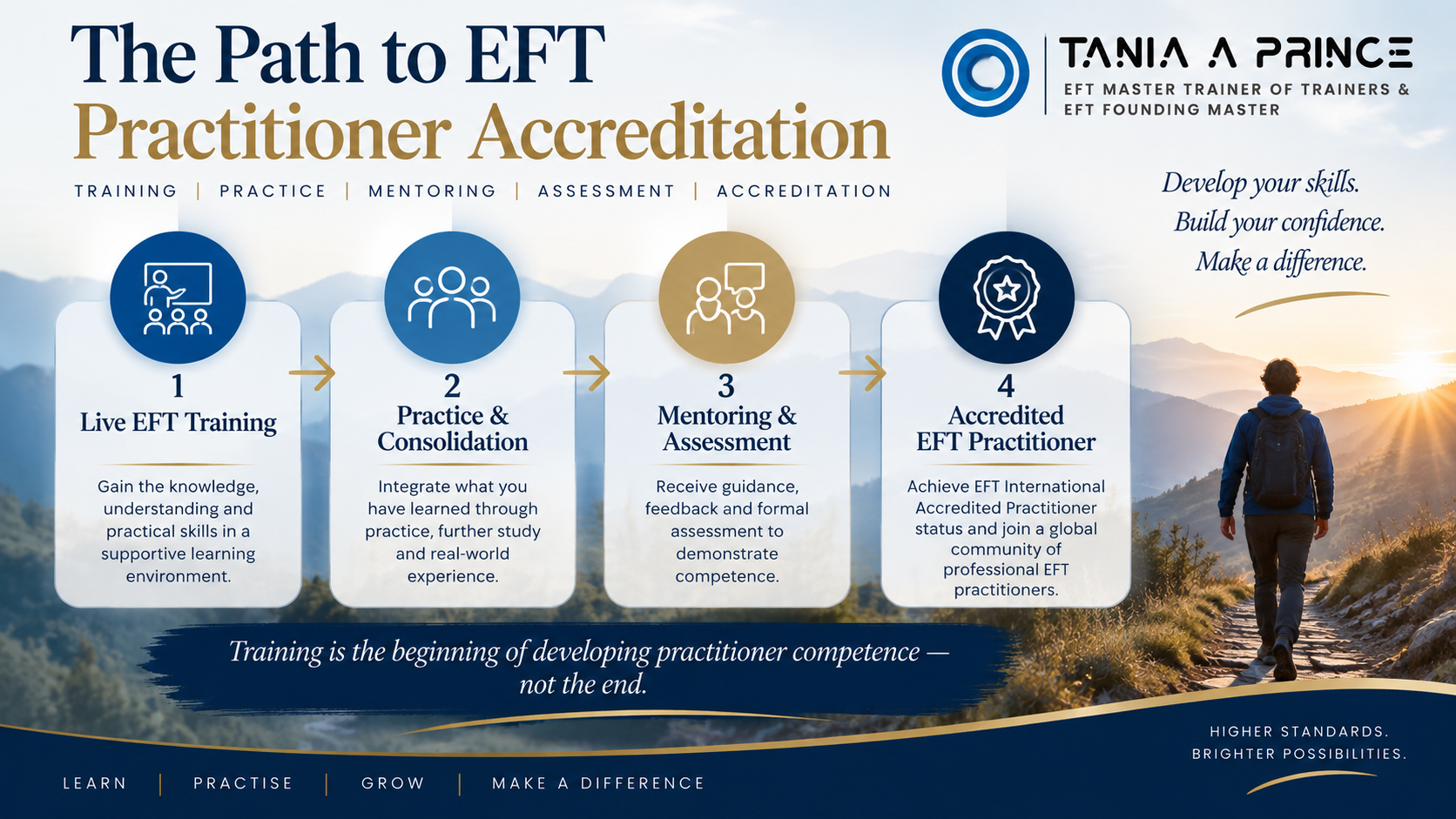
Students following the accreditation pathway are expected to complete their post-training consolidation and testing requirements within one year of attending the training.
If they do not complete the process within that period, the requirements of the accrediting organisation mean that they need to re-attend the EFT Level 2 element of the training before continuing towards accreditation. I offer this re-attendance at a discounted rate.
The purpose is to maintain a high standard among Accredited EFT Practitioners and ensure that the knowledge and practical training on which accreditation is based remain current.
How Long Does EFT Accreditation Take?
There is no single timescale that applies to everybody.
Students have different professional backgrounds, different amounts of time available for practice and different rates at which they consolidate their learning.
The fastest I have seen students achieve accreditation following training is approximately three to four months.
Others take longer, and that is not necessarily a disadvantage.
The purpose of the post-training period is not to race towards a qualification. It is to develop competence.
Students following my pathway have up to one year to complete the required consolidation and testing before Level 2 re-attendance becomes necessary.
Do You Have to Become Accredited After EFT Level 2?
No.
This is an important distinction because practitioner-level training is not only for people who intend to establish a professional EFT practice.
Some people undertake Level 2 because they want a much deeper understanding of EFT for themselves.
Others are already therapists, counsellors, coaches or practitioners in another field and want to develop additional knowledge and skills.
Some want practitioner-level EFT training because they are fascinated by the approach but have no intention of working professionally as an EFT practitioner.
All of these are valid reasons for undertaking training.
You do not have to want a new career to want practitioner-level knowledge.
If your goal is specifically to become an EFT International Accredited EFT Practitioner, however, you will need to complete the required post-training accreditation pathway.
Why Does EFT Accreditation Matter?
Accreditation provides an additional level of professional accountability.
Rather than a trainer simply saying that somebody has completed their course, there is a wider framework establishing what needs to be taught and what requirements need to be met.
This can include standards relating to training, practical competence, assessment, ethics, professional conduct, mentoring and continuing professional development.
That does not mean every accredited EFT practitioner will work in exactly the same way.
Practitioners bring their own professional backgrounds, experience, personalities and areas of specialist interest to their work.
Accreditation provides a professional framework and baseline of standards. It does not make practitioners identical.
Does an EFT Training Certificate Make You an EFT Practitioner?
Not necessarily.
The existence of a certificate does not tell you what level of training or assessment sits behind it.
This is why I recommend looking carefully at what any EFT course actually provides rather than relying solely on words such as certified, professional, practitioner or accredited in the course title.
Before enrolling, find out what you will actually have to do.
For example, you may want to ask:
- Who establishes the training standards?
- Who issues the certificate?
- Does the course follow a recognised EFT syllabus?
- Is the course live or entirely pre-recorded?
- Is practical experience included?
- Will you have opportunities to practise EFT and receive feedback?
- Is attendance alone sufficient to receive certification?
- Is there an assessment process?
- Are there post-training requirements?
- Is mentoring required?
- Does the training provide a pathway towards accreditation?
- What professional status will you actually have when you complete the process?
A reputable trainer should be able to answer these questions clearly.
EFT Is an International Community
EFT is practised internationally, and EFT International itself has a worldwide membership.
My own students attend training from different countries, which is one of the advantages of delivering the courses live online.
There can be something particularly valuable about training within an international group. Students bring different backgrounds, perspectives and professional experiences into the learning environment.
However, professional requirements are not necessarily identical in every country.
If you intend to work professionally with EFT, you should therefore also check the legal, insurance, regulatory and professional requirements that apply wherever you intend to practise.
EFT International accreditation provides an international professional framework for EFT, but it does not replace any requirements that may apply within an individual country or profession.
My Involvement in the Development of EFT Training Standards
My relationship with professional EFT training goes back to the early days of AAMET, the organisation that eventually became EFT International.
I was one of the earliest people to be awarded AAMET EFT Trainer status and was involved with the organisation during its early development.
I served on the AAMET training panel, where I was involved in setting and developing standards for EFT training.
This was a formative period for EFT. As the approach became more widely taught, there was a need to establish clearer expectations around what practitioners should be taught and the standards expected within professional EFT training.
I have therefore experienced the evolution of EFT training not only as a practitioner and trainer, but through direct involvement in some of the early professional structures concerned with developing training standards.
I was subsequently invited by EFT founder Gary Craig to undertake the assessment process through which I became one of only 29 EFT Founding Masters worldwide.
Today, I am an EFT International Accredited Master Trainer of Trainers. I have trained therapists and practitioners in EFT for 26 years and have worked therapeutically for more than 34 years. I train practitioners and trainers, and students attend my courses from around the world.
Having watched professional EFT training develop over many years, I believe strongly that students should understand what sits behind any qualification they are considering.
A Certificate Is Not the End Goal
It can be tempting when choosing professional training to concentrate on the qualification you will receive at the end.
But the real purpose of practitioner training is not the piece of paper.
It is what you can actually do.
Can you listen carefully to a client?
Can you identify what might be useful to target?
Can you recognise when your approach needs to change?
Can you work flexibly rather than mechanically following a script?
Can you use EFT within the limits of your competence?
Can you practise ethically and professionally?
A high-quality training and accreditation process should ultimately be concerned with developing practitioners who can use EFT with skill, understanding and appropriate professional judgement.
The certificate or accreditation recognises that journey. It should never become a substitute for it.
EFT Certification vs Accreditation: Which Do You Need?
The answer depends upon what you want to do with EFT.
If you want to learn EFT for your own development, you may not need professional accreditation.
If you want practitioner-level knowledge but do not intend to establish yourself as an EFT practitioner, Level 2 training may still be extremely valuable.
If you already work professionally with people, practitioner-level EFT training may add another dimension to your existing knowledge and skills, although you should always work within the professional and regulatory requirements applicable to you.
If you want to establish yourself professionally as an Accredited EFT Practitioner, you should choose training that provides a recognised route towards that status and be prepared to complete the subsequent consolidation and assessment requirements.
Choosing an EFT Training Course
Before choosing a course, I recommend looking beyond the promise of becoming “certified.”
Find out who is providing the training, their experience, what you will actually learn, how much live practical experience you will receive and what happens after the course.
Most importantly, ask what standards sit behind the qualification.
My EFT Practitioner Training combines EFT Level 1 and Level 2 and is taught live online to students from around the world. Those who wish to progress towards EFT International Accredited Practitioner status can subsequently complete the required consolidation and assessment process.
Ultimately, instead of asking only:
“Will I receive an EFT certificate?”
I suggest asking:
“What will I actually be trained to do, what standards sit behind this training, and what professional pathway does it give me?”
Those questions will tell you far more about the value of an EFT training course than the word certified ever could.