
EFT for Social Anxiety: Tapping for Fear of Judgement

You walk into a room and immediately wonder where to stand.
You become conscious of what your hands are doing.
You start thinking about whether you look nervous.
Someone asks you a question and, while you’re answering it, part of your mind is already analysing how you sound.
Later, you replay the conversation.
Why did I say that?
Did I sound stupid?
What did they think of me?
I should have said something different.
Social anxiety can turn an ordinary interaction into something that feels intensely threatening.
And the difficulty doesn’t necessarily begin when you enter the room.
You may start worrying hours, days or even weeks beforehand.
Nor does it necessarily end when you leave.
The mind can continue reviewing what happened long afterwards.
EFT (Emotional Freedom Techniques), commonly known as tapping, provides one way of working with the thoughts, feelings, physical sensations and specific situations involved.
But rather than simply tapping on:
“My social anxiety”
we can get much more specific.
What Is Social Anxiety?
Most people feel self-conscious or nervous in some social situations.
You might feel uncomfortable meeting a group of strangers, giving a presentation, attending an interview or walking into an event where you don’t know anybody.
That isn’t necessarily a disorder.
Social anxiety becomes more problematic when fear of being watched, judged, embarrassed, criticised or rejected begins to create significant distress or restrict what somebody feels able to do.
For one person it might involve public speaking.
For another it might be:
- meeting new people,
- speaking in meetings,
- eating in front of others,
- making telephone calls,
- going to parties,
- being photographed,
- talking to someone they find attractive,
- asking a question,
- saying no,
- or simply walking into a crowded room.
The important question for EFT isn’t merely:
“Do I have social anxiety?”
It is:
“What, specifically, feels threatening to me about this situation?”
Social Anxiety Is Often About What We Imagine Other People Are Thinking
Consider two people walking into exactly the same room.
One thinks:
“I wonder who I’ll meet.”
The other thinks:
“Everyone is going to notice that I don’t belong here.”
The room is the same.
The internal experience is completely different.
With social anxiety, attention can become strongly focused on how we believe we are appearing to other people.
You may imagine:
- They can see I’m nervous.
- They think I’m boring.
- They noticed I went red.
- They think I don’t know what I’m talking about.
- I’m going to embarrass myself.
These thoughts can feel like facts.
But there is an important distinction:
what somebody is actually thinking about you and what you fear they might be thinking are not necessarily the same thing.
That distinction gives us something useful to work with in EFT.
The Body Can Become Part of the Fear
Social anxiety isn’t purely a thinking problem.
Your body may respond too.
You might notice:
- a racing or pounding heart,
- heat in your face,
- blushing,
- sweating,
- shaking,
- a tight throat,
- a dry mouth,
- a feeling in your stomach,
- muscle tension,
- difficulty concentrating,
- or changes in your breathing.
Then another layer can appear:
“What if they notice?”
You are no longer only anxious about speaking.
You are anxious that people will notice that you are anxious.
That can create a feedback loop:
I feel anxious.
↓
I notice my body reacting.
↓
I’m afraid they’ll notice.
↓
I become more self-conscious.
↓
My anxiety increases.
If this sounds familiar, you may also find Why Anxiety Is Felt in the Body helpful.
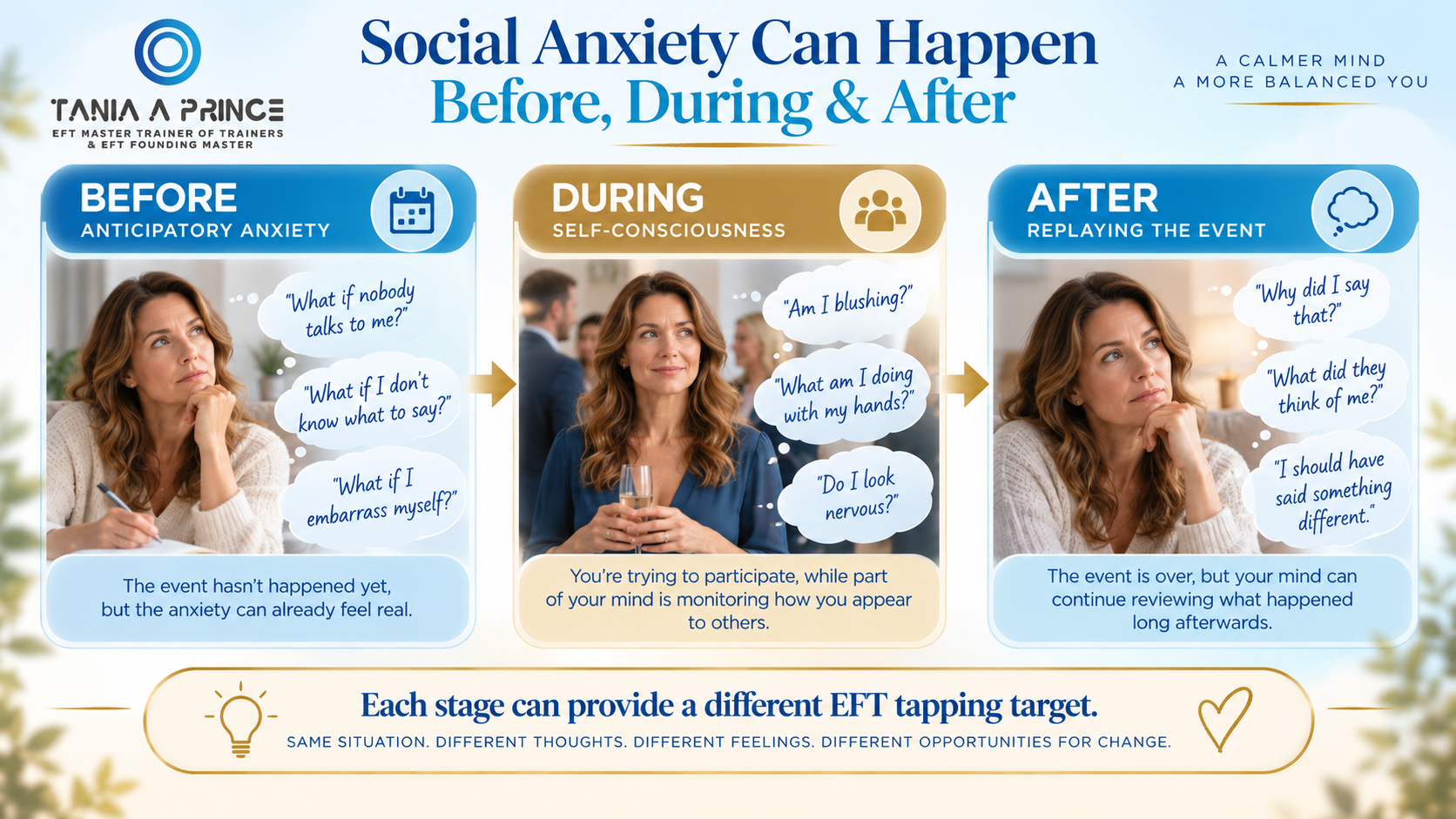
Before, During and After: The Three Stages of Social Anxiety
Social anxiety can operate across three different time periods.
Understanding which one is causing the difficulty can help make EFT more precise.
Before the Situation
This is anticipatory anxiety.
You imagine what might happen.
“What if nobody talks to me?”
“What if I don’t know what to say?”
“What if my mind goes blank?”
“What if they ask me something I can’t answer?”
The event hasn’t happened yet, but your mind and body may already be responding to your imagined version of it.
During the Situation
Attention can turn inwards.
Am I blushing?
What am I doing with my hands?
Am I talking too quickly?
Do I look uncomfortable?
At the same time, you are trying to participate in the actual conversation.
After the Situation
Then comes the review.
“I shouldn’t have said that.”
“Why didn’t I say something more interesting?”
“She looked away when I was talking.”
“I bet they thought I was awkward.”
Research into social anxiety identifies post-event rumination, avoidance and safety behaviours among processes that can help maintain the problem.
This means there isn’t necessarily one single thing called “social anxiety” to tap on.
There may be several different EFT targets.
Start With a Specific Social Situation
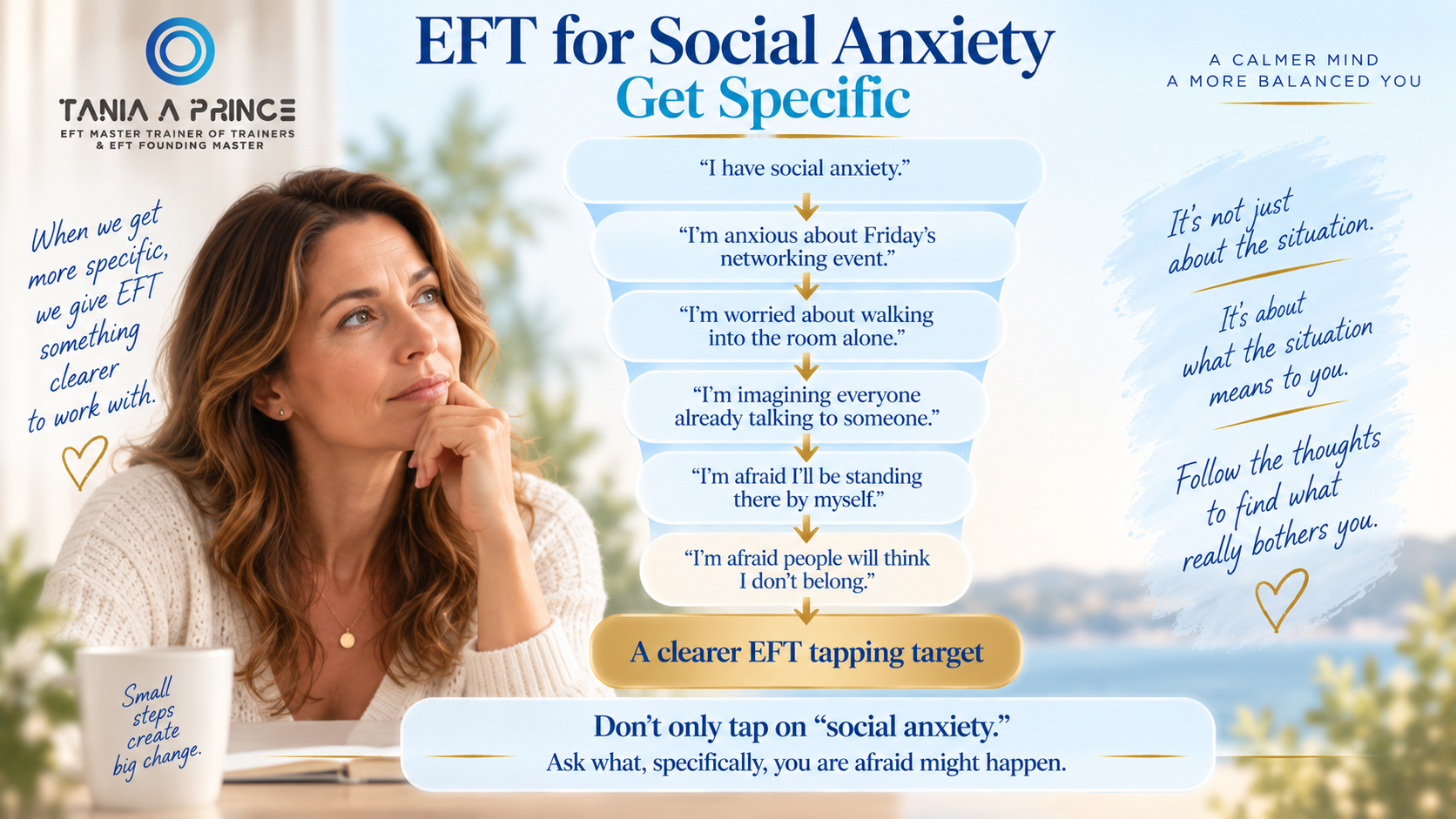
Instead of beginning with:
“Even though I have social anxiety…”
try identifying one situation.
For example:
“I have to attend a networking event on Friday.”
Then ask:
What about that bothers me?
Perhaps:
“I’m worried I’ll walk in and everyone will already be talking to somebody.”
Now ask:
What would be difficult about that?
Perhaps:
“I’ll be standing there by myself.”
Then:
What would that mean to you?
Perhaps:
“Everyone will think I have no friends.”
Now we are getting somewhere.
The EFT target has moved from:
social anxiety
to:
“I’m imagining myself standing alone while everyone notices.”
That is much more specific.
Use the Mental Movie
Sometimes you can identify the anxiety by noticing the scene your mind is already creating.
Imagine you have to give a presentation.
When you think about tomorrow, perhaps you see yourself standing at the front of the room.
What happens next in your mental movie?
Maybe you imagine somebody asking a question.
Then you see yourself freezing.
Your mind goes blank.
Everyone looks at you.
And you imagine thinking:
“They know I don’t know what I’m talking about.”
Rather than tapping on the entire presentation, you could begin with that moment.
For example:
“Even though I imagine somebody asking me a question and my mind going completely blank…”
That is a clearly defined target.
How to Use EFT Before a Social Situation
Choose one specific anticipated moment.
For example:
Walking into the room.
Rate the intensity from 0–10 if that is useful.
Then tap on the side of the hand:
“Even though I feel anxious when I imagine walking into that room and not knowing anybody, I acknowledge how I feel.”
Repeat approximately three times.
Then tap through the points.
Eyebrow:
“Walking into that room.”
Side of eye:
“Everyone already talking.”
Under eye:
“Not knowing where to stand.”
Under nose:
“What if nobody talks to me?”
Chin:
“I’ll look awkward.”
Collarbone:
“Everyone might notice.”
Under arm:
“All this anxiety about walking in.”
Top of head:
“That moment when I enter the room.”
Pause.
Then notice what happens.
Follow What Changes
Don’t automatically repeat exactly the same round.
Ask:
What bothers me now?
Perhaps the fear of entering the room has reduced, but a new thought appears:
“What if somebody talks to me and I don’t know what to say?”
Good.
That gives you your next target.
You could tap:
“Even though I’m worried somebody will start talking to me and my mind will go blank…”
Then reassess.
EFT becomes much more flexible when you follow what emerges instead of trying to force yourself through a predetermined script.
Fear of Judgement
One of the most useful questions when working with social anxiety is:
“What am I afraid they will think about me?”
Complete the sentence:
They’ll think I’m ________.
Perhaps:
- boring.
- stupid.
- awkward.
- incompetent.
- unattractive.
- weak.
- nervous.
- strange.
- unsuccessful.
Then notice which word carries emotional charge.
For example:
“They’ll think I’m incompetent.”
You might tap:
“Even though I’m afraid they’ll think I’m incompetent when I speak in the meeting…”
But we can go further.
Ask:
What would be so bad about them thinking that?
Perhaps:
“They won’t respect me.”
Or:
“I’ll lose credibility.”
Or:
“It will prove I’m not good enough.”
Again, the work is becoming more specific.
What If You’re Afraid People Will Notice You’re Anxious?
This can become a problem in itself.
Perhaps you aren’t particularly afraid of the conversation.
You’re afraid of blushing.
Or shaking.
Or sweating.
Or your voice trembling.
Your tapping target might therefore be:
“I’m afraid they’ll see my hands shaking.”
or:
“I’m afraid my face will go red and everyone will know I’m nervous.”
Notice the distinction.
The target isn’t simply:
“I don’t want to blush.”
It may be:
“I’m afraid of what people will think if they see me blush.”
That gives you another layer to explore.
What Are You Doing to Prevent the Thing You Fear?
People naturally develop strategies to feel safer in uncomfortable situations.
Perhaps you:
- rehearse sentences before speaking,
- avoid eye contact,
- hold a glass so you have something to do with your hands,
- stay close to somebody you know,
- avoid speaking unless you’re certain of the answer,
- check your phone,
- arrive late,
- leave early,
- speak very quietly,
- or avoid the situation altogether.
These behaviours can make sense because they provide immediate relief.
But in established psychological models of social anxiety, avoidance and “safety behaviours” can sometimes help maintain anxiety because they reduce opportunities to discover that feared outcomes may not happen, or may be more manageable than expected.
That doesn’t mean you should suddenly force yourself to abandon every coping strategy.
Instead, become curious.
What am I trying to prevent?
That answer may reveal another useful EFT target.
EFT for Replaying a Social Situation Afterwards
Perhaps the event is over but your mind won’t let it go.
You keep returning to one moment.
Don’t tap on:
“That whole terrible evening.”
Find the moment.
Maybe:
“When I made the joke and nobody laughed.”
Notice what happens when you remember it.
What do you feel?
What do you think?
What meaning have you given it?
Perhaps:
“They thought I was ridiculous.”
Try:
“Even though I keep replaying that moment when nobody laughed, and I feel embarrassed every time I remember it…”
Tap through the points while staying with that specific moment.
Then reassess.
Perhaps the embarrassment changes and another thought appears:
“It reminds me of being laughed at in school.”
Now something else may have become relevant.
You don’t need to go searching for childhood memories.
But if a related memory naturally emerges, notice it.
If replaying conversations and interactions becomes a repeated pattern, you may also find EFT for Overthinking useful.
Earlier Experiences Can Matter
Sometimes our present-day social fears make more sense when we understand previous experiences.
Perhaps you were:
- laughed at when answering a question,
- criticised publicly,
- excluded from a group,
- bullied,
- embarrassed during a presentation,
- teased about your appearance,
- or repeatedly told that you were shy.
A current situation may activate some of the same expectations.
For example:
Today’s problem:
“I’m terrified of speaking in meetings.”
may connect with:
Earlier experience:
“I answered a question incorrectly at school and everybody laughed.”
The adult knows the meeting isn’t the classroom.
But emotionally, there may still be a connection.
A specific memory like this can become an EFT target.
Don’t Force Yourself to Think Positively
If you currently believe:
“Everyone is going to judge me”
jumping immediately to:
“Everyone loves me and I am completely confident”
may not feel believable.
Instead, use transition language.
After some of the intensity has reduced, you might try:
“Maybe I don’t actually know what everybody is thinking.”
“Perhaps some people aren’t paying nearly as much attention to me as I imagine.”
“Maybe I don’t have to perform perfectly.”
“Perhaps it’s okay to pause before answering.”
“Maybe I can allow myself to be here without constantly monitoring myself.”
And eventually, if it feels right:
“I choose to allow myself to participate without needing to be perfect.”
The aim isn’t to paste positive thinking over anxiety.
It is to create room for another possibility.
A Simple EFT Round for Fear of Judgement
Tap on the side of the hand:
“Even though I’m worried about what people will think of me, and part of me feels as though I have to get everything right, I acknowledge how I feel.”
Repeat three times.
Then:
Eyebrow:
“What will they think of me?”
Side of eye:
“What if I say something stupid?”
Under eye:
“What if they notice I’m nervous?”
Under nose:
“I feel as though everyone’s watching me.”
Chin:
“I have to get this right.”
Collarbone:
“All this pressure.”
Under arm:
“Maybe I don’t actually know what they’re thinking.”
Top of head:
“Perhaps I don’t have to be perfect.”
Pause.
Notice what has changed.
Then work with your response, rather than automatically repeating the script.
EFT for Public Speaking Anxiety
Public speaking provides a particularly clear example because there are many possible aspects to work with.
You might be anxious about:
- walking to the front,
- people looking at you,
- introducing yourself,
- forgetting what you planned to say,
- your voice shaking,
- seeing somebody looking bored,
- being asked questions,
- not knowing an answer,
- or making a mistake.
Don’t tap on:
“Public speaking.”
Choose one moment.
For example:
“When I imagine looking up and seeing everyone looking at me.”
Work with that.
Then move to the next aspect.
Interestingly, public-speaking anxiety is one area where Emotional Freedom Techniques have been investigated directly. A randomised study involving 76 Turkish nursing students compared EFT and breathing therapy. Both groups showed reductions on measures of distress and speech anxiety after the interventions, with the EFT group showing a larger effect on speech anxiety in that study.
One study doesn’t establish EFT as a definitive treatment for social anxiety, but it is directly relevant to this particular social fear.
What Does the Wider EFT Research Say?
A 2025 systematic review examined seven randomised controlled trials involving 506 participants in which Emotional Freedom Techniques were used as a standalone intervention for anxiety symptoms.
All six studies comparing EFT with no intervention reported reductions favouring EFT. Comparisons with active treatments were more mixed; the review reported similar or better outcomes compared with breathing therapy and progressive muscle relaxation in the included trials, while finding no significant difference compared with CBT. Importantly, the authors also identified methodological limitations and concluded that higher-quality research is needed.
A 2026 systematic review and network meta-analysis of Clinical EFT for stress included 17 randomised controlled trials. It reported reductions in psychological stress and a smaller effect on physiological stress compared with controls, but again noted risk-of-bias concerns in many of the included studies.
So the evidence around EFT and anxiety/stress is developing, but we should avoid saying that research has established EFT as a treatment specifically for social anxiety disorder.
There is an additional complication when searching this subject: some research papers use the abbreviation EFT to mean Emotion-Focused Therapy, which is a completely different therapeutic approach from Emotional Freedom Techniques. Those studies shouldn’t be presented as evidence for tapping.
EFT Self-Help and Social Anxiety Disorder Are Not the Same Thing
This distinction matters.
Someone feeling nervous before a networking event may find self-directed EFT useful.
Someone whose fear of social situations is substantially affecting their work, education, relationships or ability to participate in everyday life may need more comprehensive professional support.
Social Anxiety Disorder is a recognised mental health condition.
If social anxiety is severe, persistent or significantly restricting your life, speak with an appropriately qualified healthcare or mental-health professional.
EFT self-help shouldn’t be used as a reason to avoid appropriate assessment or evidence-based treatment.
You Don’t Have to Eliminate Every Trace of Nervousness
Being slightly nervous doesn’t mean something has gone wrong.
You can be nervous and still:
- speak,
- walk into the room,
- meet somebody,
- ask the question,
- give the presentation,
- or have the conversation.
Sometimes the goal isn’t:
“I must feel absolutely no anxiety.”
A more useful shift might be:
“I can feel some nervousness and still participate.”
Or:
“I don’t have to monitor myself every second.”
Or:
“I can allow the conversation to unfold.”
That is a very different relationship with anxiety.
Learning EFT Beyond Scripts
A tapping script can help you begin.
But EFT becomes much more precise when you learn how to identify what you’re actually responding to.
With social anxiety, that might be:
- a future scene,
- a feared judgement,
- a physical sensation,
- a specific person,
- a particular moment,
- a previous embarrassing experience,
- or the meaning you have attached to what happened.
Knowing how to distinguish these aspects is an important EFT skill.
I am an EFT Founding Master and EFT International Accredited Master Trainer of Trainers, and this way of working is part of what I teach within my EFT Practitioner Training.
The aim isn’t simply to memorise tapping phrases.
It is to learn how to listen carefully to what is happening and identify where to work.
Where to Go Next
If your social anxiety begins long before the event itself, EFT for Anticipatory Anxiety is the natural next article.
If you find yourself repeatedly analysing interactions afterwards, read EFT for Overthinking.
For more about physical symptoms, read Why Anxiety Is Felt in the Body.
And if you are new to tapping, begin with How to Use EFT When You Feel Anxious and EFT Tapping Points for Anxiety.
You can also begin with the wider EFT Tapping for Anxiety guide if you would like a broader explanation of anxiety, the nervous system and EFT.
The important thing to remember is that:
“I’m socially anxious”
is the beginning of the enquiry, not necessarily the EFT target.
Ask:
What particular situation am I thinking about?
Then:
What am I afraid will happen?
Then:
What am I afraid people will think about me?
That is often where the more useful EFT work begins.
Research Referenced
The most directly relevant tapping study here is the randomised trial of Emotional Freedom Techniques for public-speaking anxiety. The broader evidence is provided by the 2025 systematic review of EFT for anxiety and the 2026 review of Clinical EFT for stress.
