
EFT Tapping for Anxiety: How to Calm Your Nervous System and Feel Safer
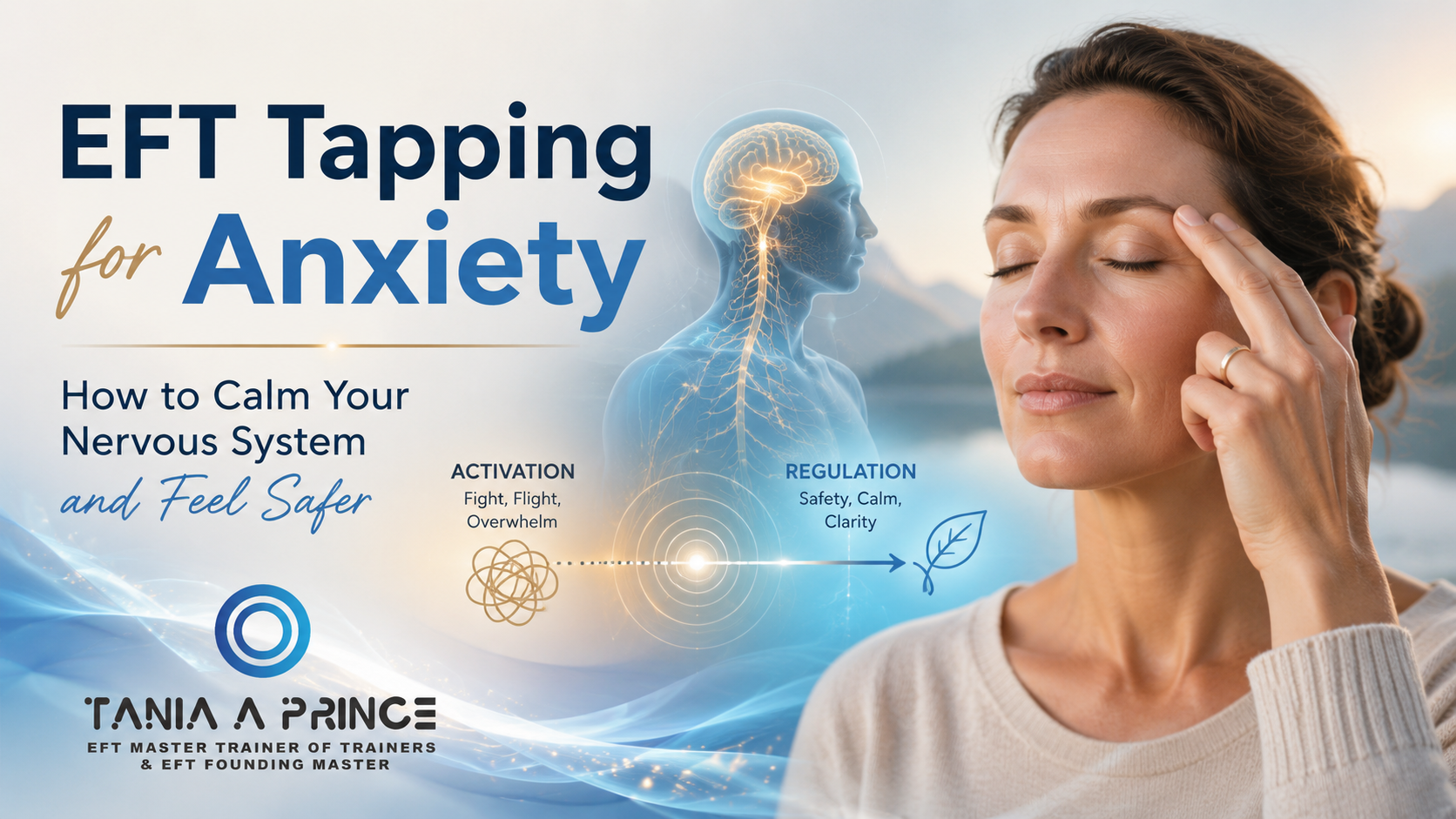
Anxiety doesn’t only happen in your thoughts. It can be a whole-body experience.
Your heart may beat faster. Your breathing may change. Your stomach may tighten. You might feel restless, shaky or unable to settle. At the same time, your mind can become increasingly focused on everything that might go wrong.
Understanding anxiety from a nervous-system perspective can help explain why simply telling yourself to stop worrying often doesn’t work.
Your body may already be responding to something it perceives as threatening.
EFT tapping for anxiety is one way of beginning to work with this response. EFT, or Emotional Freedom Techniques, combines focused attention on what you are experiencing with gentle tapping on a sequence of points on the face and upper body.
In this article, I’ll explain what may be happening in your nervous system when you feel anxious, why anxiety can sometimes seem to arise automatically, and how you can begin using EFT tapping as a simple self-help technique.
What Is Anxiety?
Anxiety is part of our natural response to perceived threat, challenge or uncertainty.
In the right circumstances, this response is extremely useful.
Imagine crossing a road and suddenly seeing a car approaching much faster than you expected.
Your nervous system needs to respond quickly.
Your attention sharpens. Your heart may beat faster. Your muscles prepare for movement and your body mobilises energy so you can get out of the way.
You don’t have to consciously instruct your body to do any of this.
It happens automatically.
The difficulty is that the same protective systems can become activated when there isn’t an immediate physical danger in front of us.
An important meeting, an uncomfortable conversation, uncertainty about the future, financial concerns, health worries, travelling, social situations or simply thinking about something that happened previously can all potentially contribute to feelings of anxiety.
The danger may not be happening in front of you, but your body can still respond as though something important requires your attention.
What Causes Anxiety From a Nervous-System Perspective?
Your nervous system is continually processing information from both inside and outside your body.
One of its important functions is helping you respond to possible danger.
The autonomic nervous system regulates many processes that happen without conscious effort, including heart rate, breathing and digestion.
When something is perceived as threatening, stressful or uncertain, the body can move towards greater mobilisation.
The sympathetic branch of the autonomic nervous system is involved in preparing the body for action.
This can contribute to physical experiences commonly associated with anxiety, such as:
- a faster heartbeat
- quicker or shallower breathing
- muscle tension
- sweating
- trembling or shakiness
- butterflies or discomfort in the stomach
- feeling restless or “on edge”
- increased alertness
Your attention may also become increasingly focused on detecting possible problems.
This can create a powerful interaction between the mind and body.
Your system perceives a possible threat.
Your body becomes activated.
You notice the physical sensations and begin thinking about what might happen.
Those thoughts can create a greater sense of threat.
Your body responds again.
The Anxiety Feedback Loop
A cycle can develop:
Perceived threat → nervous-system activation → anxious thoughts and physical sensations → increased perception of threat → further activation
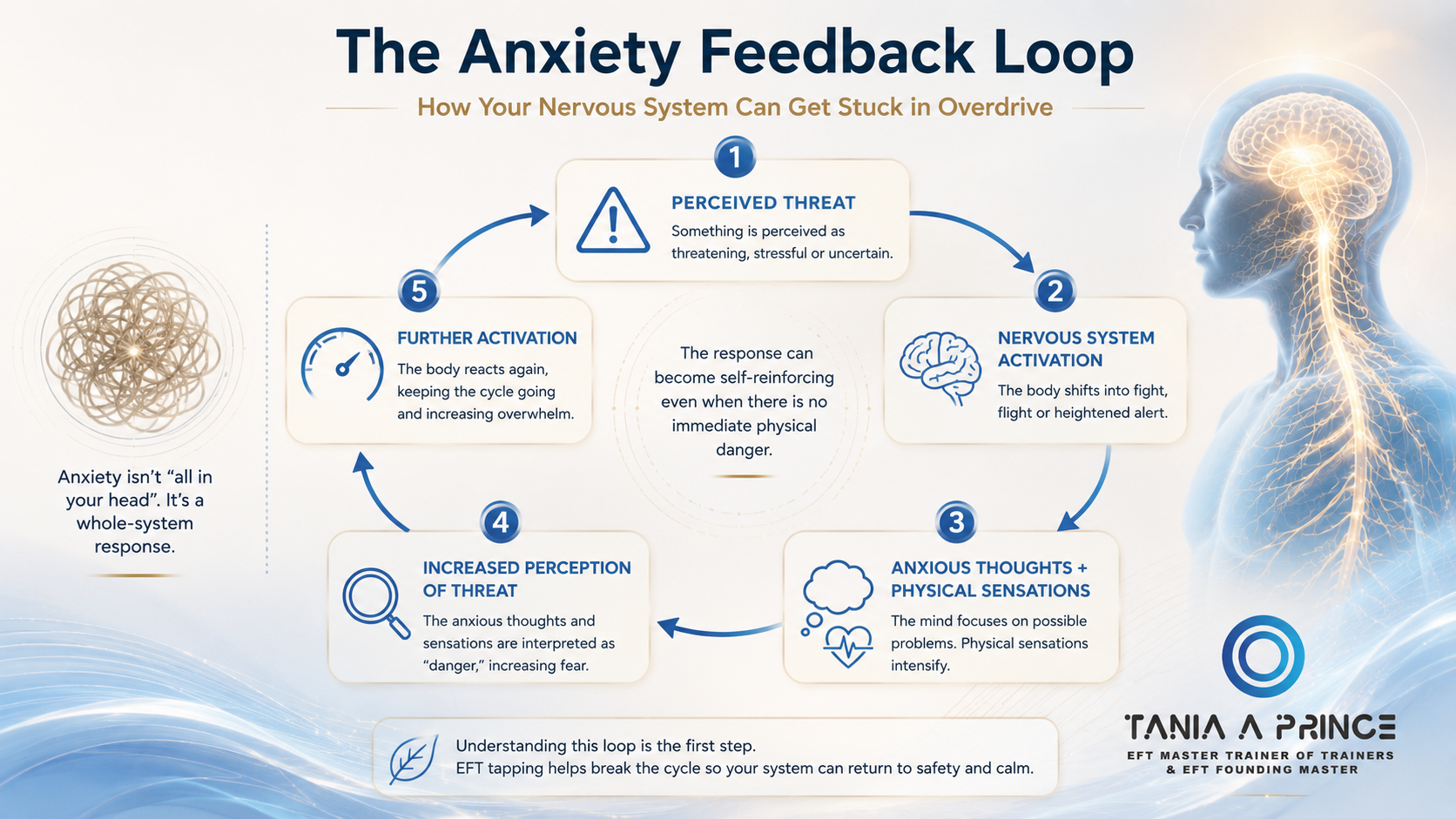
This helps explain why telling yourself to “just stop worrying” may not be enough.
Anxiety isn’t purely a conscious decision.
If your body is already responding as though something might be wrong, reasoning with yourself may only address one part of what is happening.
Why Can I Feel Anxious When I Know I’m Safe?
This is one of the most frustrating aspects of anxiety.
Logically, you may know there is nothing to be frightened of.
Your body can nevertheless respond differently.
Conscious reasoning is only one part of the way we process information. Previous experiences can influence what we learn to associate with threat.
Imagine someone who experienced intense criticism or embarrassment while speaking in front of a group.
Years later, they may consciously know that giving a presentation isn’t physically dangerous.
Yet standing in front of an audience may trigger a racing heart, sweating, trembling, a blank mind or an overwhelming desire to escape.
Something about the current situation may resemble something the nervous system has previously learned to respond to.
The reaction can feel immediate and automatic.
Anxiety Can Be About the Future – But Previous Experiences Matter
Anxiety frequently involves thoughts about what might happen:
What if I make a mistake?
What if they don’t like me?
What if something goes wrong?
What if I can’t cope?
What if I fail?
These thoughts are focused on the future, but our expectations about what might happen can be influenced by previous experiences.
If you have learned that certain situations are associated with embarrassment, rejection, conflict, loss of control or danger, something happening today may activate a similar response.
This doesn’t mean every anxious response has a hidden childhood cause.
Nor does it mean you need to search through your past to find a memory before you can do anything about your anxiety.
You can begin with what is happening right now.
This is one of the ways EFT tapping can be used.
What Is EFT Tapping?
EFT stands for Emotional Freedom Techniques. It is commonly known as tapping.
The technique involves gently tapping with your fingertips on a sequence of points on the face and upper body while focusing on a particular issue.
Rather than attempting to suppress an uncomfortable feeling, EFT usually begins by acknowledging what you are actually experiencing.
For example:
“Even though I’m feeling anxious about this meeting…”
“Even though I can feel this tension in my stomach…”
“Even though part of me thinks something is going to go wrong…”
This is an important distinction.
EFT isn’t simply about trying to replace uncomfortable thoughts with positive ones.
You begin with what is actually happening.
How Might EFT Tapping Help With Anxiety?
Research into EFT is continuing, and different explanations have been proposed for how tapping may produce its effects.
From a practical perspective, EFT brings together several elements.
You deliberately bring your attention to an emotional experience.
You notice the thoughts, feelings and physical sensations associated with it.
At the same time, you engage in the physical process of tapping.
Rather than automatically becoming absorbed in the anxiety, you are intentionally observing and working with your response.
As you tap, the experience may begin to change.
Sometimes physical sensations change first.
Sometimes a thought that seemed completely convincing feels less powerful.
Sometimes another emotion emerges.
And sometimes you suddenly realise that what you thought you were anxious about isn’t actually the part of the situation that is bothering you most.
This is why I prefer to think of EFT as a process rather than a collection of magic words.
How to Use EFT Tapping for Anxiety
If you would like to experiment with EFT tapping for anxiety, start with something specific and manageable.
Rather than:
“I’m an anxious person.”
try:
“I’m anxious about tomorrow’s meeting.”
or:
“I’m worried about making that phone call.”
or:
“I’m anxious because I haven’t heard back from them.”
Specificity gives you something clearer to work with.
Step 1: Identify What You’re Anxious About
Ask yourself:
What am I anxious about right now?
Try to identify a particular situation rather than anxiety in general.
Then notice what happens when you think about it.
Step 2: Notice What Happens in Your Body
Where do you experience the anxiety?
Perhaps you notice:
- tightness across your chest
- butterflies in your stomach
- tension in your shoulders
- a lump in your throat
- pressure in your head
- shakiness
- restlessness
Don’t worry if you can’t identify a physical sensation.
Simply notice whatever is present for you.
Step 3: Rate the Anxiety From 0–10
If it feels comfortable, give the anxiety an intensity rating from 0 to 10, where:
0 = no anxiety
and
10 = extremely intense
For example:
Anxiety about tomorrow’s meeting = 7/10
There isn’t a correct answer.
The number simply gives you a way of checking whether your response changes.
Step 4: Create an EFT Setup Statement
A traditional EFT setup statement acknowledges the problem while including a statement of self-acceptance.
For example:
“Even though I’m anxious about tomorrow’s meeting, I deeply and completely accept myself.”
If that doesn’t feel comfortable or believable, don’t force it.
You could instead say:
“Even though I’m feeling anxious about tomorrow’s meeting, I’m acknowledging how I feel.”
While gently tapping on the side-of-the-hand point, repeat your setup statement three times.
Step 5: Tap Through the EFT Tapping Points
Now tap gently through the standard EFT points while using short phrases that keep your attention connected to the problem.
Eyebrow:
“This anxiety.”
Side of the eye:
“I’m worried about tomorrow.”
Under the eye:
“All this tension.”
Under the nose:
“Part of me thinks something might go wrong.”
Chin:
“This anxious feeling.”
Collarbone:
“I can feel this in my body.”
Under the arm:
“All this anxiety about tomorrow.”
Top of the head:
“This anxiety.”
The exact words aren’t important.
You don’t need to remember somebody else’s script perfectly.
Use words that describe your experience.
Don’t Rush to Make the Anxiety Disappear
This is an important part of using EFT.
People sometimes start tapping while internally thinking:
“I have to get rid of this.”
That can create another struggle.
Instead, become curious about what you are experiencing.
You might tap while saying:
“This is what I’m noticing right now.”
“My body is responding to something.”
“Part of me doesn’t feel safe about this.”
“I don’t have to force this feeling to disappear.”
“I’m just noticing what happens as I tap.”
You are beginning with the response that is actually there rather than demanding that your body immediately feel differently.
Moving From Anxiety Towards Another Possibility
If the emotional intensity begins to change, you can introduce what I think of as bridging or transition language.
Instead of jumping from:
“I’m terrified.”
to:
“Everything is wonderful and I’m completely confident.”
you introduce a possibility your system may be more able to accept.
For example:
“Maybe I don’t have to solve everything right now.”
“Maybe my body is trying to protect me.”
“Perhaps I can allow myself to settle a little.”
“Maybe this could go more smoothly than I’m expecting.”
“Perhaps I can handle this one step at a time.”
“I wonder what it would feel like to feel slightly safer right now.”
This isn’t about convincing yourself that something is true when you don’t believe it.
You’re simply opening the door to another possibility.
Recheck Your Anxiety
After several rounds of tapping, stop.
Think about the original situation again.
Ask yourself:
What happens now when I think about it?
Then reassess the intensity.
Perhaps your original 7/10 is now a 5.
Perhaps it hasn’t changed.
Perhaps the anxiety has changed into another emotion.
Or perhaps you’ve realised something important.
For example:
“I thought I was anxious about the meeting, but actually I’m frightened they’ll criticise my work.”
That is useful information.
You now have something more specific to work with.
What I Have Learned From Working With Anxiety and EFT
I have worked therapeutically with people for more than three decades and have been working with and teaching EFT for many years.
One of the things I have repeatedly observed is that the anxiety someone initially presents with isn’t necessarily the whole problem.
Someone may say:
“I’m anxious about giving a presentation.”
That’s a starting point.
But it doesn’t necessarily tell us why their response is so strong.
We can become more curious:
What specifically about giving the presentation feels difficult?
Is it standing in front of people?
Being watched?
Being questioned?
Making a mistake?
Seeing a particular person in the room?
Not knowing what’s going to happen?
The more specific we become, the more the person’s individual pattern can begin to emerge.
An Example: “I’m Anxious About the Meeting”
Imagine someone becomes extremely anxious whenever they have an important meeting at work.
They could begin tapping on:
“Even though I’m anxious about this meeting…”
That may help with some of the immediate anxiety.
But while tapping, they notice something more specific.
The thought that creates the strongest reaction is:
“What if they ask me something and I don’t know the answer?”
Now there is something much more precise to work with:
“Even though I’m frightened they’ll ask me something I can’t answer…”
As they focus on that possibility, another thought emerges:
“They’ll think I’m stupid.”
The focus has changed again.
The anxiety isn’t simply about attending a meeting.
It involves what making a mistake might mean.
As the person continues exploring the response, an earlier experience might naturally come to mind – perhaps being embarrassed in front of a class, being criticised by an authority figure or another situation in which not knowing the answer felt humiliating.
Alternatively, no earlier memory may arise at all.
We don’t have to decide beforehand what should happen.
We follow the information that emerges.
The Present Situation Can Activate Previous Learning
The meeting in our example is happening now.
But the nervous system brings previous learning into present situations.
If an earlier experience taught someone that being questioned, making mistakes or being evaluated was threatening, something about a similar situation today may activate that learned response.
Consciously, the person may be saying:
“This is ridiculous. It’s only a meeting.”
Yet their body is responding very differently.
This is one reason I don’t view an anxious response simply as something that needs to be suppressed.
I’m interested in what the response can tell us.
You Don’t Need to Search for the “Root Cause”
It can be tempting to think you have to discover the original event that “caused” your anxiety.
I wouldn’t recommend forcing yourself to search for memories.
Start with what you know.
Ask:
What am I anxious about right now?
What specifically am I imagining might happen?
What do I notice when I think about that?
Then tap on what is actually there.
As you tap, notice what happens.
Perhaps the anxiety settles.
Perhaps another thought appears.
Perhaps a physical sensation changes.
Perhaps you realise there is one particular aspect of the situation carrying most of the emotional intensity.
Or perhaps an earlier experience naturally comes to mind.
Allow the process to unfold rather than deciding where it needs to go.
EFT Isn’t About Finding the “Right Words”
People can become very concerned about finding the perfect EFT tapping statement.
But EFT isn’t a magic collection of phrases.
The words help keep your attention connected with the experience you’re working on.
If you are tapping and suddenly think:
“Actually, that’s not what I’m worried about at all…”
pay attention to that.
It may be valuable information.
Your words can change because your understanding of the problem is changing.
A tapping script can help you get started.
Your own response tells you where to go next.
From “What’s Wrong With Me?” to “What Is My System Responding To?”
Perhaps one of the most useful shifts we can make when thinking about anxiety is moving away from:
“What’s wrong with me?”
and towards:
“What is my system responding to?”
That doesn’t mean every anxious thought is accurate.
It doesn’t mean every situation really is dangerous.
It means we can become curious about the response rather than immediately fighting it.
Our nervous systems have an extraordinary capacity to learn.
Sometimes responses learned in one situation can be activated later in circumstances where they may no longer be necessary.
When we understand anxiety this way, the goal doesn’t have to be battling with the nervous system until it submits.
We can notice the response, work with it and see what changes.
When you’re beginning to use EFT for anxiety, that can start very simply:
- Notice what is happening.
- Tap on what is actually there.
- Observe what changes.
- Follow what emerges.
Can EFT Tapping Help With Anxiety?
EFT tapping is used by many people as a self-help approach for emotional distress, including anxiety, and EFT has also been the subject of clinical research.
It is important, however, not to turn this into a promise that tapping will eliminate anxiety for everybody.
People are different, anxiety can have many contributing factors, and persistent or severe anxiety deserves appropriate professional attention.
EFT can be viewed as one approach that may help someone engage differently with anxious thoughts, feelings and physical responses.
When Should You Get Professional Help for Anxiety?
Self-help techniques can be useful, but they are not a replacement for appropriate healthcare or psychological support.
Consider speaking with a qualified healthcare or mental-health professional if your anxiety is severe, persistent, worsening or significantly interfering with your everyday life.
You should also seek appropriate professional advice if you are concerned about physical symptoms rather than assuming they are caused by anxiety.
Working independently with highly distressing or traumatic experiences may also not be appropriate. Working with a suitably trained professional can provide a more structured and supported environment.
A Simple EFT Tapping Exercise for Anxiety
If you’d like to try tapping today, choose one manageable situation that is creating some anxiety.
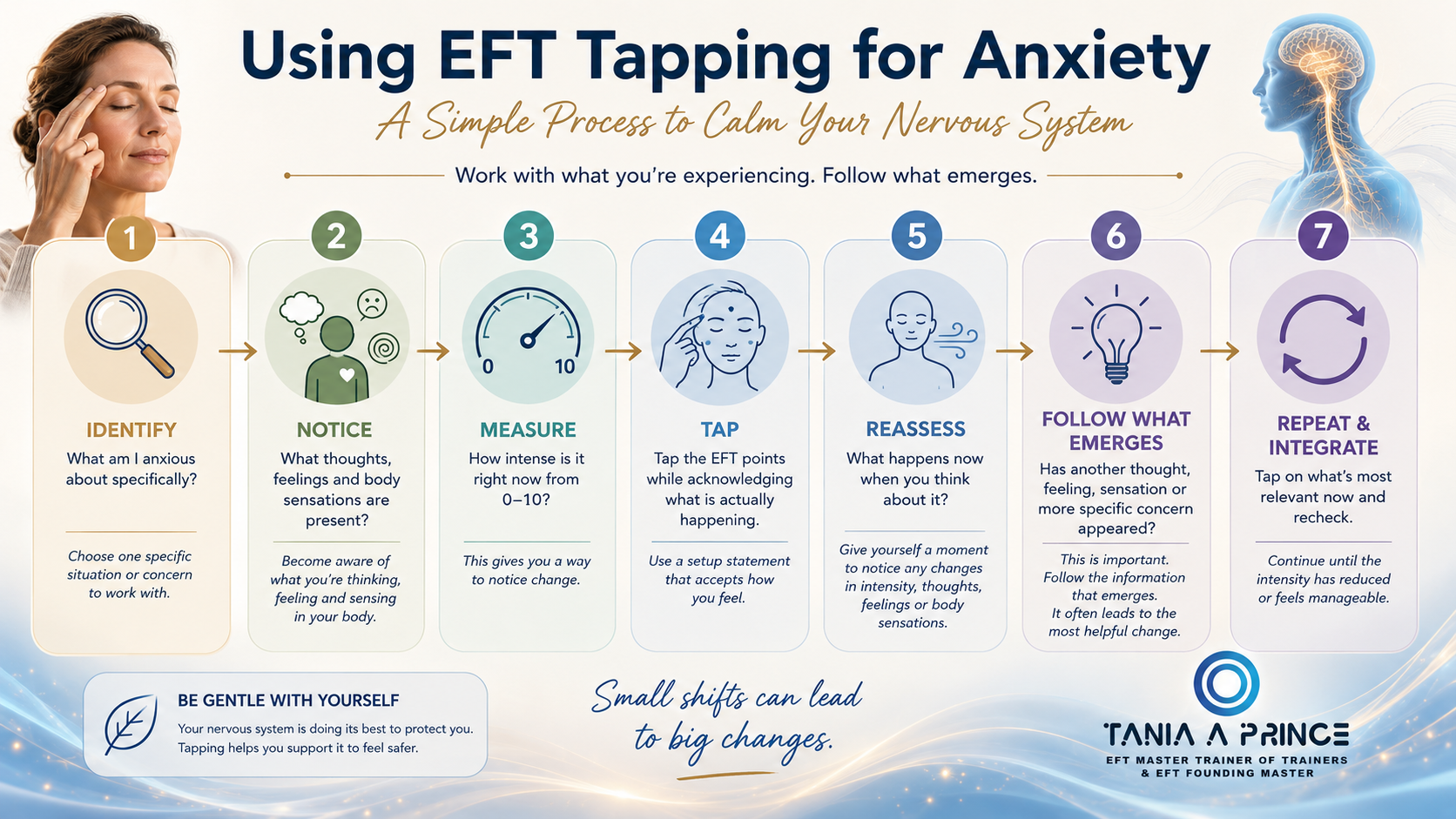
Then:
- Identify exactly what you’re anxious about.
- Notice what happens in your thoughts and body when you think about it.
- Rate the intensity from 0–10 if that feels useful.
- Create an EFT setup statement that acknowledges what you’re experiencing.
- Tap through the EFT points while staying connected with the issue.
- Notice any changes in thoughts, emotions or physical sensations.
- Introduce gentle bridging statements if appropriate.
- Reassess the original problem.
- Follow anything more specific that emerges.
You aren’t trying to force yourself to feel differently.
You’re creating an opportunity to notice what happens when you bring focused attention to the anxiety while tapping.
Sometimes the intensity may change.
Sometimes what emerges gives you a clearer understanding of what you are actually responding to.
Both are useful information.
Frequently Asked Questions About EFT Tapping for Anxiety
How do you use EFT tapping for anxiety?
Start by identifying something specific that is making you anxious. Notice the thoughts, emotions and physical sensations associated with it and, if useful, rate the intensity from 0–10. Tap through the EFT points while acknowledging what you are experiencing. After a round or two, pause and notice whether anything has changed.
What should I say when tapping for anxiety?
There isn’t one perfect phrase. Start with words that accurately describe your experience. For example: “Even though I’m anxious about tomorrow’s meeting, I’m acknowledging how I feel.” As you tap, adjust your words if more specific thoughts or feelings emerge.
Can I do EFT tapping by myself?
EFT can be used as a self-help technique for manageable everyday emotional issues. Highly distressing experiences, trauma, or severe or persistent anxiety may be better addressed with appropriate professional support.
How long should I tap for anxiety?
There is no fixed amount of time that everyone needs to tap. Rather than tapping mechanically for a predetermined period, try a round or two and then pause to notice what has changed.
What if EFT tapping doesn’t reduce my anxiety?
Don’t assume you’ve done something wrong. Stop and notice what is happening. Has the feeling changed? Has another thought appeared? Has the anxiety become more specific? Sometimes the information that emerges is as important as an immediate reduction in intensity.
Your Nervous System Isn’t the Enemy
Anxiety can be exhausting, particularly when your response seems disproportionate to what is happening.
But rather than treating your body as the enemy, it can be useful to become curious about what your system is responding to.
EFT tapping provides one practical way of doing this.
Start with the experience you have now.
Be specific.
Tap.
Notice what changes.
And follow what emerges.
That is very different from simply telling yourself:
“I shouldn’t feel anxious.”
About Tania A Prince
Tania A Prince is an EFT Founding Master and EFT International Accredited Master Trainer of Trainers. She has more than three decades of therapeutic experience and extensive experience teaching EFT to practitioners. Tania is also the creator of MBIR™️.
Tania provides professional EFT training as well as information and resources for people interested in understanding EFT in greater depth.
Want to Learn More About EFT?
If you would like to develop a deeper understanding of EFT or train professionally in the approach, explore Tania A Prince’s EFT Practitioner Training and other EFT training resources on this website.
This article is provided for educational purposes and is not intended to diagnose or treat a medical or mental-health condition. EFT should not be used as a substitute for appropriate medical or psychological care. If you are concerned about anxiety, physical symptoms or your mental health, seek advice from an appropriately qualified healthcare professional.
