
EFT for Overthinking: How to Tap When Your Mind Won’t Switch Off
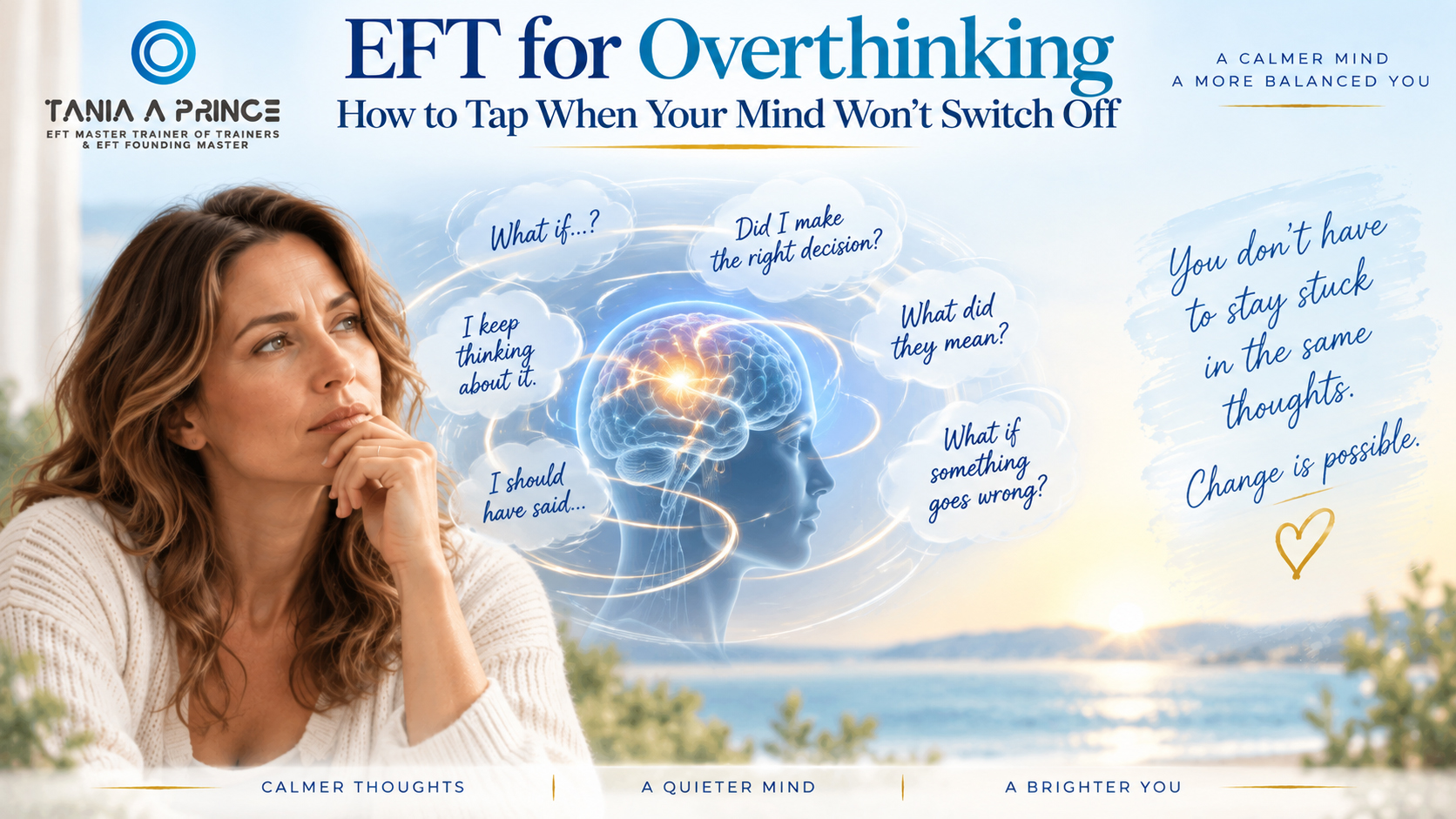
You have thought about the problem.
Then you have thought about it again.
You have considered what might happen, what you should have said, what you could do, what somebody else might think and every possible way the situation could turn out.
And somehow, despite all that thinking, you don’t feel any closer to an answer.
In fact, you may feel worse.
This is one of the frustrating things about overthinking. It can feel as though you are trying to solve a problem, when in reality your mind may be going repeatedly around the same loop.
If anxiety is involved, the thinking can become even more compelling.
What if…?
What if I’ve made a mistake?
What if they misunderstood me?
What if something goes wrong?
What if I can’t cope?
EFT (Emotional Freedom Techniques), commonly known as tapping, offers an interesting way of approaching this.
Instead of trying to force your mind to stop thinking, you can use EFT to become curious about what is driving the thinking.
Because sometimes the overthinking isn’t the real problem.
It is the strategy your mind is using to try to deal with something underneath it.
What Is Overthinking?
Overthinking isn’t a clinical diagnosis.
It is an everyday term we use to describe thinking that has become repetitive, difficult to disengage from and no longer particularly useful.
Researchers use terms such as worry, rumination and repetitive negative thinking to describe related processes.
There is an important distinction between thinking about a problem and becoming caught in a thinking loop.
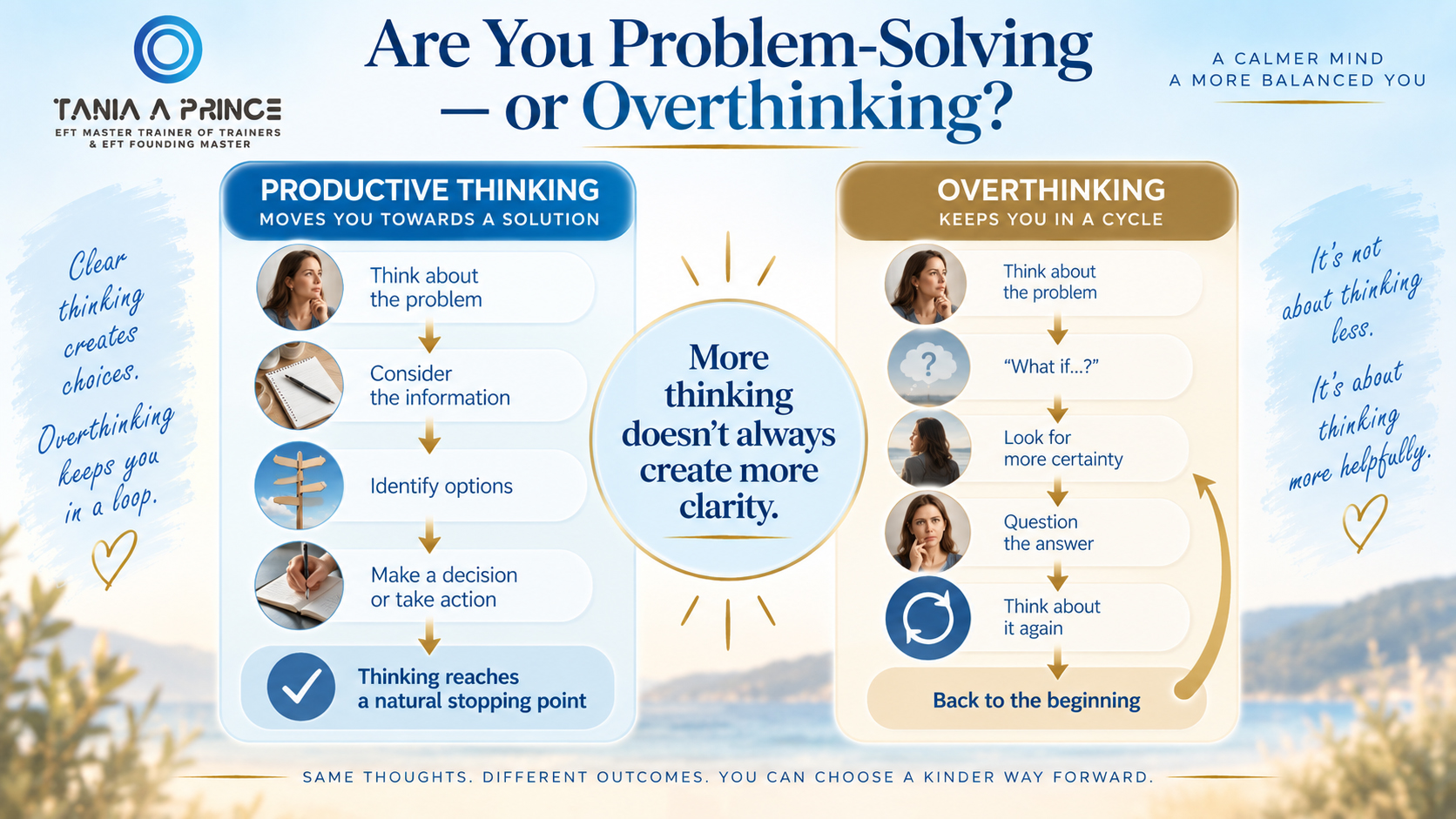
Productive thinking tends to move somewhere.
- You consider the information.
- You make a decision.
- You identify an action.
- You learn something.
- And eventually you stop.
Overthinking can feel very different.
- You return to the same question repeatedly.
- You imagine more possibilities.
- You replay the same conversation.
- You look for certainty that isn’t available.
- You arrive at an answer — and then question the answer.
The thinking continues, but little changes.
Worry and Rumination Aren’t Quite the Same Thing
Although they can overlap, worry and rumination often have different directions.
Worry tends to look forward.
“What if I can’t do it?”
“What if something goes wrong tomorrow?”
“What if they reject my application?”
Rumination often looks backwards.
“Why did I say that?”
“I should have handled it differently.”
“What did they mean when they said that?”
“Why didn’t I notice that at the time?”
Both can become forms of repetitive thinking.
Researchers sometimes bring worry and rumination together under the term perseverative cognition — repeated or sustained mental representations of stressful events, including worries about the future and rumination about the past. Research has associated these processes with prolonged physiological activation as well as psychological distress.
That is important because overthinking isn’t necessarily happening only “in your head.”
Your body may be participating too.
Why Does the Mind Keep Going Back to the Same Thought?
There isn’t one reason.
Sometimes the mind is genuinely trying to solve something.
Sometimes there is uncertainty.
Sometimes there is fear.
Sometimes something happened that doesn’t feel resolved.
Sometimes we are trying to predict every possible outcome because prediction gives us a temporary sense of control.
And sometimes the mind seems to be searching for something impossible:
absolute certainty.
Imagine you send an important email.
There is no reply.
Your mind starts:
“Maybe they’re busy.”
Then:
“Perhaps I said something wrong.”
Then:
“What exactly did I write?”
You reread the email.
For a moment you feel reassured.
Then:
“But maybe that sentence sounded rude.”
Now you are thinking again.
The problem is no longer simply the email.
There may be something underneath the thinking such as:
I’m afraid I’ve upset them.
Or:
I’m worried they’ll reject me.
Or:
I can’t bear not knowing what they think.
That is where EFT can become much more interesting.
Don’t Just Tap on “Overthinking”
You certainly can begin with:
“Even though I’m overthinking this…”
But I wouldn’t necessarily stay there.
Ask:
What am I actually thinking about?
Then:
What am I trying to work out?
And perhaps most importantly:
What am I afraid might happen?
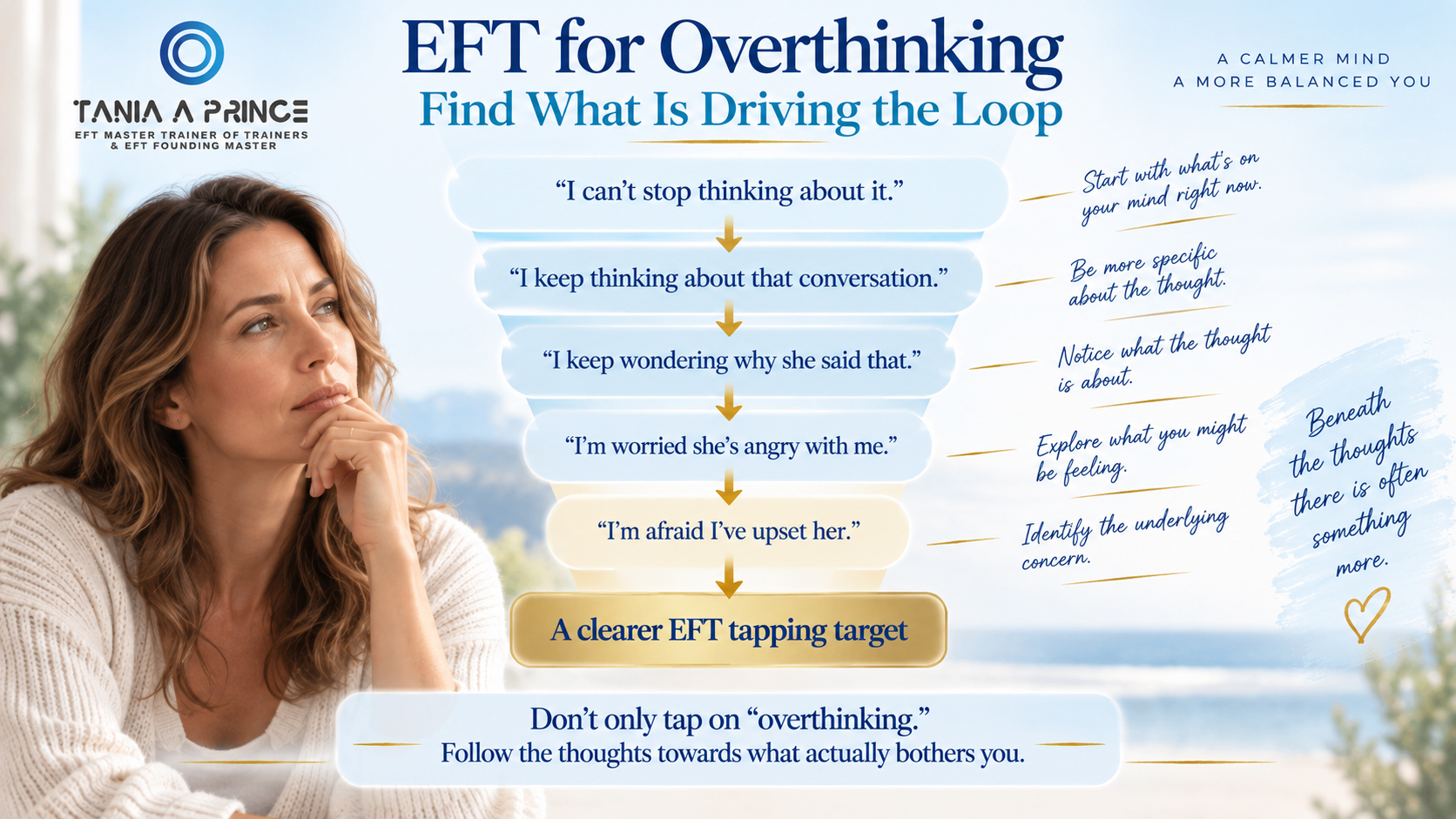
You might begin with:
“I can’t stop thinking about this.”
and discover:
“I keep thinking about the conversation.”
Then:
“I keep wondering why she said that.”
And eventually:
“I’m worried she’s angry with me.”
Now you have something much more specific to work with.
The Thought Beneath the Thoughts
When somebody says, “I can’t stop thinking,” I am interested in the content of the thinking.
Suppose you have a presentation tomorrow.
Your thoughts might sound like:
“What if I forget what I’m saying?”
“What if they ask questions?”
“What if I can’t answer?”
“What if everybody notices I’m nervous?”
It can feel like four different problems.
But perhaps there is a common thread:
“I’m afraid I’m going to look incompetent.”
That may be a much more useful EFT target than:
“I want to stop overthinking.”
Overthinking can sometimes be like a collection of branches.
EFT allows us to become curious about what those branches might be connected to.
How to Use EFT for Overthinking
If your mind is racing now, don’t try to work out the entire problem before you start tapping.
Begin with what is present.
Step 1: Catch One Thought
Ask:
What thought keeps coming back?
Choose one.
For example:
“I’m worried I’ve made the wrong decision.”
Not every thought.
Just one.
Step 2: Notice What Happens When You Think It
Say the thought to yourself.
Then notice your response.
Do you feel anything in your:
- chest?
- stomach?
- throat?
- shoulders?
- face?
Does an image appear?
Does another sentence immediately follow?
Perhaps:
“I’m worried I’ve made the wrong decision”
creates a sinking sensation in your stomach.
That sensation can become part of your tapping target.
If you’d like to understand why anxiety can produce very real bodily sensations, see Why Anxiety Is Felt in the Body.
Step 3: Rate the Intensity
If it is useful, rate the emotional intensity from 0–10.
You are not rating how many thoughts you have.
Rate your reaction to the particular thought you have chosen.
For example:
“I’ve made the wrong decision.” — 7/10
This gives you something clearer to reassess.
Step 4: Create Your Setup Statement
Tap on the side of the hand while acknowledging what is actually happening.
For example:
“Even though I keep thinking I’ve made the wrong decision, and I have this sinking feeling in my stomach, I acknowledge how I feel.”
Or:
“Even though part of me desperately wants to know I’ve made the right decision, I accept that this is where I am right now.”
Or simply:
“Even though my mind keeps going over this conversation, I’m noticing how much this is bothering me.”
The words don’t need to be elegant.
They need to be relevant.
Step 5: Tap on the Actual Thoughts
Now tap through the EFT points using short phrases connected with the problem.
For example:
Eyebrow:
“I’ve made the wrong decision.”
Side of eye:
“What if I’ve got this wrong?”
Under eye:
“I keep going over it.”
Under nose:
“I need to know.”
Chin:
“What if I regret this?”
Collarbone:
“All this uncertainty.”
Under arm:
“I keep trying to work it out.”
Top of head:
“My mind won’t leave it alone.”
You don’t have to use different words at every point.
You could tap an entire round simply saying:
“What if I’ve made the wrong decision?”
The purpose isn’t to perform the words perfectly.
It is to stay connected with the aspect you are working on.
For a guide to the tapping sequence, see EFT Tapping Points for Anxiety.
Step 6: Stop Thinking About Whether the Tapping Worked
This might sound strange in an article about overthinking, but it matters.
After a round, don’t immediately begin another mental analysis:
“Did that work?”
“How much did it work?”
“Was I tapping correctly?”
“Should I have said something different?”
That can simply become another thinking loop.
Instead, pause.
Notice.
What is different?
Perhaps your intensity changes from 7 to 5.
Perhaps the thought feels less convincing.
Perhaps your stomach feels different.
Perhaps you sigh.
Perhaps you suddenly think:
“Actually, I’m not worried about the decision. I’m worried about disappointing my mother.”
That last response is particularly useful.
Something new has emerged.
You can tap on that.
Follow What Changes
One of the skills involved in EFT is learning to follow the response rather than repeatedly performing the same tapping round.
Imagine you begin with:
“What if I’ve made the wrong decision?”
After tapping, that shifts to:
“My dad always told me I made bad decisions.”
That might connect with a specific memory:
“I remember telling him which university I wanted to attend and him saying I hadn’t thought it through.”
Now the work has changed.
You are no longer simply tapping on today’s overthinking.
A previous experience may have become relevant.
That doesn’t mean every episode of overthinking is caused by childhood or that you need to search for an old memory.
It means that if something relevant emerges, notice it.
EFT is often about following what is actually happening rather than imposing a predetermined explanation.
What If You’re Replaying a Conversation?
This is extremely common.
You might find yourself thinking:
“I should have said…”
“Why did she say…?”
“Did I sound stupid?”
“Maybe he thought…”
Rather than tapping on the entire conversation, identify the moment with the greatest emotional charge.
Perhaps it was when somebody’s expression changed.
Or when they said:
“We’ll think about it.”
Or when you walked away and realised what you wished you had said.
Try:
“Even though I keep replaying the moment he said ‘we’ll think about it’…”
Then notice what bothers you about that moment.
Perhaps the real concern is:
“I think he was rejecting my idea.”
Now you have a clearer EFT target.
What If You’re Constantly Thinking About the Future?
Future-oriented overthinking frequently takes the form of:
“What if…?”
What if I don’t sleep tonight?
What if I fail?
What if the meeting goes badly?
What if my child struggles?
What if they say no?
What if I can’t cope?
Your mind can generate an almost unlimited number of possible futures.
Instead of trying to answer every “what if,” choose one feared possibility.
Ask:
What am I actually imagining happening?
If the answer is:
“I imagine myself standing there and completely forgetting what I want to say,”
tap on that imagined moment.
This makes the target concrete.
Our article EFT for Anticipatory Anxiety explores this type of future-focused anxiety in more depth.
What If You’re Trying to Make the Perfect Decision?
Decision-making can become a major source of overthinking.
You consider Option A.
Then Option B.
Then return to A.
You make a list.
You ask somebody.
You search online.
You decide.
Then you reopen the decision.
Sometimes more information genuinely is needed.
But sometimes the problem isn’t lack of information.
It is difficulty tolerating the possibility of making the “wrong” choice.
Try asking:
What would it mean if I made the wrong decision?
You might discover:
“I’ll blame myself.”
“Other people will think I’m stupid.”
“I’ll lose something I can’t get back.”
“I won’t be able to cope with the consequences.”
These are all potential EFT targets.
Overthinking Can Feel Like Protection
It can be helpful not to treat the overthinking part of you as an enemy.
Perhaps it is trying to help.
If I think about every possibility, maybe nothing will surprise me.
If I replay the conversation enough times, maybe I’ll understand what happened.
If I analyse my decision from every angle, perhaps I won’t make a mistake.
If I anticipate everything that could go wrong, perhaps I’ll be prepared.
Seen this way, the thinking may have a positive intention even though the strategy itself has become exhausting.
You might tap:
“Even though part of me believes I have to keep thinking about this…”
Then:
“Maybe this thinking is trying to protect me somehow.”
And:
“Maybe I don’t have to force it to stop.”
That creates a very different relationship with the problem.
Moving From the Problem Towards Possibility
Once the emotional intensity has begun to shift, you may want to introduce bridging or transition language.
I prefer not to jump immediately from:
“I’m terrified I’ve made the wrong decision”
to:
“I know I’ve made the perfect decision.”
If you don’t believe the second statement, it may simply feel false.
Instead, you might move gradually:
“Maybe I don’t have to work everything out right now.”
“Maybe there are some things I can’t know yet.”
“Perhaps I can allow myself to pause.”
“Maybe I can trust myself to respond to whatever happens next.”
“Perhaps I can think about this differently.”
Then, if it feels congruent:
“I choose to give my mind permission to rest for now.”
This transition from acknowledging the problem, through possibility, towards choice can feel much more natural.
A Simple EFT Round for Overthinking
Try this when you notice yourself caught in a thinking loop.
Tap on the side of the hand:
“Even though my mind keeps going over this, and part of me feels as though I have to work it out, I acknowledge how I feel.”
Repeat three times.
Then tap:
Eyebrow:
“My mind keeps going over this.”
Side of eye:
“I keep trying to find the answer.”
Under eye:
“All these thoughts.”
Under nose:
“What if I get it wrong?”
Chin:
“Part of me doesn’t want to let this go.”
Collarbone:
“Maybe it’s trying to keep me safe.”
Under arm:
“Maybe I don’t have to solve everything right now.”
Top of head:
“Perhaps I can give myself permission to pause.”
Stop.
Notice what happens.
Then tap on what is there now, rather than automatically repeating the same round.
Is There Research on EFT for Overthinking?
At present, it would be misleading to say there is strong research specifically demonstrating that EFT treats “overthinking” as a distinct problem.
Most EFT research has investigated outcomes such as anxiety, stress, depression and related psychological symptoms.
A 2025 systematic review examined seven randomised controlled trials involving 506 participants in which EFT was used as a standalone intervention for anxiety symptoms. The studies comparing EFT with no intervention favoured EFT, while comparisons with active treatments were more mixed. The authors concluded that EFT appears promising but highlighted methodological limitations and the need for higher-quality trials.
More recently, a 2026 systematic review and network meta-analysis examining Clinical EFT for stress included 17 randomised controlled trials. It reported reductions in psychological stress and a smaller effect on physiological stress compared with control conditions, while again noting that many included studies had some concerns or a high risk of bias.
Separately, research on repetitive negative thinking suggests that worry and rumination can be associated with prolonged physiological activity. A meta-analysis of 60 studies found associations between perseverative cognition and measures including heart rate, blood pressure, cortisol and heart-rate variability.
So there are interesting reasons to explore EFT in the context of worry and overthinking, but we shouldn’t claim that research has established EFT as a specific treatment for overthinking when that question has not yet been adequately studied.
When Overthinking Is Telling You Something
Not all repetitive thinking should simply be eliminated.
Sometimes you really do need to make a decision.
Sometimes there is a problem requiring action.
Sometimes a conversation needs to happen.
Sometimes you need more information.
A useful question is:
Is this thinking helping me move towards something, or am I repeatedly travelling over the same ground?
If there is a practical action available, take it.
If there isn’t, EFT can provide a way of exploring the emotional response that may be keeping the thinking active.
When to Get Professional Help
Persistent worry, rumination and repetitive thoughts can occur alongside anxiety disorders, depression, obsessive-compulsive disorder and other difficulties.
If your thoughts are causing significant distress, interfering with sleep or everyday life, feel uncontrollable, or involve intrusive material that frightens you, seek appropriate professional support.
EFT self-help shouldn’t be used as a substitute for appropriate psychological or medical care.
Learning EFT Beyond a Tapping Script
Knowing the tapping points is useful.
But some of the real skill in EFT lies in knowing what to tap on.
Is the target:
- the repetitive thought?
- the feared consequence?
- the bodily sensation?
- an imagined future event?
- a specific memory?
- the meaning you have attached to what happened?
Learning how to differentiate these aspects can make EFT much more precise.
I am an EFT Founding Master and EFT International Accredited Master Trainer of Trainers, and this is something I teach within my EFT Practitioner Training.
The goal isn’t simply to collect more tapping scripts.
It is to understand how to listen to what is happening and work with it.
Where to Go Next
If overthinking is part of a wider pattern of anxiety, begin with EFT Tapping for Anxiety: Understanding Anxiety and Calming the Nervous System.
You may also find these articles useful:
- How to Use EFT When You Feel Anxious
- Why Anxiety Is Felt in the Body
- EFT for Anticipatory Anxiety
- EFT for Social Anxiety
- EFT for Fear and Panic
- EFT for Work-Related Anxiety
- EFT for Feeling Overwhelmed
- Can EFT Help Calm the Nervous System?
- What to Say While Tapping for Anxiety
- EFT Tapping Script for Anxiety
And if you find yourself overthinking today, you don’t necessarily have to make your mind go blank.
Start with one thought.
Ask yourself:
What about this thought bothers me?
Tap on that.
Then notice what happens next.
