
Why Anxiety Is Felt in the Body
Anxiety can begin with a thought, but it often doesn’t feel like a thought.
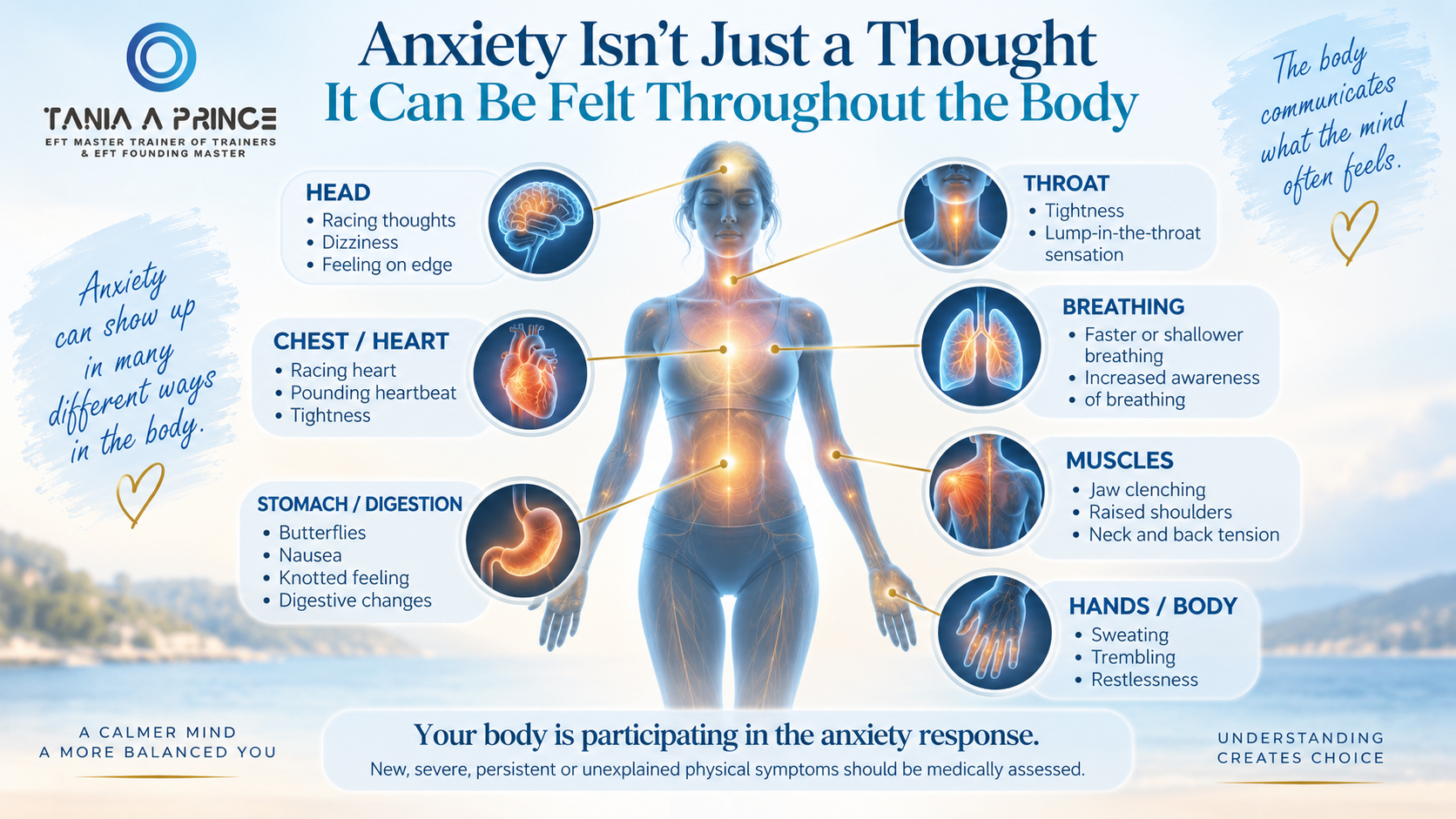
It can feel like a racing heart.
A tight chest.
Butterflies or nausea in your stomach.
Tension across your shoulders.
A lump in your throat.
Shaky hands.
Restlessness.
A sense that you cannot quite take a satisfying breath.
Or simply an uncomfortable feeling in your body that tells you something isn’t right.
For some people, these physical sensations are actually the first indication that they are anxious. They may notice their heart pounding or their stomach tightening before they have consciously recognised what they are worried about.
This can be confusing.
But anxiety is not purely a thinking process. It involves an ongoing interaction between the brain, body and nervous system.
Understanding this can change the way you respond to anxiety.
Instead of thinking, Why is my body doing this?, you can begin to recognise that your body may be responding to something it perceives as important, uncertain or potentially threatening.
Anxiety Is a Whole-Body Response
We often talk about anxiety as though it exists entirely inside the mind.
In reality, emotions involve the body too.
When your brain detects or anticipates something potentially threatening, physiological systems can begin preparing you to respond.
This may involve changes in:
- heart rate
- breathing
- muscle tension
- sweating
- digestion
- attention and alertness
- bodily arousal
Physical symptoms such as increased heart rate, sweating, difficulty breathing, restlessness and muscle tension are well recognised in anxiety.
So if you experience anxiety physically, you are not imagining the sensations.
The sensations themselves are real physiological experiences.
The question is why your system is producing them.
Your Nervous System Is Constantly Assessing What Is Happening
Your nervous system is continually responding to information coming from both outside and inside your body.
Much of this happens automatically.
You don’t consciously instruct your heart to beat faster when you become frightened.
You don’t deliberately tense your muscles when something startles you.
And you don’t have to consciously decide to become more alert when you hear an unexpected noise behind you.
These responses can happen extremely quickly.
The body’s autonomic nervous system plays an important role in regulating functions such as heart rate, breathing and digestion.
When a potential challenge or threat is detected, sympathetic nervous-system activity can contribute to the physiological arousal associated with preparing the body for action. Anxiety itself is associated with both attention towards potential threat and complex physiological arousal.
This is part of the reason anxiety can feel so physical.
Your body isn’t merely accompanying your anxious thoughts.
It is participating in the response.
The Threat Doesn’t Have to Be Happening Right Now
There is another important piece of the puzzle.
You don’t necessarily need to be in immediate physical danger for your body to respond.
Consider what happens when you think about:
- tomorrow’s presentation,
- an upcoming medical appointment,
- a difficult conversation,
- an exam,
- getting on an aeroplane,
- meeting unfamiliar people,
- or something you are afraid might happen several months from now.
Nothing dangerous may be occurring in the room where you are sitting.
Yet your heart can accelerate.
Your stomach can tighten.
Your breathing can change.
Your muscles can tense.
Your body can respond to the anticipated situation.
This is particularly relevant to anxiety because anxiety frequently involves uncertainty and predictions about what could happen next.
The mind can effectively bring the future into the present.
Why Does Your Heart Beat Faster When You’re Anxious?
One of the most noticeable physical sensations associated with anxiety is a change in heartbeat.
When your system prepares for action, cardiovascular activity can change.
You may experience:
“My heart is pounding.”
“I can feel my heartbeat.”
“My heart suddenly seems very fast.”
Once you notice this sensation, something else can happen.
You may become anxious about the sensation itself.
For example:
“My heart is racing.”
can become:
“Why is my heart racing?”
which becomes:
“What if something is wrong?”
which creates more anxiety.
This can potentially increase physiological arousal further.
The result can become a feedback loop between sensation, interpretation and anxiety.
Why Anxiety Can Affect Your Breathing
Breathing and anxiety are closely connected.
Research has identified relationships between anxiety and changes in breathing, the perception of breathing and responses to respiratory sensations.
When anxious, some people notice that their breathing becomes quicker or shallower.
Others become very aware of their breathing.
They may feel:
“I can’t get a proper breath.”
“I need to take a deep breath.”
“My chest feels tight.”
“I’m thinking about every breath.”
Again, the interpretation of the sensation matters.
If you notice an unusual breathing sensation and interpret it as dangerous, the fear generated by that interpretation may intensify your experience.
This is one reason it can be helpful to understand what is happening rather than immediately becoming frightened by every physical change.
However, new, severe or unexplained breathing difficulties should not automatically be attributed to anxiety. Appropriate medical assessment is important where symptoms are concerning.
Why Anxiety Can Be Felt in the Stomach
The digestive system and nervous system communicate extensively.
Many people know this intuitively.
We talk about having:
- butterflies in the stomach
- a gut feeling
- or feeling sick with worry.
During anxiety you might experience:
- butterflies
- nausea
- a knotted sensation
- changes in appetite
- abdominal discomfort
- an urge to go to the toilet
These experiences are another reminder that emotional states aren’t isolated inside the brain.
Your internal bodily state forms part of your emotional experience.
Why Your Muscles Become Tight
Anxiety can also show up as muscular tension.
You might notice yourself:
- clenching your jaw,
- lifting your shoulders,
- tightening your stomach,
- curling your toes,
- clenching your hands,
- or holding tension across your neck and back.
Sometimes people have been doing this for so long that they don’t consciously recognise it.
Imagine that your body believes it may need to deal with something difficult.
Preparing the muscles for action makes sense.
The problem occurs when that readiness continues even though no physical action is required.
You may be sitting at a computer worrying about an email while your body is behaving as though it needs to prepare for something much more immediate.
Your Brain Also Listens to Your Body
Communication does not simply travel in one direction from the brain to the body.
Your brain is also continually receiving and interpreting information from within your body.
The term interoception describes processes involved in sensing and interpreting the internal physiological state of the body. Contemporary definitions encompass sensing, interpreting, integrating, regulating and predicting internal bodily information.
This includes information associated with things such as:
- heartbeat,
- breathing,
- temperature,
- muscle tension,
- pain,
- hunger,
- and gastrointestinal sensations.
This body-to-brain communication is highly relevant to understanding anxiety.
A major 2024 meta-analysis involving 71 studies found that anxiety was associated with greater negative evaluation of bodily signals, greater reported frequency and sensitivity to those signals, and increased negative attention towards them. Importantly, research into interoception and anxiety is complex: objective heartbeat-detection accuracy, for example, does not show the same straightforward relationship.
In other words, the relationship isn’t simply:
anxious people are better at detecting their heartbeat.
How bodily sensations are noticed, attended to and interpreted appears to matter too.
When the Sensation Itself Becomes Frightening
This can help explain something particularly important in anxiety and panic.
Imagine that you notice:
a flutter in your chest.
One person might think:
“That’s interesting.”
Another might think:
“Something is seriously wrong.”
The physical sensation may initially be similar.
But the meaning assigned to it can dramatically change the emotional response.
This is sometimes described in relation to anxiety sensitivity — fear about anxiety-related bodily sensations and what they might mean.
Research on panic has examined how fear of bodily sensations can amplify anxious arousal.
A cycle can develop:
I notice a sensation
↓
I interpret it as threatening
↓
I become more anxious
↓
my physiological arousal increases
↓
I notice more sensations
↓
those sensations appear to confirm that something is wrong
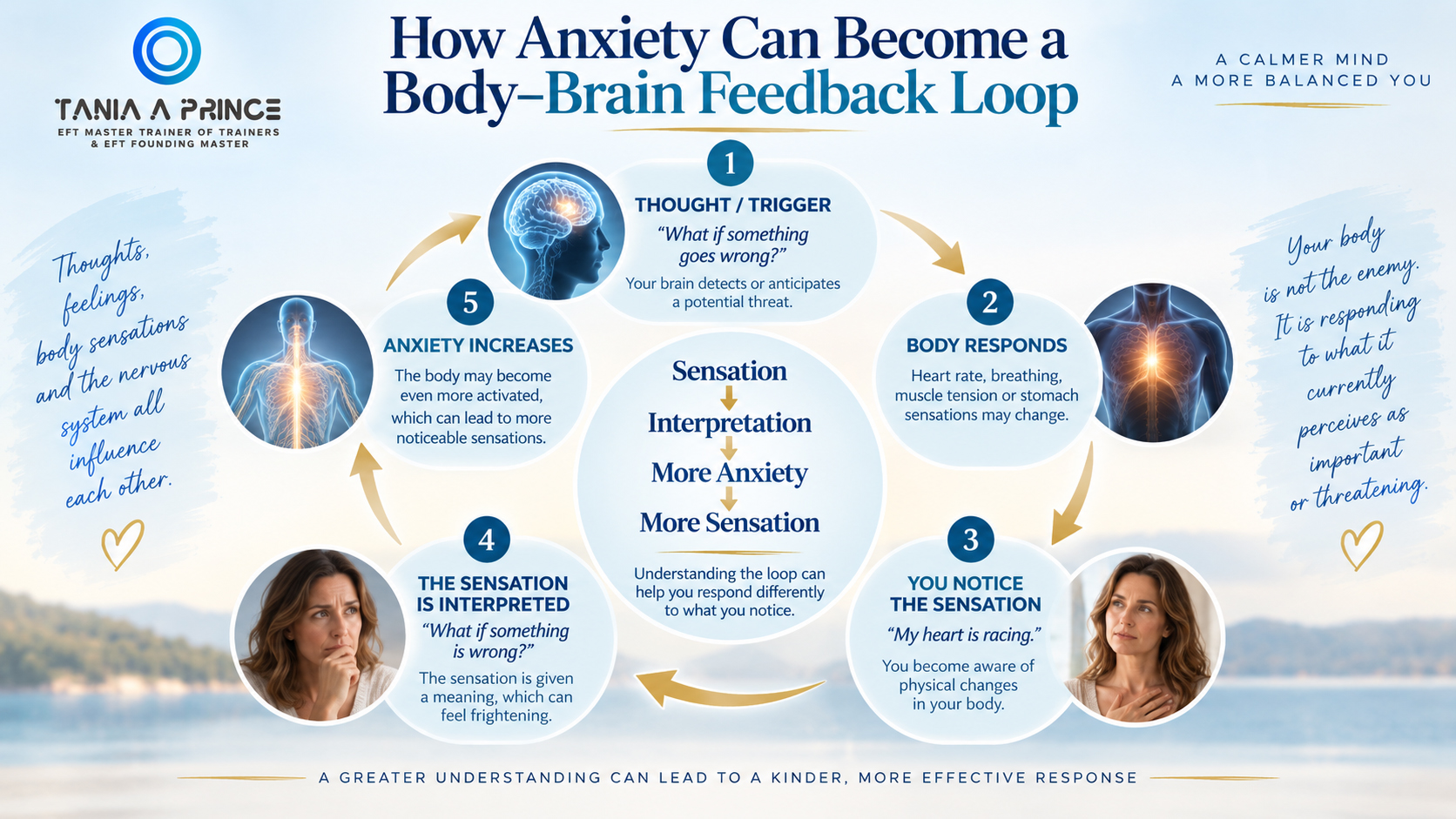
Understanding that loop can itself be useful.
Sometimes the Body Seems to React Before the Conscious Mind
People sometimes say:
“I don’t know what I’m anxious about. My body just feels anxious.”
That experience deserves attention.
Not every emotional response begins with a clearly articulated conscious thought.
The systems involved in detecting and responding to potential threat operate at multiple levels, and our awareness of bodily changes and their causes isn’t always immediate.
Sometimes you become aware of:
- a tight chest,
- an uneasy stomach,
- a change in breathing,
- or a feeling of agitation
before you can put the experience into words.
Rather than immediately trying to make the sensation disappear, it can be useful to become curious about it.
- What am I noticing?
- Where do I feel it?
- When did I first notice it?
- What was happening just before it started?
- What had I been thinking about?
- Does anything come to mind when I focus on this feeling?
These questions can sometimes reveal a much more specific concern.
Why “Just Stop Worrying” Often Doesn’t Work
If anxiety involved only conscious thinking, it might be relatively easy to talk yourself out of it.
You could simply say:
“There’s nothing to worry about.”
And your body would immediately relax.
But many people know that isn’t what happens.
You can logically know that something is unlikely while still experiencing anxiety about it.
You can know that flying is statistically safe and still become anxious before boarding an aeroplane.
You can know that you have prepared thoroughly for a presentation and still feel your stomach tighten before speaking.
You can know that a social situation isn’t dangerous while your body reacts as though something important is at stake.
Logical reassurance can certainly help.
But the physical component of anxiety helps explain why logic alone isn’t always enough.
The Body Isn’t the Enemy
When anxiety feels unpleasant, it is understandable to want the sensations to stop.
But it can be useful to shift the way you think about what your body is doing.
Instead of:
“My body is going wrong.”
you might consider:
“My system is responding to something it currently perceives as important or threatening.”
That doesn’t mean the perceived danger is actually present.
It means there may be a response worth becoming curious about.
That distinction can change the starting point.
Rather than fighting your body, you can begin exploring the response.
Where EFT Tapping Fits In
This is one reason I find EFT (Emotional Freedom Techniques) particularly interesting when working with anxiety.
EFT isn’t simply about repeating positive statements.
During EFT, we deliberately bring attention to an aspect of the problem while tapping on a sequence of points on the face and upper body.
That might involve noticing:
the thought
“I’m going to make a fool of myself.”
the image
seeing yourself standing in front of an audience.
the emotion
fear.
the physical sensation
tightness in your stomach.
Or some combination of these.
Instead of insisting:
“I’m calm. Everything is fine.”
when that isn’t what you actually feel, EFT allows you to begin with your present experience.
For example:
“Even though I have this tight feeling in my stomach when I think about tomorrow’s meeting…”
The physical sensation becomes useful information rather than something you have to immediately suppress.
Can EFT Affect Anxiety?
Research into EFT continues to develop.
A systematic review published in 2025 examined seven randomised controlled trials involving 506 participants in which EFT was used as a standalone intervention for anxiety symptoms. All six studies comparing EFT with no intervention reported significant reductions favouring EFT. Comparisons with active treatments produced more mixed results; EFT showed similar or better outcomes than breathing therapy and progressive muscle relaxation in the included studies, while there was no significant difference from CBT. The reviewers also highlighted methodological limitations and risk-of-bias concerns, so stronger research is still needed.
That is a more useful way to describe the evidence than claiming that tapping simply “switches off” the nervous system.
The science of anxiety — and the mechanisms through which EFT may exert its effects — is considerably more complex.
Using the Body as Information When You Tap
If you feel anxiety physically, try not to see the bodily sensation as an inconvenience that needs to be ignored.
It can become part of your EFT work.
Suppose you are anxious about travelling.
You notice:
“There’s a tight band across my chest.”
You could begin there.
Or perhaps you notice:
“My stomach drops when I picture getting on the plane.”
That is more specific.
Perhaps while tapping you realise:
“It’s actually the moment they close the aircraft door that bothers me.”
Now you have an even clearer target.
This is one of the reasons I encourage people to notice what changes as they tap rather than simply repeating a generic phrase such as “this anxiety.”
Your body can provide feedback.
For practical instructions, read How to Use EFT When You Feel Anxious.
Anxiety Can Involve Thoughts, Feelings, Images and Sensations
Rather than separating anxiety into “mental” versus “physical,” it may be more useful to recognise the interaction between:
Thoughts
“What if something goes wrong?”
Images
Imagining the feared event.
Emotions
Fear, apprehension or dread.
Physical sensations
Tightness, butterflies, heat, trembling or changes in breathing.
Attention
Becoming increasingly focused on signs of possible danger.
These can influence one another.
And that gives us several possible places to begin when using EFT.
What If You Feel Anxious but Don’t Know Why?
Start with what you do know.
You don’t have to manufacture an explanation.
If all you know is:
“I have this strange feeling in my stomach.”
begin there.
For example:
“Even though I don’t know what this is about, I notice this uncomfortable feeling in my stomach.”
Then tap.
Notice what happens.
Perhaps nothing immediately changes.
Perhaps the sensation reduces.
Perhaps another emotion appears.
Perhaps a thought comes into your awareness.
Perhaps you suddenly remember what you were thinking about when the feeling started.
That information can become the next focus of your tapping.
The process is one of noticing and following rather than forcing.
When Physical Symptoms Should Be Checked Medically
It is important not to assume that every physical symptom is caused by anxiety.
Chest pain, breathlessness, heart palpitations, dizziness, gastrointestinal symptoms and other physical sensations can have many causes.
If a symptom is new, severe, persistent, unexplained or concerning, seek appropriate medical advice.
EFT should not be used as a way of avoiding necessary medical assessment.
Once appropriate medical causes have been considered, understanding the relationship between anxiety and physical sensations can make those experiences considerably less mysterious.
Learning to Work With Anxiety Rather Than Fighting It
One of the most useful shifts can be moving from:
“How do I make this feeling disappear?”
towards:
“What is happening in my system right now?”
That gives you somewhere to begin.
Notice the thought.
Notice the image.
Notice the physical sensation.
Notice what your mind predicts might happen.
Then work with what is actually present.
If you’d like to try this practically, continue with How to Use EFT When You Feel Anxious, where I take you through the process step by step.
Continue Exploring EFT and Anxiety
This article forms part of my wider series on EFT tapping for anxiety.
You may also find these articles useful:
- EFT Tapping for Anxiety: Understanding Anxiety and Calming the Nervous System
- How to Use EFT When You Feel Anxious
- EFT Tapping Points for Anxiety
- EFT for Overthinking
- EFT for Anticipatory Anxiety
- EFT for Social Anxiety
- EFT for Fear and Panic
- EFT for Work-Related Anxiety
- EFT for Feeling Overwhelmed
- Can EFT Help Calm the Nervous System?
- What to Say While Tapping for Anxiety
- EFT Tapping Script for Anxiety
If you want to move beyond self-help and learn how to work with EFT systematically, you can also explore my EFT Practitioner Training.
I am an EFT Founding Master and EFT International Accredited Master Trainer of Trainers, and my professional EFT training teaches not simply where to tap, but how to identify and work with the different aspects underlying an emotional response.
Research Referenced
The article is grounded particularly in recent work on interoception and anxiety, including a 2024 eClinicalMedicine review and a 2024 systematic review/meta-analysis of 71 studies, as well as the 2025 systematic review of randomised controlled trials of EFT for anxiety.
