
How to Use EFT When You Feel Anxious
Anxiety can arrive in many different ways.
You might notice a tight feeling in your chest, butterflies in your stomach, a racing heart or tension in your shoulders. Your thoughts may speed up. You may find yourself imagining everything that could go wrong, replaying conversations or struggling to concentrate on anything else.
Sometimes you know exactly why you feel anxious.
At other times, you simply notice that your body feels unsettled.
EFT (Emotional Freedom Techniques), commonly known as tapping, is a practical technique that you can use when anxiety arises. It combines focusing on what you are experiencing with tapping gently on a sequence of points on the face and upper body.
Rather than trying to force yourself to stop feeling anxious, EFT gives you a structured way to acknowledge what is happening and work with your response.
In this article, I’ll take you through a simple way to begin using EFT when you feel anxious.
What Happens When You Feel Anxious?
Anxiety isn’t only something that happens in your thoughts.
It is also experienced in the body.
When your brain and nervous system detect a potential threat, your body can begin preparing you to respond. Your heart rate may increase, your breathing can change and your muscles may become more tense and ready for action.
This response can be extremely useful when there is a genuine immediate danger.
The difficulty is that the same protective systems can become activated by situations that aren’t physically dangerous.
An upcoming meeting.
A difficult conversation.
Waiting for test results.
Travelling somewhere unfamiliar.
Thinking about something that might happen next week.
Even imagining a future situation can sometimes trigger a very real physical response in the present.
This is why telling yourself to “stop worrying” isn’t always particularly helpful.
Your conscious mind may know that you are safe while another part of your system is responding as though something needs your attention.
For a deeper explanation, read EFT Tapping for Anxiety: Understanding Anxiety and Calming the Nervous System.
How Can EFT Help When You Feel Anxious?
EFT gives you something practical to do with the anxiety you are experiencing.
Instead of immediately trying to get rid of the feeling, begin by noticing it.
Where do you feel the anxiety?
What thoughts are accompanying it?
What are you imagining might happen?
What feels threatening, uncomfortable or uncertain?
EFT works particularly well when you become specific about what you are experiencing rather than simply tapping on the broad statement:
“I have anxiety.”
For example, you might notice:
“I have this tight feeling in my chest when I think about tomorrow’s meeting.”
Or:
“I’m worried that I’ll make a mistake.”
Or:
“I keep imagining them judging me.”
Or simply:
“I don’t know why, but I have this uneasy feeling in my stomach.”
These statements give you something more specific to work with.
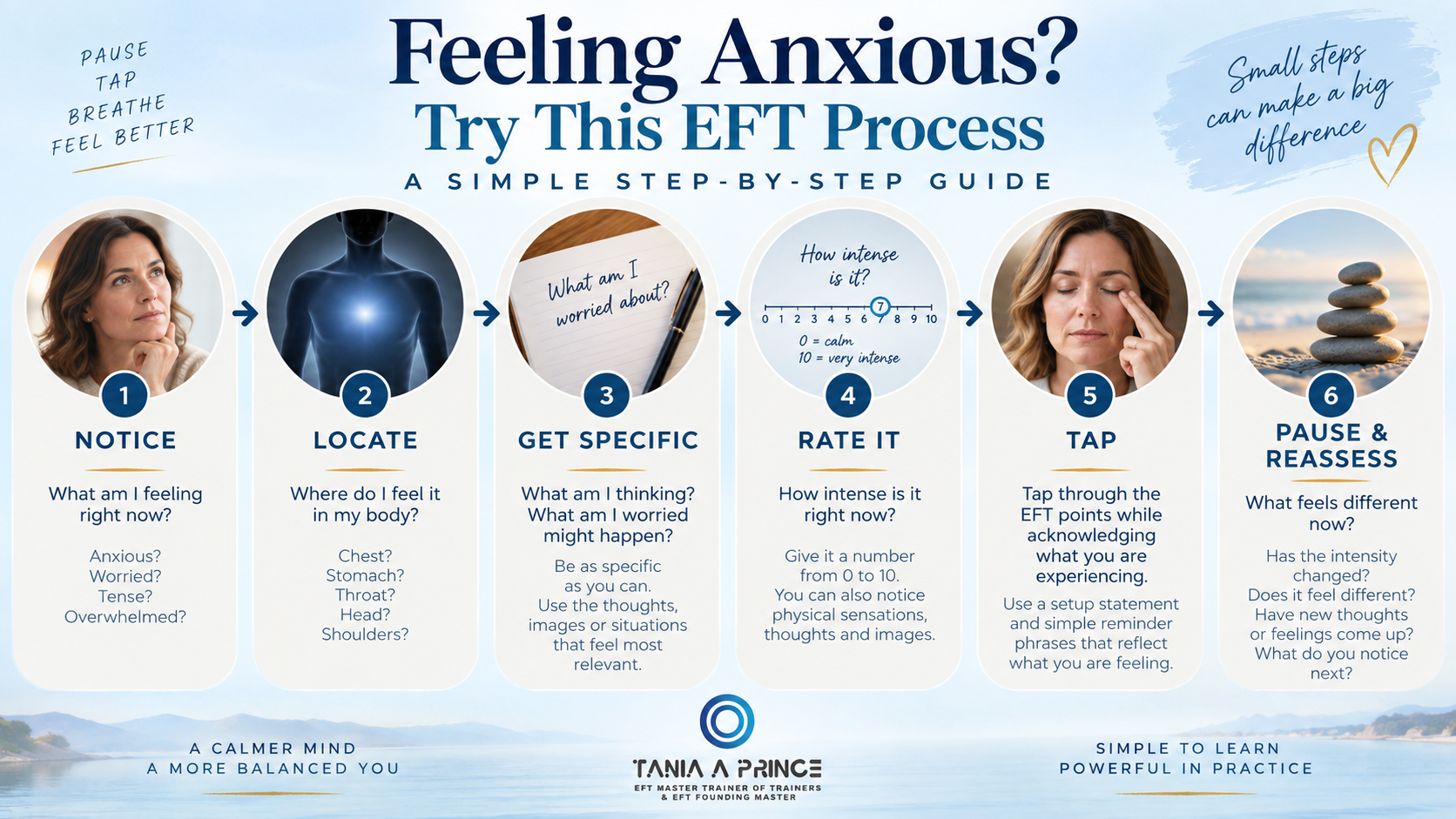
Step 1: Notice What Is Happening Right Now
Before you begin tapping, take a moment to notice your current experience.
You don’t need to analyse it extensively.
Just become curious.
You might ask yourself:
- What am I feeling right now?
- Where do I feel it in my body?
- What was I thinking about immediately before I noticed the anxiety?
- What am I worried might happen?
Your answer might be surprisingly simple:
“I have a knot in my stomach.”
“My chest feels tight.”
“I keep thinking something will go wrong.”
“I’m worried I’ll embarrass myself.”
“I don’t know what I’m anxious about. I just feel on edge.”
All of these are perfectly reasonable starting points for EFT.
Step 2: Give the Anxiety a Number
Before tapping, you can give the intensity of what you are experiencing a number from 0 to 10.
Zero means there is no emotional intensity around the issue.
Ten represents the strongest intensity you can imagine.
For example:
Anxiety about tomorrow’s presentation: 7/10
The number isn’t a test and it doesn’t have to be exact.
It simply gives you a reference point so that you can notice whether anything changes while you tap.
You can also pay attention to physical sensations, thoughts and images because change doesn’t always show up as a dramatic reduction in a number.
Sometimes the first thing you notice is that your breathing feels easier.
Sometimes the feeling moves.
Sometimes a thought that seemed overwhelming suddenly feels less important.
Sometimes another memory or concern comes into awareness.
All of these can provide useful information about what to tap on next.
Step 3: Create an EFT Setup Statement
Traditional EFT commonly begins by tapping on the side-of-the-hand point while repeating a setup statement.
A simple structure is:
“Even though I have this [feeling/problem], I deeply and completely accept myself.”
For example:
“Even though I have this anxious feeling in my stomach when I think about tomorrow, I deeply and completely accept myself.”
You don’t have to use those exact words.
The important part is that your statement reflects what is actually happening for you.
You might prefer:
“Even though I’m really anxious about this meeting, I accept that this is how I feel right now.”
Or:
“Even though part of me thinks something is going to go wrong, I acknowledge how anxious I feel.”
Or:
“Even though I don’t know why I feel anxious, I can feel this tension in my body right now.”
Use language that feels natural rather than trying to find the “perfect” EFT phrase.
Step 4: Tap Through the EFT Points
After your setup statement, gently tap through the standard EFT tapping points.
These commonly include:
- Eyebrow
- Side of the eye
- Under the eye
- Under the nose
- Chin
- Collarbone
- Under the arm
- Top of the head
As you move through the points, use short reminder phrases connected with what you are experiencing.
For example:
Eyebrow:
“This anxiety.”
Side of eye:
“All this tension.”
Under eye:
“This feeling in my stomach.”
Under nose:
“I’m worried about tomorrow.”
Chin:
“Part of me thinks something will go wrong.”
Collarbone:
“All this anxiety.”
Under arm:
“My body feels so tense.”
Top of head:
“This anxious feeling.”
You don’t need to say something different at every tapping point.
Repeating the same phrase is fine.
The words are there to help you stay connected with the issue you are addressing.
For more detail about where the points are located, see EFT Tapping Points for Anxiety.
Step 5: Stop and Notice What Has Changed
After one or two rounds, stop tapping.
Take a moment.
Notice your body.
Notice your thoughts.
Then ask yourself:
What is happening now?
If you began at 7/10, perhaps the anxiety is now 5/10.
Or it may still be 7/10 but feel different.
Perhaps the knot in your stomach has reduced but you have become aware of tension in your throat.
Perhaps you suddenly realise:
“It’s not actually the meeting I’m worried about. I’m worried my manager will criticise me.”
That is valuable information.
You now have something more specific to tap on.
For example:
“Even though I’m worried my manager will criticise me…”
EFT often develops in this way.
You begin with what you consciously know and then follow what emerges.
You Don’t Have to Make the Anxiety Disappear
One mistake people sometimes make when using EFT for anxiety is constantly checking:
“Has it gone yet?”
That can turn tapping into another battle with the feeling.
Instead, approach the process with curiosity.
You might think:
“This is what my system is doing right now. Let’s see what happens when I tap.”
Sometimes the intensity reduces quickly.
Sometimes it changes gradually.
Sometimes tapping reveals that the anxiety is connected with something more specific that needs attention.
The goal isn’t to force yourself into feeling calm.
It is to work with what is actually happening.
What If You Don’t Know Why You’re Anxious?
You don’t have to know.
Start with what you can observe.
For example:
“Even though I don’t know why I feel anxious, I have this tight feeling in my chest.”
Then tap using simple reminder phrases:
“This tight feeling.”
“This anxiety.”
“This tension in my chest.”
“I don’t know what this is about.”
As you tap, you may notice thoughts, memories or associations appearing.
You can then decide whether you want to work with those.
What If Your Mind Won’t Stop Thinking?
Anxiety and repetitive thinking frequently occur together.
You might find yourself repeatedly asking:
“What if this happens?”
“What if I can’t cope?”
“What if I’ve made the wrong decision?”
“What if they don’t like me?”
“What if something goes wrong?”
Rather than trying to stop the thoughts, you can use them as tapping material.
For example:
“Even though I keep thinking something is going to go wrong…”
Or:
“Even though my mind keeps running through everything that could happen…”
Then tap on the actual thoughts.
If repetitive thinking is a major part of your anxiety, you may also find EFT for Overthinking helpful.
Using EFT for Anxiety About Something That Hasn’t Happened Yet
A great deal of anxiety is anticipatory.
The event hasn’t happened yet, but your mind is already experiencing possible versions of it.
Imagine that you have to give a presentation next week.
Rather than tapping broadly on:
“I’m anxious about my presentation,”
notice exactly what you imagine when you think about it.
Perhaps you picture yourself forgetting what to say.
Tap on that.
Perhaps you imagine people staring at you.
Tap on that.
Perhaps you imagine someone asking a question you can’t answer.
Tap on that.
Breaking a future event into specific feared moments can give you much more precise targets for EFT.
You can explore this further in EFT for Anticipatory Anxiety.
A Simple EFT Round for Anxiety
If you are feeling anxious now and want something simple to begin with, try this.
Tap on the side of the hand:
“Even though I’m feeling anxious right now, I acknowledge that this is what I’m experiencing.”
Repeat three times.
Then tap through the points:
Eyebrow:
“This anxiety.”
Side of eye:
“All this tension.”
Under eye:
“My body feels anxious.”
Under nose:
“All these anxious thoughts.”
Chin:
“This feeling.”
Collarbone:
“All this tension in my system.”
Under arm:
“I’m noticing it.”
Top of head:
“This anxiety right now.”
Stop.
Notice what you experience.
Then use whatever you notice as the starting point for your next round.
For a longer guided example, see EFT Tapping Script for Anxiety and What to Say While Tapping for Anxiety.
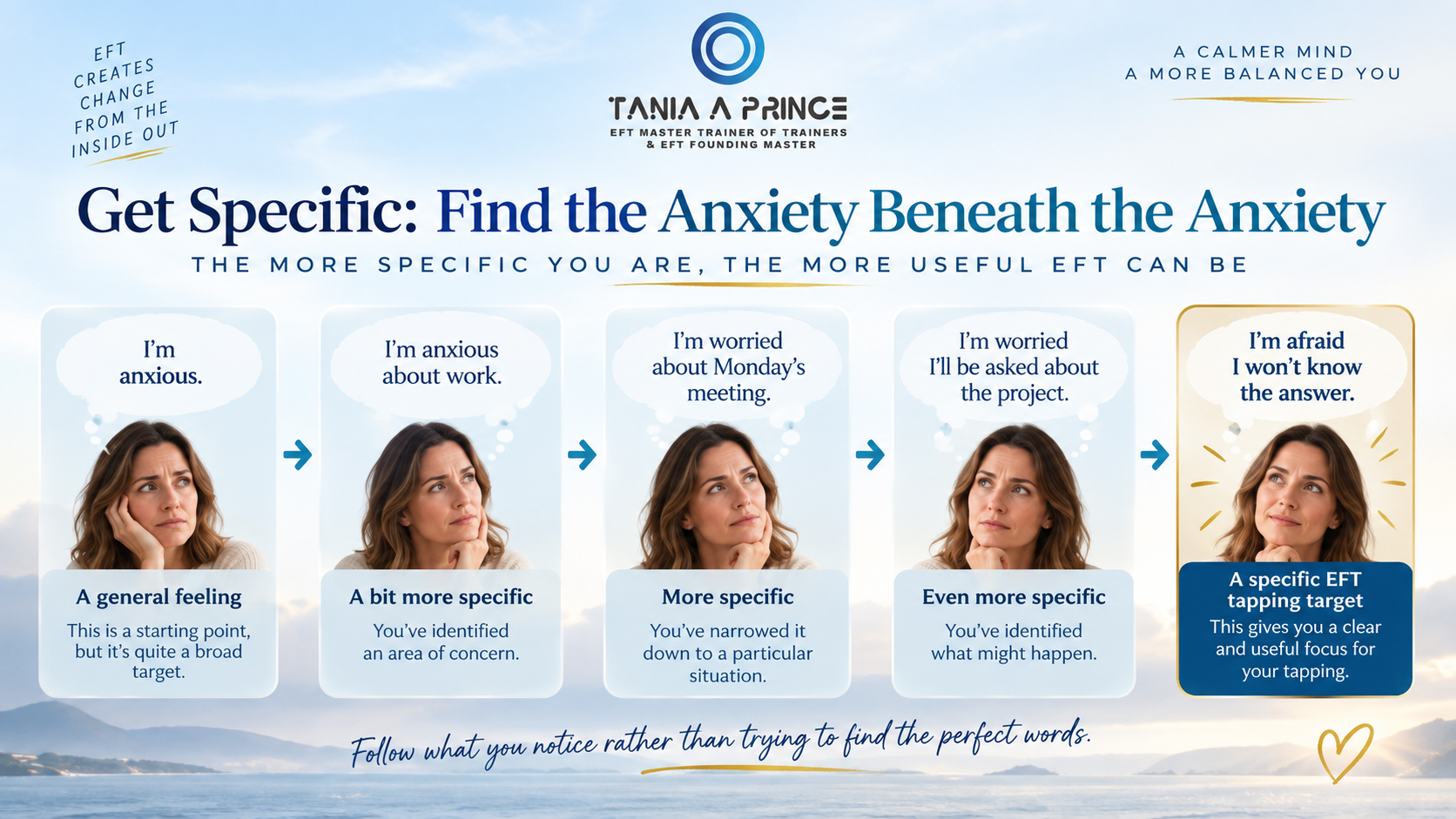
Getting More Specific Can Make EFT More Useful
If you have been tapping repeatedly on “my anxiety” without much change, consider becoming more specific.
Instead of:
“I’m anxious.”
Try identifying:
What am I anxious about?
Then:
What specifically about that worries me?
Then:
What do I imagine could happen?
You may move from:
“I’m anxious about work.”
to:
“I’m anxious about Monday.”
to:
“I’m worried about the meeting on Monday.”
to:
“I’m worried I’ll be asked about the project.”
to:
“I’m afraid I won’t know the answer.”
That final statement is a much more precise tapping target than “anxiety.”
This is one of the reasons learning EFT as a process can be very different from simply memorising the tapping points.
Different Types of Anxiety May Need Different Approaches
Anxiety is a broad term.
For one person it may appear primarily as overthinking.
For another, it may involve social situations.
Someone else may become anxious around work, uncertainty or particular future events.
You can explore these topics in more detail in:
- EFT for Social Anxiety
- EFT for Fear and Panic
- EFT for Work-Related Anxiety
- EFT for Feeling Overwhelmed
- EFT for Anticipatory Anxiety
Each gives you a more specific way of approaching the experience with EFT.
When to Seek Professional Support
Self-tapping can be a useful wellbeing tool, but there are times when working with an appropriately qualified professional may be more suitable.
If anxiety is severe, persistent, significantly affecting your everyday life, or connected with trauma or experiences that feel overwhelming to approach alone, consider seeking appropriate professional support.
EFT is not a replacement for medical or psychological care where that is needed.
If you are experiencing symptoms that are new, severe or concerning, speak with an appropriate healthcare professional.
Learning EFT Beyond Self-Help
Following a tapping sequence from an article can introduce you to EFT, but there is much more to the method than knowing where to tap.
Effective EFT work involves learning how to identify useful targets, work with specific events, notice changes, follow different aspects of an issue and know when to slow down or stop.
For people who want to develop those skills in greater depth, professional EFT training provides a structured way to learn both the technique and the principles behind its use.
I am an EFT Founding Master and EFT International Accredited Master Trainer of Trainers, and I have been teaching EFT internationally for many years.
You can find information about my EFT Practitioner Training courses on this website.
Where to Go Next
If you would like to understand anxiety and EFT in greater depth, start with:
EFT Tapping for Anxiety: Understanding Anxiety and Calming the Nervous System
Then explore whichever article most closely matches what you are experiencing:
- EFT Tapping Points for Anxiety
- Why Anxiety Is Felt in the Body
- EFT for Overthinking
- EFT for Anticipatory Anxiety
- EFT for Social Anxiety
- EFT for Fear and Panic
- EFT for Work-Related Anxiety
- EFT for Feeling Overwhelmed
- Can EFT Help Calm the Nervous System?
- What to Say While Tapping for Anxiety
- EFT Tapping Script for Anxiety
The important thing is not to find perfect words.
Start with what is happening right now.
Notice the feeling.
Notice the body.
Notice the thought.
Tap on what is actually there.
Then stop, reassess and allow what you notice next to guide you.
