
Why Tapping on the Thymus Point Calms the Nervous System
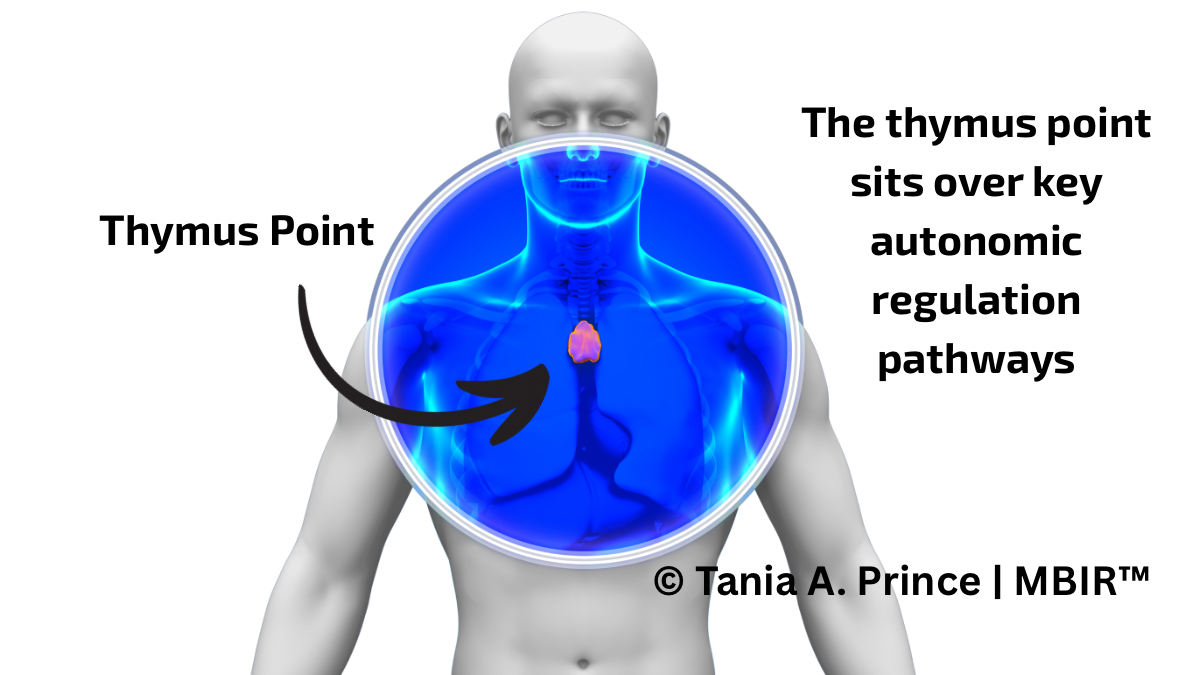
Tapping on the thymus point is often described as an energy or mind–body technique.
But in practice, what I see again and again is something much simpler — and much more profound.
It calms the nervous system.
Not through analysis.
Not through emotional processing.
But by sending the body a clear signal of safety and rhythm.
This is why thymus tapping has become a core element of Mindfulness-Based Inner RePatterning™ (MBIR™) and why it can be effective even when clients don’t want to talk about what’s wrong.
⸻
Where the thymus point sits in the body
The thymus point is located on the upper sternum, just below the collarbones, in the centre of the chest.
Anatomically and neurologically, this area sits over a convergence zone that includes:
- The cardiac plexus
- Branches of the vagus nerve
- Dense interoceptive sensory receptors
- The heart–lung interface, where breathing and heart rhythm meet
These systems are central to autonomic regulation — the part of the nervous system that determines whether we feel safe, threatened, or overwhelmed.
⸻
What happens in the nervous system when you tap
When you gently and rhythmically tap on the thymus area, you stimulate mechanoreceptors in the skin and underlying tissue.
These signals travel via:
- Vagal afferent pathways
- Spinal sensory nerves
to the brainstem, particularly areas involved in regulating breathing, heart rate, and stress responses.
In simple terms, the body receives the message:
“This sensation is predictable. Nothing is attacking me.”
For many nervous systems, that message alone is enough to begin settling things down.
⸻
Vagal regulation without trying to relax
In my clinical and training work, I often notice clients’ breathing slow within seconds of tapping the thymus point — before we’ve discussed anything at all.
This reflects a shift away from:
- Fight or flight (sympathetic activation)
- Collapse or shutdown (dorsal vagal states)
…and toward ventral vagal regulation, which is associated with:
- Calm alertness
- Emotional safety
- A sense of being present rather than braced
What’s important is that this happens without effort.
The nervous system reorganises itself first. The mind usually follows.
⸻
Rhythm, coherence, and why tapping works
The nervous system is highly responsive to rhythm.
Steady thymus tapping — particularly when paired with a slower exhalation — helps synchronise:
- Heart rate variability
- Breathing patterns
- Brainstem timing circuits
This creates a state often described as coherence, where different systems in the body begin working together more efficiently.
From a therapeutic perspective, this allows regulation to happen bottom-up, rather than being forced cognitively.
⸻
Interoception: changing state from the inside out
The chest is a key centre for interoception — the brain’s perception of internal bodily states.
For many people, especially those with a history of trauma or chronic stress, sensations in the chest are closely linked to:
- Anxiety
- Emotional threat
- Holding or shutdown patterns
Rhythmic tapping provides non-threatening sensory input in exactly this area.
Over time, the nervous system learns that sensations here do not automatically mean danger.
That learning is somatic, not intellectual.
⸻
Why this works without analysing the problem
One of the reasons thymus tapping is so effective is that it does not reinforce the threat narrative.
There’s no need to:
- Recall distressing memories
- Name emotions precisely
- Explain or justify reactions
In fact, many people regulate before they understand what has shifted.
This is why I often teach thymus tapping before any verbal exploration — and sometimes instead of it.
⸻
Why the thymus point feels especially grounding
Compared with tapping on the face or hands, the thymus point is:
- Close to the body’s core
- Associated with self-soothing touch
- Developmentally linked to early experiences of being held and comforted
For many nervous systems, this makes it:
- Less activating
- Less overwhelming
- More stabilising during high emotional load
It is particularly supportive for people who dissociate or shut down under pressure.
⸻
Why thymus tapping is central to MBIR™
In Mindfulness-Based Inner RePatterning™ (MBIR™), the emphasis is on state change rather than story.
Thymus tapping supports this approach by:
- Creating safety before insight
- Allowing internal parts to soften without interrogation
- Reducing reliance on verbal processing
- Supporting regulation through rhythm and coherence
When the body feels safe, change does not need to be forced.
⸻
A simple way to think about it
Tapping on the thymus point sends calm, rhythmic signals to the part of the nervous system responsible for breathing, heart rate, and threat detection.
When the body no longer feels under threat, the mind doesn’t need to stay on high alert.
Sometimes, that’s all that’s needed.
⸻
Frequently Asked Questions
Does tapping on the thymus point stimulate the vagus nerve?
It doesn’t mechanically “stimulate” the vagus nerve, but it activates sensory pathways in an area rich in vagal connections and interoceptive receptors. These signals travel to brainstem centres involved in autonomic regulation.
In practice, this often results in a vagal shift toward regulation, reflected in slower breathing and reduced tension.
⸻
Is thymus point tapping the same as EFT tapping?
No. While thymus tapping may be used within EFT, it is not the same as a full EFT tapping sequence.
Traditional EFT typically involves multiple acupoints, verbal statements, and emotional focus.
Thymus tapping — particularly as used in MBIR™ — can be done without words or analysis, making it especially suitable for trauma-sensitive work.⸻
⸻
Why does thymus tapping feel calming so quickly?
The thymus point sits over the heart–lung interface, where breathing and heart rhythm interact.
Rhythmic tapping provides predictable sensory input that the nervous system interprets as non-threatening, allowing the body to settle out of survival mode.
⸻
Can thymus tapping help with anxiety or overwhelm?
Many people find thymus tapping helpful for anxiety or overwhelm because it works below the level of conscious thought.
Rather than trying to calm the mind, it helps the body regulate first — and clarity often follows.
If you’d like to learn this approach in depth, you can explore the MBIR™ Practitioner Training Online Course here:
👉 https://www.taniaaprince.com/product/mindfulness-based-inner-repatterning-mbir-practitioner-training-online-course/
⸻
What if I don’t feel anything when I tap?
Not everyone experiences an immediate sensation. That doesn’t mean it isn’t working.
For nervous systems accustomed to chronic activation, regulation can be subtle at first and become clearer with repeated practice.
⸻
Is thymus tapping safe for trauma-sensitive work?
When used gently and without forcing emotional exploration, thymus tapping is generally well tolerated.
Because it does not require memory recall or verbal processing, it can be particularly supportive for people who dissociate or shut down under pressure.
⸻
How does thymus tapping fit into MBIR™?
In Mindfulness-Based Inner RePatterning™, thymus tapping supports state change before content.
It helps create nervous system safety and coherence, allowing internal parts to soften naturally without interrogation or analysis.
You can find full details of the MBIR™️ Practitioner Training Online Course here:
👉 https://www.taniaaprince.com/product/mindfulness-based-inner-repatterning-mbir-practitioner-training-online-course/
⸻
About the author
Written by Tania A. Prince — EFT Founding Master, Accredited EFT International Master Trainer of Trainers, and creator of Mindfulness-Based Inner RePatterning™ (MBIR™). Tania has been teaching nervous-system-informed, trauma-sensitive approaches internationally for over 15 years.
