
What to Say While Tapping for Anxiety

If you are new to Emotional Freedom Techniques (EFT), one of the first questions you may have is:
What am I supposed to say while I’m tapping?
You may have seen tapping demonstrations where people use very specific phrases. This can make it seem as though there are particular words you need to remember or a special script you need to follow.
There aren’t.
When using EFT for anxiety, the words are primarily there to help you keep your attention connected to what you are experiencing while you tap.
In fact, some of the most useful tapping phrases can be remarkably simple:
“I feel anxious.”
“I can feel this tightness in my chest.”
“I’m worried about tomorrow.”
“Something feels wrong.”
“I don’t know what’s going to happen.”
You do not have to make the anxiety sound positive. You do not have to persuade yourself that everything is fine.
Start with what is true for you right now.
Why Do We Say Anything While Tapping?
EFT combines focused attention on an emotional or physical experience with tapping on a sequence of points on the body.
The words help you stay connected to the experience you are working with.
This matters because anxiety is not always experienced simply as a thought.
You might notice it as:
- tightness in your chest;
- butterflies or churning in your stomach;
- tension in your jaw or shoulders;
- a feeling of pressure;
- racing thoughts;
- an urge to escape;
- restlessness;
- a sense that something bad is about to happen.
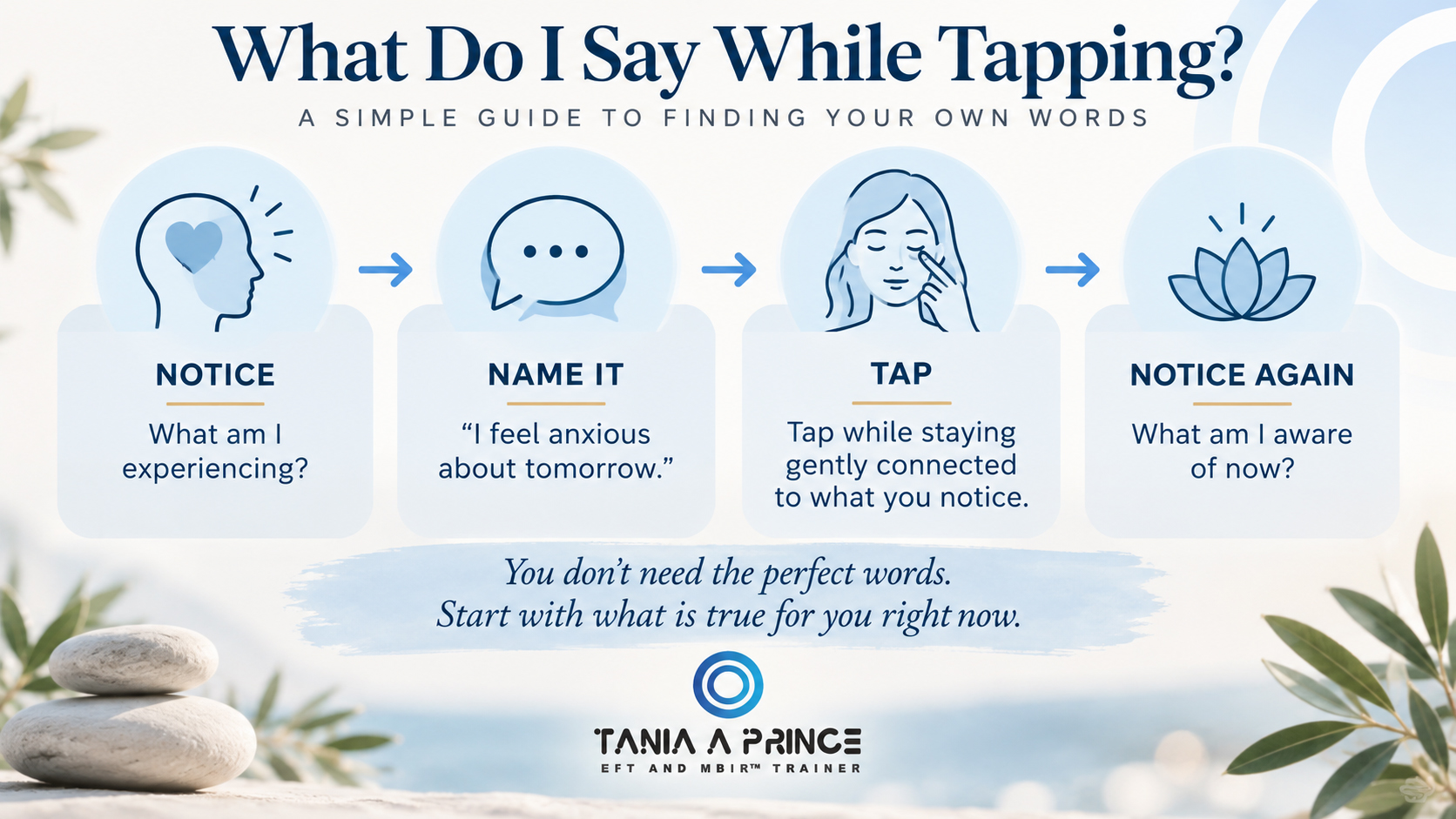
Rather than trying to find the “right” EFT words, begin by noticing what is happening.
Then describe it.
What Should I Say When Tapping for Anxiety?
A useful starting principle is:
Say what you notice.
Imagine you have an important meeting tomorrow and you are already becoming anxious about it.
Rather than using a general phrase such as:
“This anxiety.”
you could become more specific:
“I’m worried about tomorrow’s meeting.”
Then notice what happens when you think about the meeting.
Perhaps you realise:
“I’m scared I’m going to make a mistake.”
You might then notice a physical sensation:
“I can feel this tightness in my stomach when I think about making a mistake.”
And beneath that you might discover another concern:
“I’m worried they’ll think I’m not good enough.”
Your words can change as your experience changes.
You are not trying to repeat the perfect phrase. You are following what is happening for you.
Start With What Is Happening Now
If you are unsure what to say while tapping, ask yourself:
What am I noticing right now?
For example:
“I feel nervous.”
“My chest feels tight.”
“My stomach is churning.”
“I keep thinking something is going to go wrong.”
“I don’t want to feel like this.”
“I feel overwhelmed.”
“My mind won’t stop.”
These statements are useful because they acknowledge your current experience rather than arguing with it.
You can tap while slowly describing whatever you notice.
You Don’t Have to Say “Even Though…”
Many people associate EFT with the traditional Setup Statement:
“Even though I have this anxiety, I deeply and completely accept myself.”
This wording comes from the traditional EFT Basic Recipe and can certainly be used.
However, you do not need to force yourself to say words that do not feel natural or believable.
If saying:
“I deeply and completely accept myself”
feels uncomfortable, artificial or simply irrelevant to what you are experiencing, you can work with language that feels more authentic.
For example:
“Even though I feel anxious about tomorrow, this is how I feel right now.”
Or simply:
“I feel anxious about tomorrow.”
The purpose is not to perform EFT perfectly.
It is to remain connected to your experience while tapping.
What If I Don’t Know Why I’m Anxious?
Sometimes anxiety appears to have an obvious trigger.
At other times, you may simply wake up feeling anxious or notice that your body is tense and activated without knowing why.
You don’t have to know the cause before you begin tapping.
You could start with:
“I don’t know why I feel anxious.”
“There’s this anxious feeling in my body.”
“Something feels unsettled.”
“I can feel this tension, even though I don’t know what it’s about.”
Then notice what happens.
A thought, memory, image or concern may come into your awareness.
If it does, you can begin tapping on that.
If it doesn’t, you can continue working with the physical sensation or emotional feeling you are experiencing.
Describe Where You Feel the Anxiety in Your Body
Anxiety often has a strong physical component.
Instead of focusing exclusively on your thoughts, notice what is happening in your body.
You might say:
“This tight feeling across my chest.”
“This heavy feeling in my stomach.”
“This tension in my throat.”
“This restless feeling in my arms.”
You can become even more specific.
What does the sensation feel like?
Is it:
- tight?
- heavy?
- hot?
- cold?
- fluttery?
- compressed?
- tingling?
- moving?
- still?
If the sensation had a size, shape or colour, what would it be?
There is no correct answer. You are simply paying closer attention to your experience.
Say What You Are Afraid Might Happen
Anxiety often involves anticipation.
Your nervous system may be responding not only to what is happening now, but also to what you imagine might happen next.
This makes future-focused thoughts useful targets for tapping.
For example:
“I’m scared I’m going to panic.”
“I’m worried they’ll judge me.”
“I’m afraid I’ll get it wrong.”
“I’m worried something bad will happen.”
“I’m scared I won’t be able to cope.”
“What if I embarrass myself?”
“What if everything goes wrong?”
Notice which thought creates the strongest reaction in your body.
That can give you a useful place to begin.
Use Your Own Words, Not Someone Else’s
One of the limitations of generic EFT scripts is that they cannot know exactly what your anxiety means to you.
Two people may both say:
“I’m anxious about giving a presentation.”
But their underlying concerns may be completely different.
One person may be thinking:
“I’m scared I’ll forget what I’m going to say.”
Another may be thinking:
“I’m scared everyone will notice I’m nervous.”
Another:
“My boss will think I’m incompetent.”
And another:
“This reminds me of being humiliated at school.”
The situation may look the same from the outside, but the emotional experience is different.
That is why your own words can be so valuable.
Follow the Anxiety as It Changes
EFT does not necessarily stay focused on one statement throughout the tapping.
As you tap, something else may become more noticeable.
For example, you might begin with:
“I’m anxious about the meeting tomorrow.”
Then realise:
“I’m worried my manager is going to criticise me.”
After tapping on that, you remember:
“She criticised me in front of everyone last month.”
You may then notice:
“I can still see everyone’s faces looking at me.”
This gives you much more specific information to work with.
Instead of trying to drag your attention back to the original phrase, notice where your mind naturally goes.
Sometimes anxiety is the doorway into something more specific.
What If My Mind Goes Blank While I’m Tapping?
That is fine.
You do not have to talk continuously.
You can pause.
Tap.
Notice your breathing.
Notice your body.
Then ask:
“What am I aware of now?”
If nothing comes to mind, you can simply use a short reminder phrase such as:
“This anxiety.”
or:
“This feeling.”
The words do not have to be complicated.
Can I Say Negative Things While Tapping?
People sometimes worry that talking about their fears while tapping will reinforce them.
The purpose of acknowledging a fear is not to convince yourself that it is true.
You are acknowledging that the thought or feeling is already present.
If your mind is saying:
“I’m terrified I’m going to fail.”
pretending instead that:
“I’m completely confident and everything will be wonderful”
may create an internal mismatch.
Start with what feels true.
As your emotional response begins to shift, your language may naturally change too.
Moving Towards More Helpful Thoughts
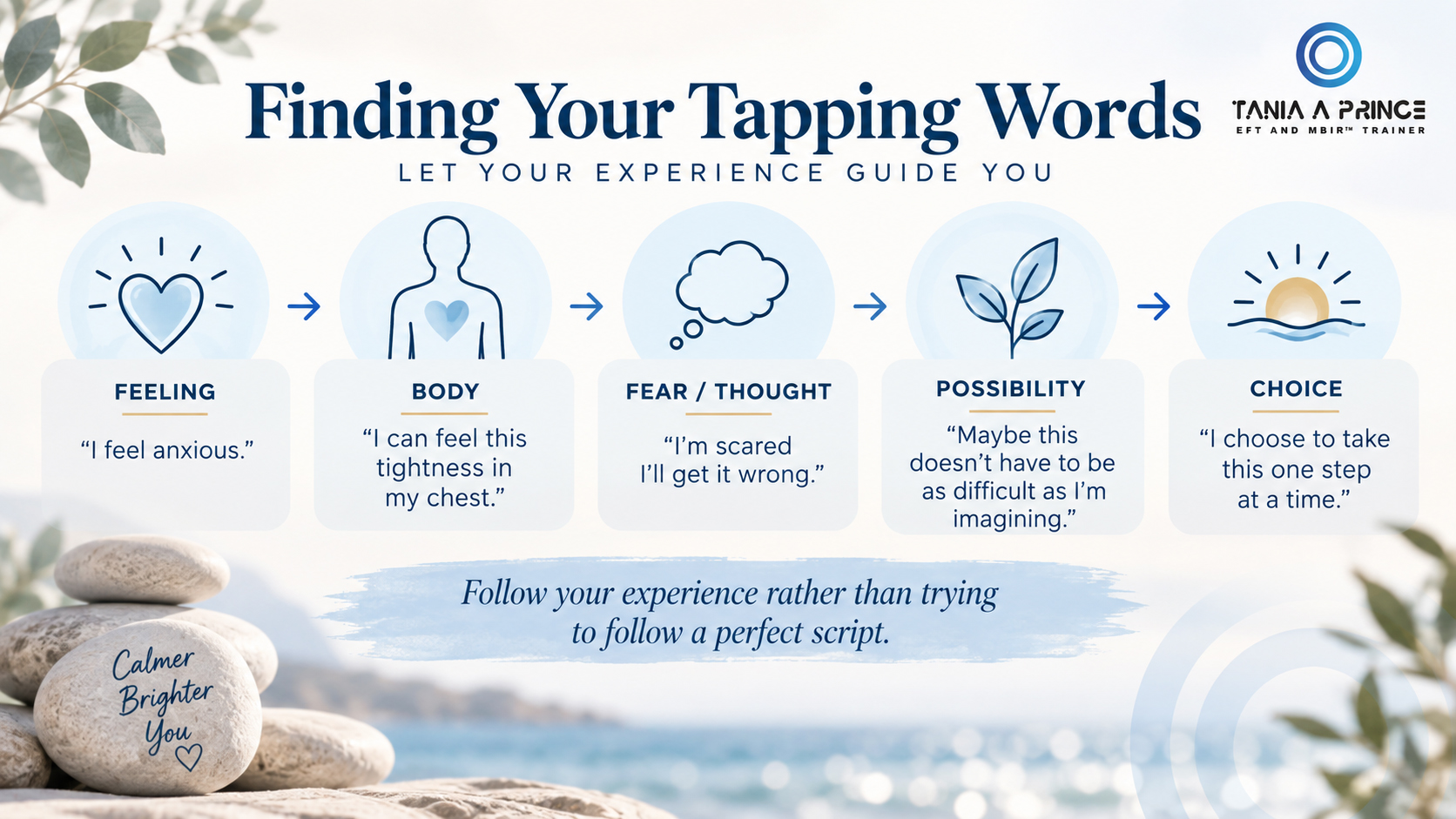
You do not have to rush into positive statements.
However, as the intensity of the anxiety changes, you may notice that other possibilities begin to feel believable.
This is where transitional language can be useful.
For example:
“Maybe this doesn’t have to be as difficult as I’m imagining.”
“Maybe I can handle this differently.”
“Perhaps I don’t have to know exactly what will happen.”
“Maybe my body can begin to settle.”
“Perhaps I can take this one step at a time.”
“Maybe I can feel nervous and still cope.”
The important word here is believable.
A gentle possibility can sometimes be easier for the mind and body to accept than a dramatic positive affirmation.
Choosing How You Would Like to Feel
As the original emotional intensity reduces, you can also begin to introduce choice.
For example:
“I choose to approach this calmly.”
“I choose to feel grounded while I deal with this.”
“I choose to trust myself to handle whatever happens.”
“I choose to take this one step at a time.”
“I choose to allow my body to settle.”
Again, these statements are not designed to suppress anxiety.
Use them when they genuinely feel possible.
A Simple Example of What to Say While Tapping for Anxiety
Suppose you are anxious about attending a social event.
You might begin:
“I’m anxious about going tonight.”
As you continue tapping:
“I’m worried I won’t know what to say.”
Then:
“I can feel that nervous feeling in my stomach.”
Then perhaps:
“I’m scared people will judge me.”
After some tapping:
“Maybe I don’t have to impress everyone.”
Then:
“Maybe I can just take it one conversation at a time.”
And eventually:
“I choose to let myself relax and see what happens.”
Notice the progression.
Current experience → specific fear → body response → underlying concern → possibility → choice.
You do not have to deliberately manufacture this sequence. It simply demonstrates how tapping language can evolve as your emotional response changes.
Questions to Ask Yourself While Tapping
When you don’t know what to say, these questions can help:
- What am I feeling right now?
- Where do I feel it in my body?
- What am I worried will happen?
- What am I imagining?
- What is the worst part of this for me?
- What does this situation mean to me?
- Does this feeling remind me of anything?
- What am I noticing now?
You do not need to answer every question.
One useful answer may be enough to give you something more specific to tap on.
Should I Use an EFT Tapping Script for Anxiety?
Scripts can be helpful when you are learning EFT because they give you an idea of the kind of language you might use.
However, a script is best treated as a starting point rather than something you must follow word for word.
Your own responses provide information that a generic script cannot know.
If a phrase doesn’t fit your experience, change it.
If another thought appears, follow it.
If you suddenly become aware of a physical sensation, acknowledge it.
Your experience is more important than the script.
If you would prefer to begin with a structured example, read my EFT Tapping Script for Anxiety, which takes you through a complete tapping sequence.
What If Tapping Brings Up a Memory?
Sometimes focusing on anxiety can bring a past experience into awareness.
That can be useful information because present anxiety can sometimes be connected with earlier experiences.
However, you do not need to push yourself into distressing or traumatic memories.
If something feels overwhelming, stop and orient yourself to the present.
More complex or traumatic experiences are generally better addressed with appropriate professional support rather than trying to work through them alone.
EFT for Different Types of Anxiety
The words you use while tapping will often depend on the type of anxiety you are experiencing.
If you are worrying about something that has not happened yet, see EFT for Anticipatory Anxiety.
If your anxiety relates to being around other people or fear of judgement, see EFT for Social Anxiety.
If anxiety becomes intense fear or panic, see EFT for Fear and Panic.
If pressure at work is driving your anxiety, see EFT for Work-Related Anxiety.
If everything feels like too much, see EFT for Feeling Overwhelmed.
You may also find it helpful to understand Can EFT Help Calm the Nervous System?, particularly if your anxiety feels strongly physical.
The Most Important Thing to Remember
You don’t need the perfect words to tap effectively.
Start with what is there.
Notice it. Name it. Tap. Then notice what happens next.
Your words might be:
“I’m anxious.”
They might be:
“I’m scared they’re going to reject me.”
Or they might simply be:
“There’s this horrible tight feeling in my stomach.”
All of these give you somewhere to begin.
Rather than asking:
“What am I supposed to say?”
try asking:
“What am I noticing right now?”
That answer can become your next tapping phrase.
About Tania A Prince
Tania A Prince is an EFT Founding Master and an EFT International Accredited Master Trainer of Trainers, with decades of experience working therapeutically and teaching EFT. She is also the creator of Mindfulness-Based Inner RePatterning™️ (MBIR™️).
Her work focuses on helping people understand emotional patterns, nervous-system responses and practical approaches that can support meaningful change.
Important Note
This article is provided for educational purposes and is not a substitute for medical or psychological diagnosis or treatment. Anxiety can have many causes. If anxiety is severe, persistent, significantly affecting your daily life, or you are concerned about your mental or physical health, seek advice from an appropriately qualified healthcare professional.
