
Degrees of Activation, the Window of Tolerance and Choosing the Right EFT Technique

When working with difficult experiences and trauma using EFT (Emotional Freedom Techniques), one of the most important skills a practitioner can develop is recognising how much activation a person’s system can comfortably accommodate.
Not everyone has the same capacity.
Some people can think about a difficult event, experience considerable emotion and remain present, connected and able to process what is happening.
For others, even the thought of approaching the problem can feel overwhelming.
This has important implications for how we use EFT.
We do not always need to activate a problem in order to begin helping someone.
Sometimes the gentlest and most appropriate starting point is simply:
Don’t deliberately think about the problem. Get on with normal life — and tap.
What Is the Window of Tolerance?
The term Window of Tolerance is particularly associated with the work of psychiatrist Daniel Siegel and has become widely used within trauma-informed therapy.
It describes a range of nervous-system activation within which a person can remain sufficiently present and regulated to think, feel, communicate and process what is happening.
When we are within this range, we can experience emotion without necessarily becoming overwhelmed by it.
This means that being within the Window of Tolerance does not mean being calm all the time.
A person may cry, feel angry, experience fear or notice strong physical sensations and still remain present and capable of processing.
Equally, someone who appears extremely calm may actually have moved towards shutdown or disconnection.
The aim therefore is not simply to make someone calm.
We are interested in whether the person can remain sufficiently present, connected and able to process.
Hyperactivation and Hypoactivation
When activation rises beyond a person’s current capacity, they may move towards hyperactivation.
This might involve:
- fear or panic
- agitation
- racing thoughts
- muscular tension
- rapid or restricted breathing
- an urge to escape
- overwhelming emotion
- fight-or-flight responses.
At the other end of the spectrum, a person may move towards hypoactivation.
They might become:
- numb
- blank
- disconnected
- very still
- unusually tired
- unable to find words
- emotionally flat
- distant from themselves, their body or their surroundings.
This distinction is important in therapy.
Someone becoming quiet does not necessarily mean the problem has resolved.
And someone crying does not necessarily mean they are overwhelmed.
We need to observe the whole person.
Different People Have Different Windows
One of the difficulties with talking about trauma activation is that the same degree of activation can be manageable for one person and overwhelming for another.
Imagine two people experiencing what appears to be the same amount of emotional activation.
One has a relatively broad Window of Tolerance.
They remain present, curious and able to engage with what is happening.
The other currently has a very narrow window.
The same degree of activation may rapidly move them towards overwhelm or shutdown.
Therefore, the question is not simply:
“How intense is this problem?”
A more useful question may be:
“How much activation can this person comfortably accommodate while remaining present and connected?”
That answer should influence the way we work.
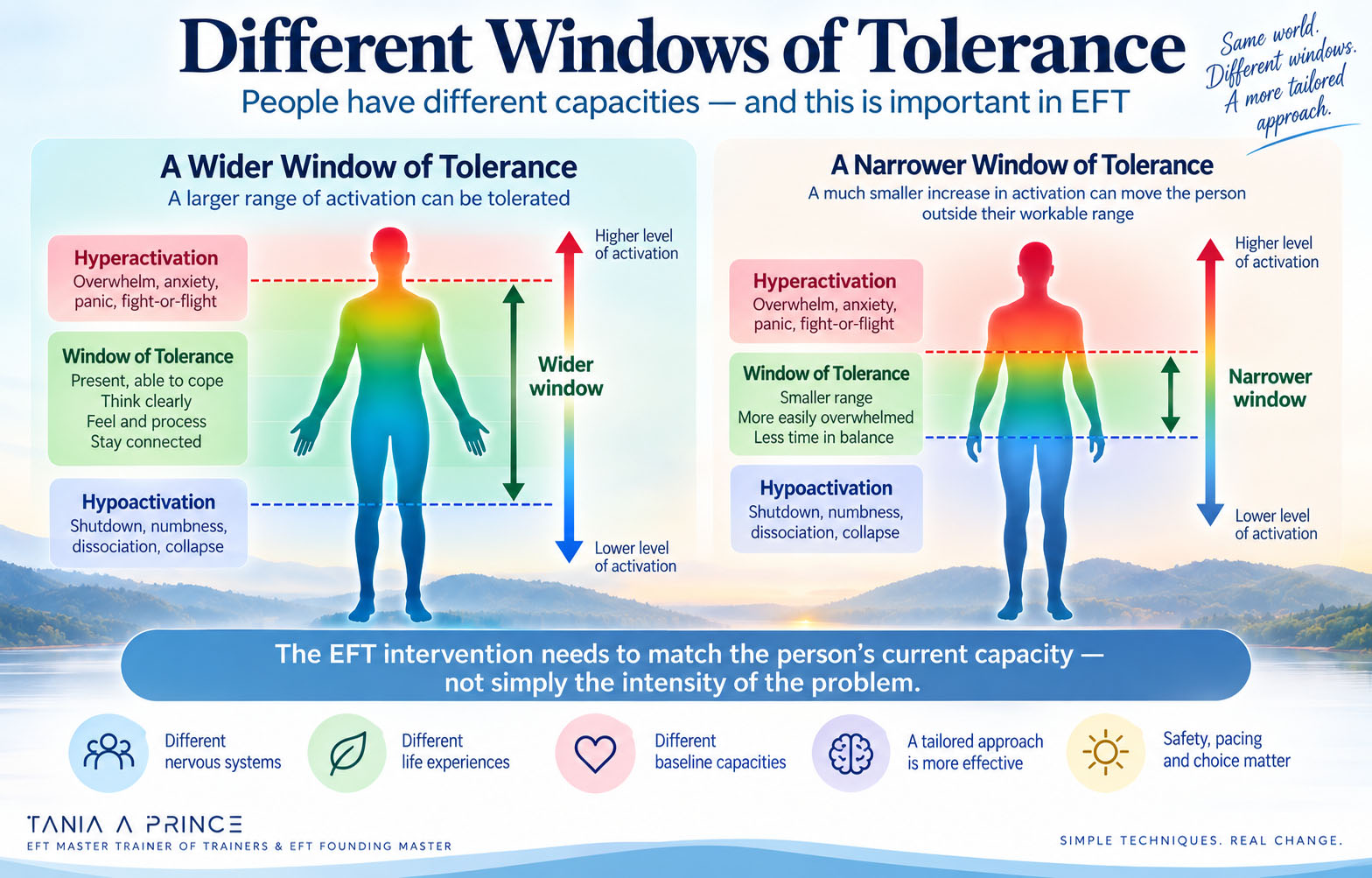
EFT interventions can be adapted accordingly. ©️ Tania A Prince 2026.
A Small Window of Tolerance Requires a Different Approach
With someone who has a very small Window of Tolerance, even apparently gentle therapeutic questions can create activation.
For example:
“What happens when you think about it?”
“Where do you feel it in your body?”
“What number would you give it?”
“Can you give the event a title?”
All of these require the person to make some contact with the problem.
For many clients that is completely manageable.
For some it is not.
Even saying:
“You don’t need to go into the memory; just notice what happens when you think about it”
still requires them to think about it.
Sometimes even the anticipation of having to approach difficult material is enough to activate the person’s protective responses.
In these circumstances, I may choose not to deliberately activate the problem at all.
SET: Tapping Without Deliberately Targeting the Problem
This is one of the reasons I value SET (Simple Energy Techniques), developed by Steve Wells and Dr David Lake.
SET can be used without requiring someone to deliberately focus on a problem.
Wells and Lake refer to the regular incorporation of tapping into everyday life as energy toning.
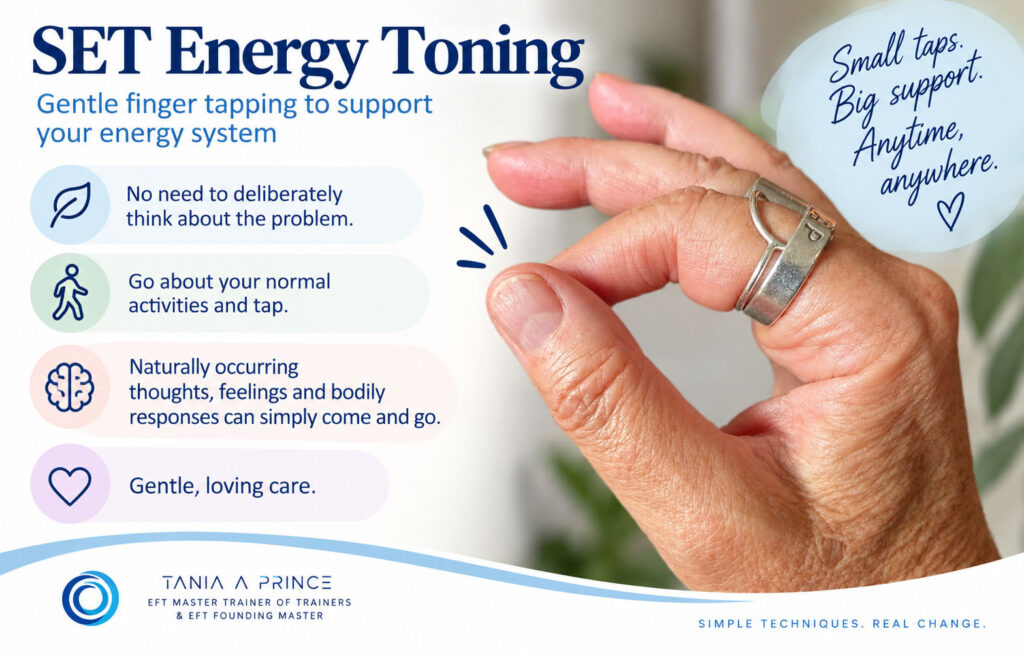
The person does not have to sit down and announce:
“Now I am going to work on my trauma.”
They can simply continue with their normal activities and tap.
They might tap while:
- watching television
- reading
- walking around the house
- having a cup of tea
- sitting in the garden
- having an ordinary conversation
- travelling as a passenger
- waiting for an appointment
- carrying out everyday activities.
There is no requirement to identify a target.
There is no requirement to tell the story.
There is no requirement to identify an emotion.
There is no requirement to measure a SUD score.
And there is no requirement to deliberately think about the trauma.
Just get on with life and tap.
No Deliberate Activation Does Not Mean No Activation
There is an important distinction here.
If someone is not deliberately thinking about their trauma, it does not mean their nervous system is completely unactivated.
We naturally think about our problems during everyday life.
Something reminds us.
A thought pops into our mind.
We anticipate something happening.
An emotion appears.
And sometimes the body responds before we have consciously recognised what has happened.
A person might notice themselves:
- bracing
- tightening their jaw
- raising their shoulders
- holding their breath
- tightening their abdomen
- clenching their hands
- becoming vigilant
- preparing to withdraw or escape.
These protective responses may have become highly familiar.
Sometimes the person barely notices them.
The body can continue responding to learned associations even when the person is not deliberately recalling the experiences associated with them.
So when someone uses SET energy toning while going about everyday life, it would be inaccurate to say that there is necessarily zero activation.
There may already be plenty happening.
The important distinction is:
we are not deliberately adding activation.
Working With What Naturally Arises
This gives us a very different therapeutic possibility.
Rather than:
Think about the problem → activate distress → tap
we can begin with:
Live ordinary life → tap → allow naturally occurring experiences to come and go.
A thought about the problem may arise.
Tap.
The body may brace.
Tap.
An uncomfortable feeling may briefly appear.
Tap.
Nothing noticeable may happen at all.
Keep going with normal life.
There is no requirement to analyse every response.
There is no need to turn every sensation into a therapeutic target.
And there is no requirement to pursue a memory simply because it briefly appears.
For someone with a very small Window of Tolerance, this can be an exceptionally gentle way of introducing tapping.
Gentle, Loving Care
I regard this way of working as a form of gentle, loving care.
There is no demand to confront anything.
There is no requirement to revisit the past.
There is nothing the person has to achieve.
They can simply go about their everyday life and tap.
For me, there is something profoundly compassionate about being able to say:
You don’t have to go there.
You don’t have to tell me about it.
You don’t have to make yourself feel it.
You don’t even have to work on it right now.
You can simply tap.
The message is not:
“We need to get to the trauma.”
It is:
“We can begin by taking gentle care of the system that has been carrying it.”
Why People Sometimes Avoid Tapping
There is another reason this approach can be particularly useful.
Human beings naturally tend to avoid things we expect will feel unpleasant, frightening or overwhelming.
That is not necessarily resistance to therapy.
It can be a completely understandable protective process.
If someone believes:
“If I tap, I’m going to have to think about that awful thing,”
it is understandable that part of them may not want to tap.
They may intend to do it later.
They may keep putting it off.
They may suddenly find other things that need doing.
They may forget.
They may decide they will start tomorrow.
We may label this procrastination.
Sometimes it may make more sense to recognise that the person’s protective system is effectively saying:
“I don’t want to go there.”
Perhaps we don’t need to make them go there.
Making Tapping Something the Person Wants to Do
This changes the invitation completely.
Instead of:
“Let’s think about the problem and tap on whatever comes up,”
we can say:
“You don’t need to think about the problem. Just get on with your day and tap whenever it feels comfortable.”
Now there is no frightening therapeutic task waiting for them.
Tapping can become associated with care rather than confrontation.
That may also make it far easier to incorporate into everyday life.
The most sophisticated therapeutic technique in the world has limited practical value if someone is too frightened to use it.
Sometimes making an intervention gentler does not make it less meaningful.
It makes it possible.
When We Begin to Approach the Problem
Of course, not everyone requires this degree of distance.
And the same person’s capacity may change over time.
When appropriate, we can begin moving gradually towards more deliberate contact with the problem.
The important word is gradually.
We do not need to move from:
“Don’t think about it”
straight to:
“Tell me exactly what happened.”
There are many degrees between those two positions.
Degrees of Activation in EFT
I find it useful to think of EFT interventions as existing along a continuum of deliberate activation.
This is a clinical teaching model rather than a validated diagnostic scale.
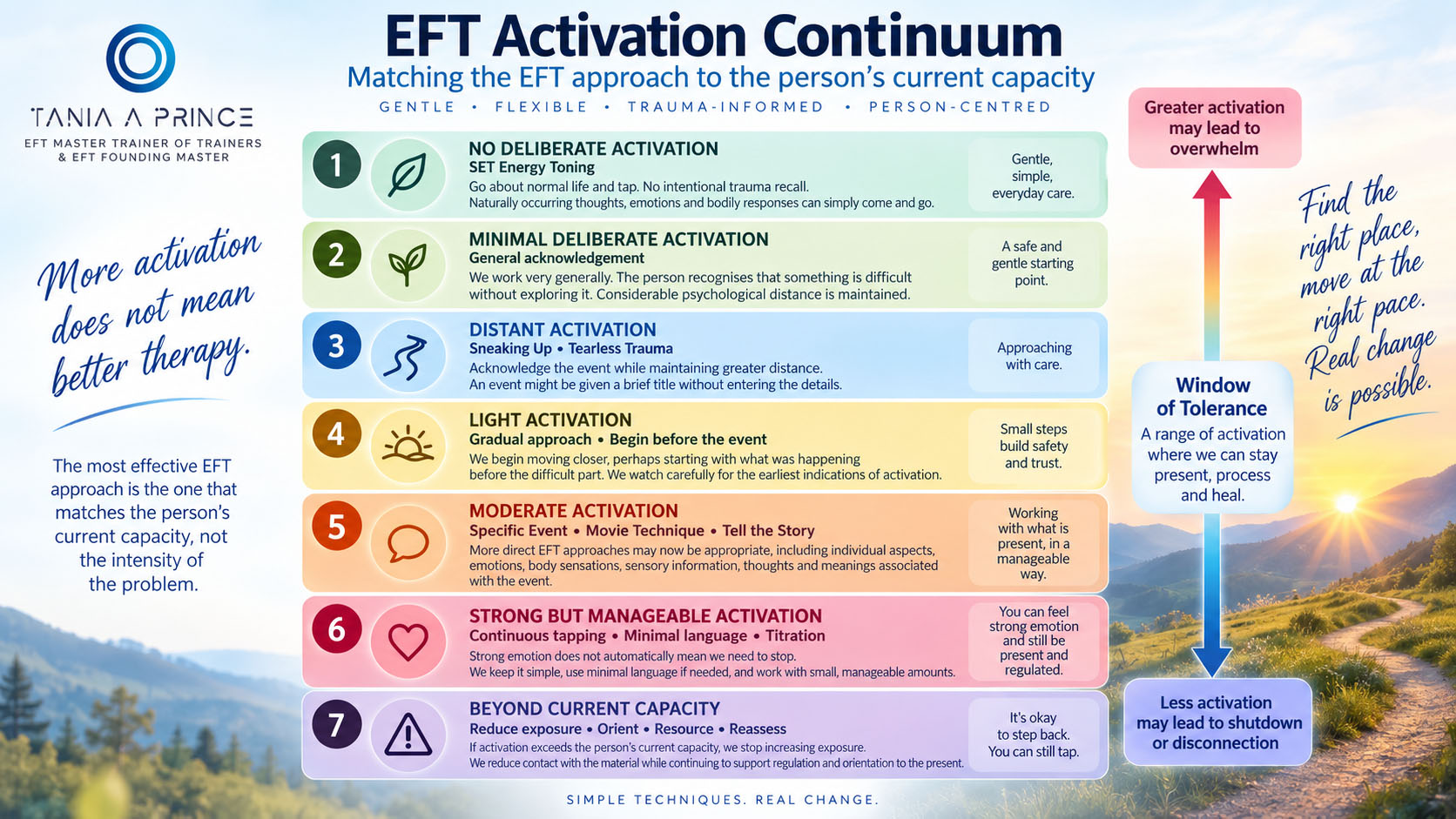
1. No Deliberate Activation
The person goes about normal life and taps.
SET energy toning can sit here.
There is no intentional trauma recall and no requirement to identify a target.
Naturally occurring thoughts, emotions and bodily responses can simply arise and pass while the person continues tapping.
2. Minimal Deliberate Activation
The person acknowledges that something is difficult without exploring it.
We may work very generally.
There is still considerable distance from the material.
3. Distant Activation
Approaches such as Sneaking Up and Tearless Trauma may allow the person to acknowledge an event while maintaining greater psychological distance.
An event might be given a brief title without entering the details.
4. Light Activation
We begin moving closer.
This might involve approaching the event carefully or beginning with what was happening before the difficult part occurred.
The practitioner watches closely for the earliest indications that activation is increasing.
5. Moderate Activation
More direct EFT approaches may now become appropriate.
These might include:
- Specific Event work
- the Movie Technique
- Tell the Story
- individual aspects
- emotions
- body sensations
- sensory information
- thoughts and meanings associated with the event.
6. Strong but Manageable Activation
Strong emotion does not automatically mean that we need to stop.
Someone may be crying intensely and still remain completely present.
At this point, however, I often favour simplicity.
Continuous tapping can be useful.
Language may become minimal:
“This fear.”
“This feeling.”
“Right here.”
Or there may be no need for words at all.
7. Activation Exceeds Current Capacity
If the person begins moving beyond their ability to remain present and process what is happening, the goal changes.
We stop deliberately increasing exposure.
But that does not necessarily mean stopping tapping.
We can reduce contact with the traumatic material while continuing to support regulation and orientation to the present.
Beginning Before the Event
When I do begin working more directly with a traumatic event, I will often start before anything went wrong.
I might ask:
“What was happening before the event occurred?”
If that period was neutral or positive, we can tap and talk about it.
Then we gradually move forward.
I am watching and listening carefully.
A change in breathing.
A hesitation.
A facial movement.
A change in posture.
A shift in voice.
A particular word.
A sudden stillness.
These may indicate that we are beginning to reach meaningful material.
We do not necessarily need to keep pushing forward.
We can work with what has just appeared.
Titration: Working With Small Amounts
This is the principle of titration.
Rather than activating the whole traumatic experience, we work with a small, manageable amount.
Approach.
Notice.
Tap.
Allow things to settle.
Reassess.
Then decide whether to move forward.
The aim is not to discover how much distress someone can withstand.
The aim is to find the amount of activation that can be therapeutically useful without unnecessarily overwhelming the system.
Moving Back Towards Resource
Trauma work does not have to move relentlessly towards greater activation.
We can move backwards and forwards.
Resource → Approach → Notice activation → Tap → Return towards resource → Reassess
This resembles what somatic trauma approaches describe as pendulation — movement between activation and areas of relative stability or resource.
Sometimes I establish useful resources before approaching the difficult material.
For example, if an event involved someone the client loves and everything ultimately turned out well, it may sometimes be appropriate to explore that positive outcome first.
We might talk about the person.
What are they like?
Funny?
Cheeky?
Warm?
Strong?
Naturally occurring words associated with that state can sometimes become useful ways of helping the person reconnect with the resource later.
Clinical judgement is essential. A resource should never be imposed simply because the practitioner thinks the client ought to experience something positively.
The Body Gives Us Information
Advanced EFT work involves more than listening to the client’s words.
We are continually calibrating.
We notice:
- breathing
- facial expression
- posture
- muscular tension
- movement
- voice
- hesitation
- changes in language
- orientation
- engagement.
Sometimes the body indicates activation before the person consciously identifies it.
This is why I am interested not only in what the client says but in what their whole system appears to be doing.
Regulation Is Not the Same as Calm
The aim is not to make people permanently calm.
A healthy nervous system changes state.
We become activated when action is required.
We settle when the demand passes.
We experience excitement, concentration, fear, pleasure, tiredness, relaxation and energy.
The goal is greater flexibility rather than permanent stillness.
Someone can therefore be highly emotional and regulated.
Someone else can be very quiet and dysregulated.
The practitioner needs to distinguish between the two.
The Window of Tolerance Is Not Fixed
It is also important not to turn the Window of Tolerance into another label.
A person’s capacity can change.
Someone may have greater capacity on one day than another depending upon sleep, stress, relationships, physical wellbeing and what else is happening in their life.
Capacity can also change during a single session.
The question therefore isn’t:
“Does this person have a small Window of Tolerance?”
It is:
“What degree of activation can this person comfortably work with right now?”
And sometimes the answer is:
very little.
That is enough.
Matching EFT to the Person
This gives us a different way of thinking about EFT.
We don’t simply learn a collection of techniques and decide which one we prefer.
We learn to match the intervention to the person in front of us.
A useful continuum is:
NO DELIBERATE ACTIVATION
SET energy toning • ordinary activities • no intentional targeting
↓
MINIMAL DELIBERATE ACTIVATION
General acknowledgement • considerable psychological distance
↓
DISTANT ACTIVATION
Sneaking Up • Tearless Trauma • event title
↓
LIGHT ACTIVATION
Approaching carefully • beginning before the event • noticing the earliest response
↓
MODERATE ACTIVATION
Specific Event • Movie Technique • Tell the Story • aspects
↓
STRONG BUT MANAGEABLE ACTIVATION
Continuous tapping • minimal language • titration • careful observation
↓
BEYOND CURRENT CAPACITY
Reduce deliberate exposure • orient • reconnect • resource • continue appropriate regulation • reassess
This is not a ladder.
There is no requirement to reach the bottom.
More activation does not mean more successful therapy.
And more direct work is not necessarily more advanced work.
Sometimes advanced practice means knowing when not to activate the problem.
A Different Way of Thinking About Trauma-Informed EFT
Perhaps one of the most important questions we can ask is not:
“How do I get to the trauma?”
but:
“How can I work in a way this person’s system can comfortably accommodate?”
For one person that may involve detailed Specific Event work.
For another it may involve approaching a memory in tiny increments.
For someone else it may mean sitting together and tapping without discussing the trauma at all.
And for another person, it may simply mean:
Go about your life.
Don’t deliberately work on anything.
Tap.
We do not have to create distress in order to begin offering support.
Sometimes the most appropriate place to start is with what I think of as gentle, loving care.
No pressure to confront.
No requirement to perform.
No demand to go somewhere the person is frightened to go.
Just an opportunity to begin taking care of a system that may already have been carrying far too much.
Important Note
EFT can be used very gently, but working therapeutically with trauma requires appropriate training, competence and clinical judgement. Significant dissociation, severe trauma symptoms or substantial psychological risk may require appropriately qualified trauma or mental-health support.
The degrees-of-activation continuum presented here is a clinical teaching framework. It is intended to help practitioners think about the relationship between a person’s current capacity for activation and the choice of EFT intervention. It is not a diagnostic scale or a claim that particular levels of activation have been experimentally established as discrete nervous-system states.
©️ Tania A Prince 2026. All rights reserved.