
EFT Tapping for Procrastination: From Resistance to Choice
There are times when we procrastinate because we have a choice about whether to do something.
And then there are those tasks that simply have to be done.
I recently found myself dealing with the latter.
I had a substantial amount of legal and administrative work to do behind my business. It wasn’t something I could avoid, and much of it wasn’t something I could delegate.
I was the person who knew the history. I knew what the information was, what it meant and, importantly, where I might be able to find it.
There was also potentially a massive benefit to completing the work.
Logically, I knew all of this.
But knowing something logically doesn’t necessarily change how you feel about doing it.
And my internal voice had plenty to say.
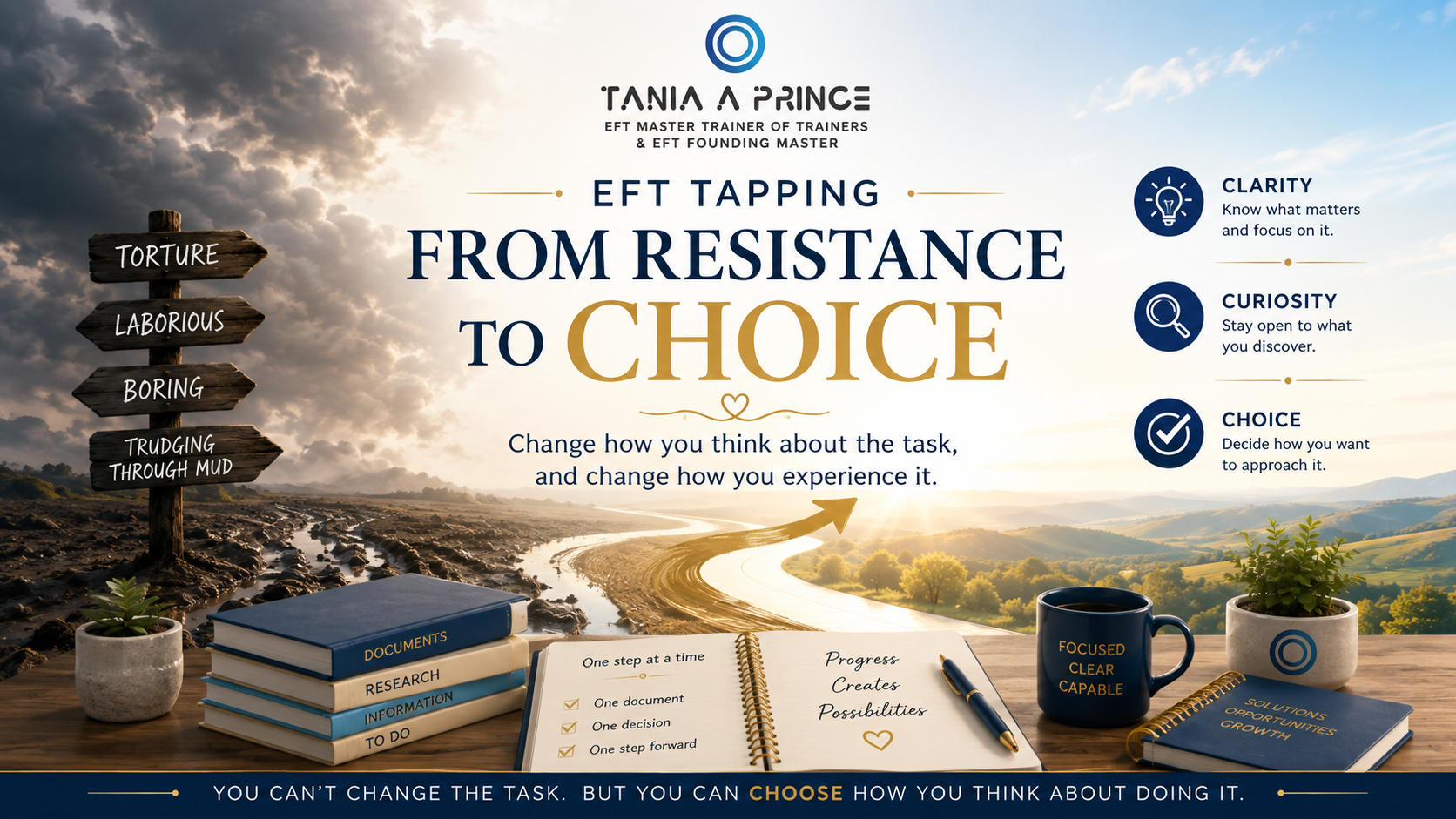
“This is torture.”
“This is so laborious.”
“This is boring.”
“It feels like I’m trudging through mud.”
That’s when I decided to tap.
When You Can’t Change the Task
One of the things I find particularly useful about EFT is that we don’t necessarily have to change the external situation in order to work with our response to it.
I couldn’t change the fact that this work needed to be done.
There was no point tapping on:
“I don’t have to do this.”
because I did.
Nor did I want to pretend that I suddenly found the work fascinating.
Instead, I realised:
I can’t change the fact that I have to do it, but I can change how I think about doing it.
That became the focus of my tapping.
Listening to Your Internal Voice
When using EFT, I often encourage people to pay attention to the conversation already taking place inside their head.
We can be so accustomed to this internal commentary that we barely notice it.
In my case, it was very clear:
“This is torture.”
“This is laborious.”
“This is boring.”
“There’s so much of it.”
“I don’t want to do this.”
“Why do I have to do all this?”
“I feel like I’m trudging through mud.”
Imagine repeatedly giving yourself those instructions while trying to work.
Before trying to change any of it, I tapped and acknowledged it.
Not because I wanted to reinforce the resistance, but because that was genuinely where I was at that moment.
Why I Don’t Immediately Jump to Positive Thinking
If I am sitting there genuinely thinking:
“This is torture.”
and immediately start tapping:
“I love doing this. This is wonderful!”
there may be another voice inside me saying:
“No, you don’t.”
That is one of the reasons I like using bridging or transition language.
Rather than trying to leap from one state to its opposite, I can introduce another possibility.
For example:
“Maybe I can think about this another way.”
“Perhaps this could feel different.”
“Maybe I don’t have to experience this as trudging through mud.”
“What if I could approach this differently?”
I haven’t told myself that I have to feel differently.
I’ve simply introduced the possibility.
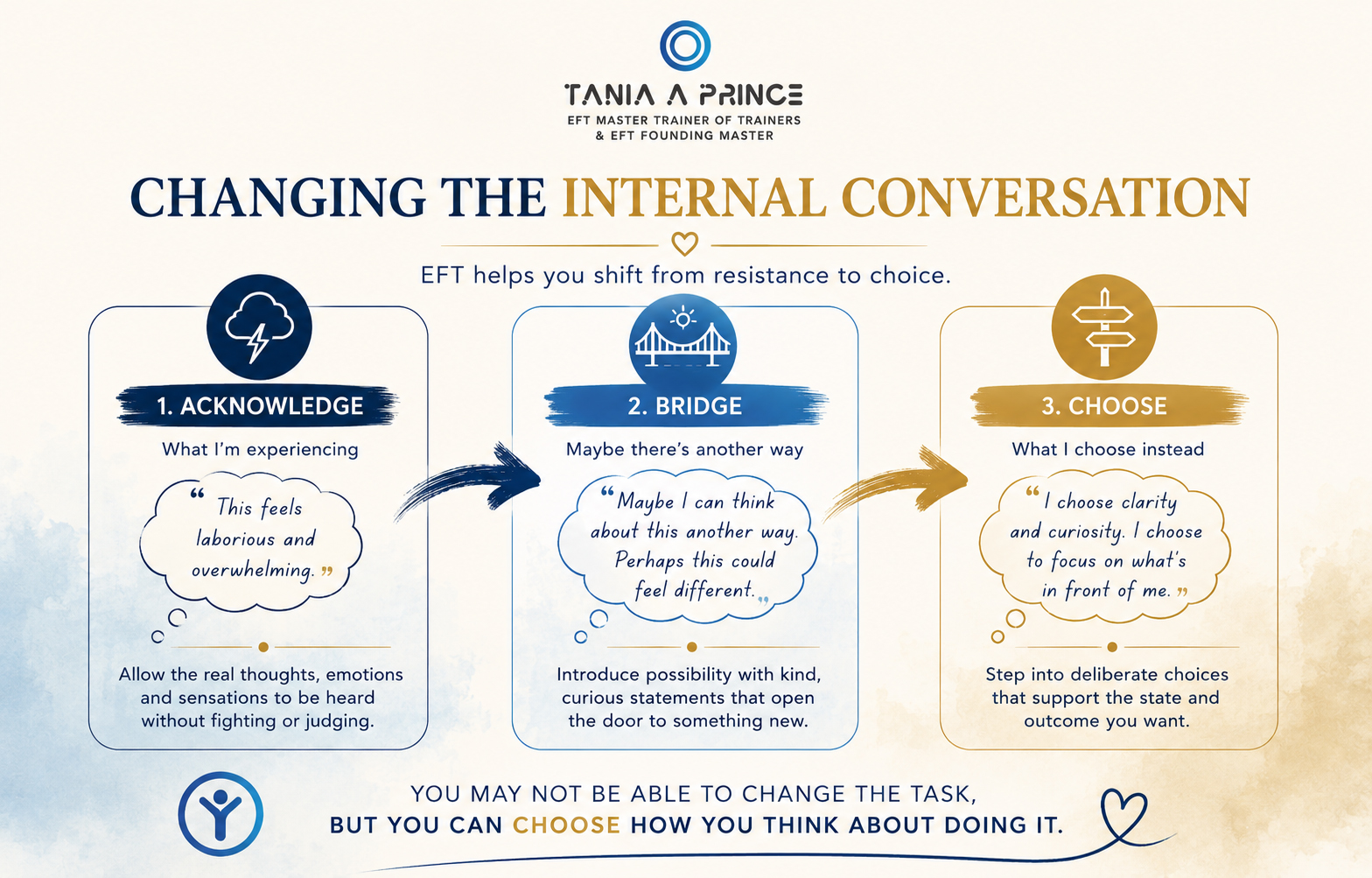
Acknowledge → Bridge → Choose
This gives us a simple way of thinking about the process:
1. Acknowledge
Start with what is genuinely there.
“This is boring.”
“I don’t want to do it.”
“This feels overwhelming.”
“I feel like I’m trudging through mud.”
2. Bridge
Introduce possibility.
“Maybe I can think about this another way.”
“Perhaps this could be easier.”
“Maybe I could become curious.”
“What if I didn’t have to experience this in quite the same way?”
3. Choose
When the new direction begins to feel credible, introduce a choice.
“I choose clarity.”
“I choose curiosity.”
“I choose to focus on what’s in front of me.”
“I choose to notice my progress.”
“I choose to connect with how good I will feel when this is finished.”
The external task hasn’t changed.
But our relationship with it may begin to.
EFT Tapping Script for Procrastination and Resistance
The following script is based on the approach I used.
You don’t have to follow these words rigidly.
In fact, I prefer tapping to become a conversation. If another thought arises while you are tapping, acknowledge it.
The words are there to provide a structure, not to stop you listening to what is actually happening internally.
Setup
While tapping on the side of the hand:
Even though I really don’t want to do this, and it feels laborious, boring and never-ending, I acknowledge that’s how I feel about it right now.
Even though I know this has to be done, and there’s really no way around it, I acknowledge how much resistance I have to doing it.
Even though part of me feels as though I’m trudging through mud, and I’d much rather be doing something else, I’m open to listening to how I actually feel about this.
Round 1 — Giving the Internal Voice Permission to Speak
Eyebrow:
I really don’t want to do this.
Side of Eye:
It feels like such hard work.
Under Eye:
It’s laborious.
Under Nose:
It’s boring.
Chin:
There’s so much to do.
Collarbone:
And I’m the one who has to do it.
Under Arm:
I can’t just hand this over to somebody else.
Top of Head:
Sometimes it feels like torture.
Eyebrow:
Like I’m trudging through mud.
Side of Eye:
I have to make myself keep going.
Under Eye:
And part of me is saying, “I don’t want to.”
Under Nose:
I wish somebody else could do it.
Chin:
But they can’t.
Collarbone:
I’m the person who knows the information.
Under Arm:
I’m the person who knows where to find it.
Top of Head:
And right now, I’m really fed up with it.
Take a breath.
Notice what comes up.
If your internal voice produces another thought, you don’t have to ignore it because it isn’t part of the script.
Tap on it.
Round 2 — Beginning the Bridge
Now we can begin introducing the possibility that there may be another way of experiencing the task.
Eyebrow:
Maybe I don’t have to change the fact that I have to do this.
Side of Eye:
Maybe I can think about it another way.
Under Eye:
Maybe the task isn’t the only thing affecting how this feels.
Under Nose:
Maybe some of the heaviness is coming from what I’m telling myself about it.
Chin:
“Torture.”
Collarbone:
“Laborious.”
Under Arm:
“Boring.”
Top of Head:
“Trudging through mud.”
Eyebrow:
No wonder it feels heavy when that’s the conversation going on inside me.
Side of Eye:
Maybe I don’t have to argue with those thoughts.
Under Eye:
And maybe I don’t have to keep reinforcing them either.
Under Nose:
Perhaps there’s another way of approaching this.
Chin:
I don’t know exactly what that would feel like yet.
Collarbone:
And I don’t have to know.
Under Arm:
I’m just open to the possibility…
Top of Head:
…that this could feel different.
Round 3 — Transitioning Towards Possibility
Eyebrow:
What if this doesn’t have to feel like trudging through mud?
Side of Eye:
What if I could approach it with a little more clarity?
Under Eye:
Maybe I could even become curious.
Under Nose:
Curious about what I’m going to find next.
Chin:
Curious about how much I can get done.
Collarbone:
Curious about how it might feel when another piece is completed.
Under Arm:
Maybe I don’t have to focus on how much there is still to do.
Top of Head:
Maybe I can simply focus on what’s in front of me.
Eyebrow:
One document.
Side of Eye:
One piece of information.
Under Eye:
One decision.
Under Nose:
One step at a time.
Chin:
And maybe that could feel surprisingly easy.
Collarbone:
I don’t need to force that.
Under Arm:
I’m simply allowing the possibility…
Top of Head:
…that I can experience this differently.
Round 4 — Moving Into Choice
Once those possibilities begin to feel believable, we can move more directly into choice.
Eyebrow:
I still have to do the task.
Side of Eye:
But I don’t have to do it feeling as though I’m trudging through mud.
Under Eye:
I can choose how I approach it.
Under Nose:
And I choose clarity.
Chin:
I choose curiosity.
Collarbone:
I choose to deal with what’s in front of me.
Under Arm:
I choose to notice my progress.
Top of Head:
I choose to let this be easier than I expected.
Eyebrow:
I choose to feel clear and focused.
Side of Eye:
I choose to be curious about what I can accomplish.
Under Eye:
I choose to notice when things are going well.
Under Nose:
I choose to allow myself to get into a flow.
Chin:
And I choose to connect with how good it will feel when this is finished.
Collarbone:
The relief of knowing it’s done.
Under Arm:
The satisfaction of knowing I’ve dealt with it.
Top of Head:
And the possibilities that completing this could open up.
Final Choice
Eyebrow:
I can’t necessarily choose whether this needs to be done.
Side of Eye:
But I can choose how I think about doing it.
Under Eye:
I can choose the state I bring to it.
Under Nose:
I choose clarity.
Chin:
I choose curiosity.
Collarbone:
I choose focused, productive action.
Under Arm:
I choose to let it be easier.
Top of Head:
And I choose to enjoy the feeling of moving towards completion.
Take a breath.
Rather than immediately asking yourself:
“Do I want to do this?”
you might ask:
“What feels like the next clear step?”
Then notice what happens.
What Happened When I Went Back to the Task
I didn’t do one quick round of tapping.
I allowed myself an extended period of fairly free-flowing EFT, following the thoughts that arose and gradually moving through the bridging language and into choices.
Then I went back to work.
What happened next was interesting.
I was highly productive.
For approximately two hours, I worked through a massive amount of material.
But something else struck me.
Everything seemed to go more smoothly.
Instead of feeling as though I was battling my way through every stage, I found myself getting on with what was in front of me.
The nature of the task hadn’t suddenly changed.
The legal work was still the legal work.
The documents were still the documents.
The difference I noticed was in my experience of doing it.
And then, after approximately two hours, something changed again.
My body very clearly said:
“No. Time for a rest.”
So I stopped.
Not Every “No” Means the Same Thing
I think this is an important part of what happened.
Before tapping, my “no” was:
“I don’t want to start.”
“This is torture.”
“This is too much effort.”
“I don’t want to do any of this.”
After around two hours of highly productive work, the message was different.
It was simply:
“Enough. Time for a rest.”
And I listened.
The purpose of tapping wasn’t to override myself so that I could continue working indefinitely.
It wasn’t about forcing productivity.
It wasn’t about turning myself into a machine that could keep going regardless of what my body was communicating.
For me, it was about changing my relationship with something that genuinely needed to be done.
And once I had done a substantial amount, I could also respond to the information that it was time to stop.
EFT Isn’t About Finding the “Right” Positive Words
This experience also demonstrates something important about how I personally work with the language of EFT.
I don’t think we always need the perfect phrase.
Sometimes we need to listen.
Start with what is there.
Tap.
Let the internal voice talk.
Notice what changes.
And when a little possibility begins to appear, follow it.
Maybe…
Perhaps…
What if…
I’m open to the possibility…
These words can create a bridge.
And eventually that bridge may take us somewhere where choice becomes believable:
I choose clarity.
I choose curiosity.
I choose to approach this differently.
I choose to connect with how I will feel when this is finished.
That is very different from trying to force yourself to believe something you don’t currently believe.
Can EFT Tapping Help With Procrastination?
People procrastinate for many different reasons, so there isn’t one tapping script that will apply to everyone.
If you find yourself continually putting something off, you might begin by becoming curious about the internal conversation associated with the task.
What happens when you think about starting it?
What do you tell yourself?
What emotions arise?
What happens in your body?
What are you imagining?
You can then tap on what is actually there rather than beginning with what you think you should be feeling.
What Should I Say When Tapping for Procrastination?
Start with your own words.
If the thought is:
“I can’t face this.”
tap on:
“I can’t face this.”
If it’s:
“This is going to take forever.”
start there.
If it’s:
“I don’t know where to start.”
acknowledge that.
You can then experiment with bridging language such as:
“Maybe I can think about this another way.”
“Perhaps I don’t have to solve everything at once.”
“What if I only need to identify the next step?”
“I’m open to the possibility that this could feel easier.”
And if that begins to feel credible, you can introduce your choices.
What If I Still Don’t Want to Do It?
Then that is information too.
Don’t use the choice statements to silence what is still present.
Continue tapping and become curious about the remaining resistance.
There may be another aspect of the problem that needs attention.
There may also be times when your reluctance is providing useful practical information. Perhaps you genuinely need a rest. Perhaps you need more information. Perhaps the task needs breaking down. Perhaps something else needs to happen first.
The goal isn’t to force yourself into a predetermined state.
It is to become curious about your experience and what changes as you tap.
You May Not Be Able to Change the Task — But You Can Explore Changing Your Relationship With It
There will always be things in life that simply have to be done.
Sometimes we cannot delegate them.
Sometimes we cannot avoid them.
Sometimes there is a significant benefit waiting on the other side, and we still don’t want to do the work required to get there.
When that happens, notice the conversation happening inside you.
You may not be able to change the task.
But you can explore whether you can change the internal conversation you bring to it.
Acknowledge → Bridge → Choose.
For me, on this particular occasion, that shift was followed by two hours of remarkably productive work.
And then I rested.
Both responses mattered.
Want to Learn EFT in Greater Depth?
I have been working with and teaching EFT for many years, and one of the skills I encourage practitioners to develop is the ability to move beyond mechanically repeating scripts and learn to listen and respond to what is actually emerging.
If you would like to develop your EFT skills further, you can explore my EFT training programmes and learn more about professional EFT training with me.
About Tania A Prince
Tania A Prince is an EFT Founding Master and EFT International Accredited Master Trainer of Trainers with extensive experience working therapeutically and training EFT practitioners.
Her approach emphasises flexible, responsive use of EFT: listening carefully to the individual’s experience and working with what emerges rather than relying solely on predetermined scripts.
This article describes Tania’s personal experience and approach to EFT. Individual experiences with EFT vary, and the example described should not be interpreted as a guarantee of a particular outcome.
