
EFT for Fear and Panic: How Tapping Can Help When Your Body Goes Into Alarm

When your brain and nervous system detect something that appears threatening, your body can react extraordinarily quickly. Your heart may race. Your breathing may change. Your muscles tense. You may feel hot, shaky, dizzy or nauseous. You may have an overwhelming urge to escape.
When this response becomes intense, it can feel frightening in its own right.
You may think:
“Something is terribly wrong.”
“I’m going to lose control.”
“I need to get out of here.”
“What if I can’t stop this?”
And sometimes:
“What if this is a panic attack?”
EFT (Emotional Freedom Techniques), commonly known as tapping, offers a practical way of working with fear and anxiety while they are happening, as well as exploring some of the triggers and experiences that may be contributing to the response.
The important starting point is not to fight the fear.
It is to understand what your system is responding to.
What Happens in the Body When We Feel Fear?
Fear isn’t simply a thought.
It involves a coordinated response throughout the body.
When something is perceived as threatening, the nervous system can rapidly prepare you to protect yourself.
You might experience:
- a racing or pounding heart
- rapid or shallow breathing
- tightness in your chest
- trembling or shaking
- sweating
- nausea or butterflies
- dizziness or light-headedness
- tingling sensations
- muscle tension
- feeling hot or cold
- difficulty thinking clearly
- an urge to run or escape
- a sense that something terrible is about to happen
These sensations can be extremely uncomfortable.
But there is an important distinction to make.
Sometimes we are frightened because of something happening around us.
At other times, we become frightened by the sensations of fear themselves.
That distinction can be particularly important when working with panic.
Fear and Panic Are Not Quite the Same Thing
Fear usually has an identifiable focus.
You may be afraid of:
- dogs
- flying
- public speaking
- driving
- heights
- medical procedures
- conflict
- being rejected
- something bad happening to somebody you love
Panic can feel different.
A panic response may arrive rapidly and become intensely physical. Sometimes the person knows what triggered it. Sometimes they don’t.
And once someone has experienced a frightening panic episode, another problem can develop:
fear of the panic happening again.
The original panic response may therefore become part of the trigger for future anxiety.
The Fear of Fear
Imagine that you once became extremely anxious while shopping.
Your heart began racing. You felt dizzy and couldn’t seem to breathe normally. You thought you might collapse.
Eventually, the sensations passed.
But the experience frightened you.
The next time you go shopping, you remember what happened.
You begin checking your body.
“Is my heart beating faster?”
“Do I feel dizzy?”
“Is it starting again?”
You notice a small physical sensation.
That sensation makes you anxious.
The anxiety increases the sensation.
The stronger sensation increases the fear.
A feedback loop can develop:
Physical sensation → “Something is wrong” → fear → stronger physical sensations → more fear
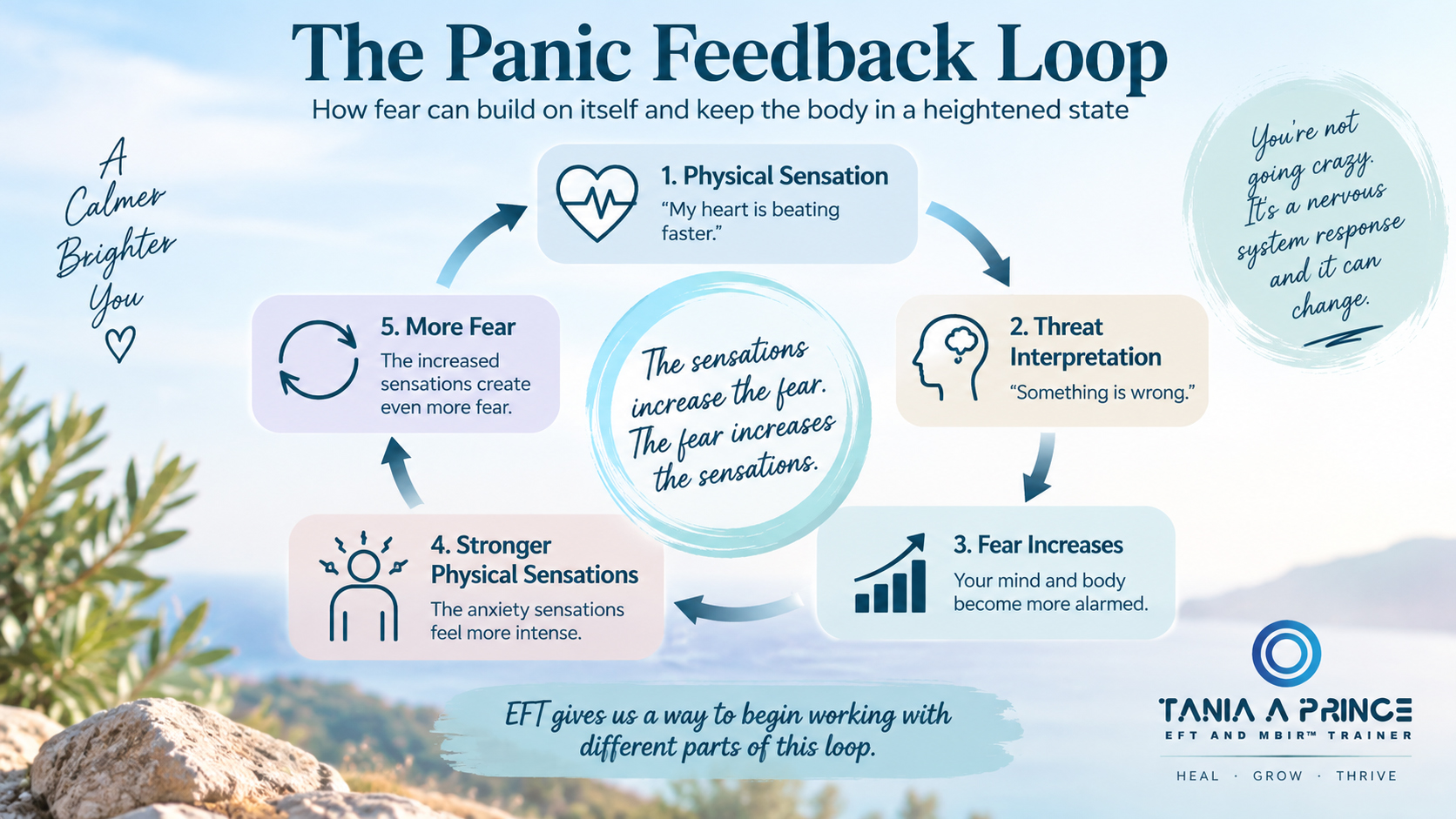
This is one reason panic can become so self-reinforcing.
The person isn’t imagining the physical sensations.
They are real.
But the interpretation of those sensations can sometimes add another layer of threat.
Why Does Panic Feel So Convincing?
During intense fear, the body is preparing to respond to danger.
Your attention may narrow towards anything that could indicate a threat.
That includes sensations inside your own body.
A faster heartbeat that you might normally ignore suddenly becomes extremely important.
A slight change in breathing becomes:
“I can’t breathe.”
Feeling light-headed becomes:
“I’m going to faint.”
A strange sensation becomes:
“Something terrible is happening.”
The more frightening the interpretation, the greater the potential nervous-system response.
This doesn’t mean you should automatically assume physical symptoms are anxiety. New, severe, unusual or concerning symptoms should be medically assessed rather than self-diagnosed as panic.
But when fear and panic are established patterns, understanding the feedback loop can be extremely useful.
How Can EFT Help With Fear and Panic?
EFT combines focusing on an experience with tapping on a sequence of acupoints on the face and upper body.
With fear and panic, there are several different things we might work with:
- The immediate physical sensations
- The thought or image that triggered the fear
- What we are afraid will happen
- The fear of experiencing panic again
- Memories of previous frightening episodes
- Earlier experiences associated with the current trigger
Rather than treating all of these as one problem called “anxiety”, EFT allows us to become more specific.
If You Are Feeling Panicky Right Now
When somebody is highly activated, this is generally not the time to start searching deeply for childhood memories or trying to uncover the origin of the problem.
Start with what is happening now.
Keep it simple.
Notice your surroundings.
Feel the support of the chair or floor beneath you.
Look around and orient yourself to where you actually are.
Then, if tapping feels comfortable, you can tap gently while acknowledging what you notice.
You don’t need complicated words.
You might simply say:
“My heart is beating really fast.”
“There’s all this fear in my body.”
“I can feel this tightness in my chest.”
“My body feels as if something is wrong.”
“I’m noticing how scared I feel.”
The aim isn’t to force the sensations to disappear.
You’re beginning by noticing what is present while tapping.
A Simple EFT Tapping Round for Fear
Before you begin, notice what you are feeling.
You might identify:
“This tightness in my chest.”
or:
“This fear that I’m going to panic.”
If it feels useful, rate the intensity from 0–10.
Then tap on the side of the hand while saying something such as:
“Even though I’m feeling this fear right now, I’m noticing what’s happening in my body.”
Repeat this several times.
Then tap through the points.
Eyebrow:
“This fear.”
Side of Eye:
“My body feels really activated.”
Under Eye:
“This feeling in my chest.”
Under Nose:
“It feels as though something is wrong.”
Chin:
“All this fear.”
Collarbone:
“My body is reacting strongly.”
Under Arm:
“I’m noticing this response.”
Top of Head:
“This fear I’m feeling right now.”
Then pause.
Notice your surroundings again and check what has happened.
Don’t immediately decide whether the tapping has “worked.”
Instead ask:
What’s different now?
The intensity might have reduced.
The physical sensation may have changed location.
A different emotion may have appeared.
A thought or memory may have come into awareness.
Or nothing obvious may have changed yet.
All of that is information.
Work With What You Are Afraid Will Happen
Sometimes the most important part of the fear isn’t the physical sensation.
It’s what you believe the sensation means.
Ask:
“What am I afraid is going to happen?”
The answer might be:
- “I’m going to faint.”
- “I’m going to lose control.”
- “People will notice.”
- “I won’t be able to escape.”
- “I’ll embarrass myself.”
- “I’m going to have another panic attack.”
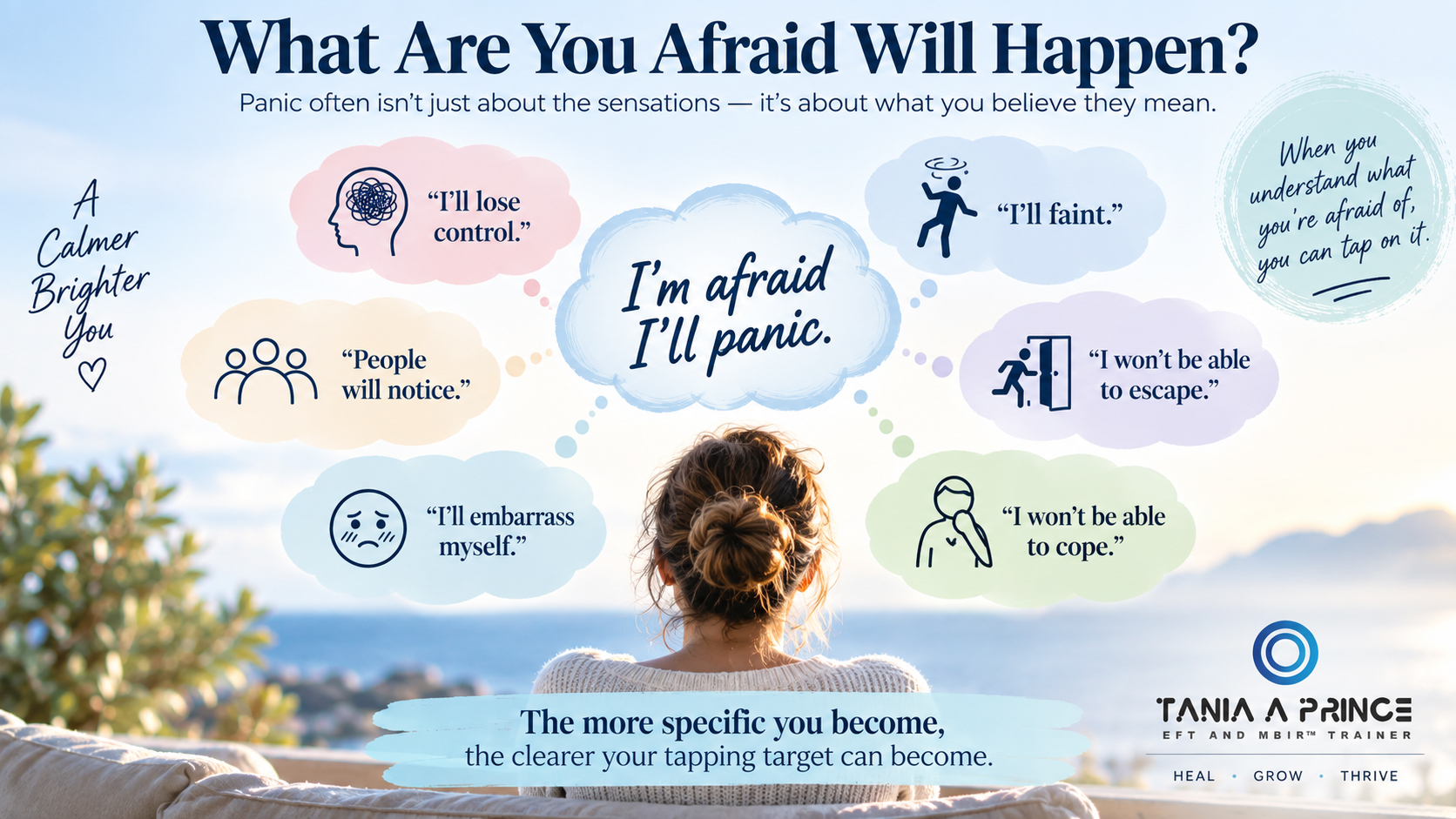
Now you have something more specific to work with.
For example:
“Even though I’m scared I’ll lose control if this feeling gets stronger…”
or:
“Even though I’m afraid people will see me panic…”
Specificity can make an enormous difference.
What Triggered the Fear?
When the immediate activation has reduced, you can become curious about what happened immediately before it began.
What were you:
- seeing?
- hearing?
- thinking?
- imagining?
- remembering?
Perhaps somebody looked at you in a particular way.
Perhaps you noticed a sensation in your chest.
Perhaps you imagined being trapped.
Perhaps you remembered a previous panic attack.
Perhaps you thought:
“I can’t get out of here.”
The trigger is not always obvious.
But when you find it, it can provide a useful tapping target.
Panic Can Become Associated With Places and Situations
After a frightening panic experience, the nervous system may begin associating particular situations with danger.
For example:
- supermarkets
- motorways
- trains
- aeroplanes
- crowded places
- restaurants
- being alone
- being far from home
The person may logically know that the place itself isn’t dangerous.
But their body has learned an association.
This can lead to avoidance.
And avoidance brings relief.
That relief can unintentionally reinforce the pattern:
Situation → fear → avoidance → relief → increased likelihood of future avoidance
The person can gradually begin organising their life around preventing panic.
EFT and the Fear of a Future Panic Attack
If you’ve experienced panic before, you don’t need to wait until another episode occurs before using EFT.
You can work with the anticipation.
Imagine being in the situation where you are afraid panic might happen.
Then notice your response.
For example:
“When I imagine getting onto that train, I immediately feel tension in my stomach.”
Tap on that response.
Then ask:
“What am I afraid will happen next?”
Perhaps:
“I’ll start feeling trapped.”
Tap on that.
Then:
“And if I feel trapped, what am I afraid will happen?”
Perhaps:
“I’ll panic and won’t be able to get off.”
Now the structure of the fear is becoming clearer.
You can work through it one part at a time.
Look for Specific Memories
Current fears can sometimes be linked to earlier experiences.
If you’re afraid of driving, perhaps there was an accident.
If you’re frightened of dogs, perhaps you were chased or bitten.
If public speaking terrifies you, perhaps you remember being laughed at in school.
If you’re afraid of panic, perhaps there was one particular episode when you genuinely thought something terrible was happening.
Instead of tapping broadly on:
“My fear of driving.”
you might eventually work with:
“That moment when the other car pulled out in front of me.”
Or instead of:
“My fear of panic.”
you might work with:
“That moment in the supermarket when my heart started racing and I thought I was going to collapse.”
Specific experiences can sometimes sit underneath much broader fears.
Don’t Force Yourself Into the Worst Part of a Memory
If a fear is connected with trauma, there is no benefit in overwhelming yourself in an attempt to make EFT work faster.
You do not need to deliberately relive an experience at maximum intensity.
You can approach difficult material gradually.
Sometimes it is enough initially to acknowledge:
“There is something about that experience that still feels frightening.”
If even thinking about an event produces overwhelming activation, dissociation, flashbacks or a sense of being unable to stay present, working with an appropriately qualified trauma-informed professional may be safer than attempting to process the experience alone.
What If Tapping Makes the Fear Worse?
Stop.
EFT isn’t about pushing through distress.
Put your attention back into the present environment.
Look around the room.
Notice colours and objects.
Feel your feet on the floor.
Notice the support underneath your body.
You can move, walk around, get some fresh air or do something ordinary that helps you reconnect with your present surroundings.
You can return to tapping later if appropriate.
More intensity does not necessarily mean more therapeutic benefit.
Do You Need Positive Statements?
Not necessarily.
When someone is frightened, saying:
“I am completely safe.”
or:
“Everything is going to be fine.”
may create an internal argument if that isn’t how they feel.
You can start with something more congruent:
“Part of me is really scared.”
“My body is responding as if I’m in danger.”
“I’m noticing this fear.”
As the intensity changes, you may naturally become able to consider something different:
“Maybe I don’t have to solve everything right now.”
“Perhaps I can notice that I’m here, in this moment.”
“Maybe this sensation can change.”
“I can take this one moment at a time.”
This kind of bridging language can sometimes be easier for the nervous system to accept than jumping directly from fear to reassurance.
Fear Is Information
Fear is not evidence that you are weak.
It is a protective response.
The more useful question is:
What is my system responding to?
Is it responding to something happening now?
A physical sensation?
Something you’re imagining?
Something you fear will happen?
A previous panic episode?
An earlier frightening experience?
When we begin to separate these elements, something that initially feels like one enormous problem can become a series of much more specific things to work with.
EFT gives us a way to bring attention to those responses while tapping.
Sometimes the starting point can be remarkably simple:
“This is what I’m noticing right now.”
And from there, you follow what happens next.
When to Seek Professional or Medical Support
Fear and panic symptoms can overlap with symptoms caused by physical health conditions. If you experience new, unexplained, severe or concerning physical symptoms, seek appropriate medical advice rather than assuming they are caused by anxiety.
Professional psychological support is also appropriate if panic attacks are frequent, you’re increasingly avoiding everyday activities, fear is substantially restricting your life, or traumatic memories are involved.
If you feel at immediate risk or unable to keep yourself safe, seek urgent professional or emergency support.
EFT can be a useful self-help tool, but it isn’t a substitute for appropriate medical or psychological care when that is needed.
About Tania A Prince
Tania A Prince is an EFT Founding Master and EFT International Accredited Master Trainer of Trainers with extensive experience working therapeutically and training EFT practitioners. She is also the creator of Mindfulness-Based Inner RePatterning (MBIR™️).
Her work focuses on helping people understand and work with emotional patterns, nervous-system responses and the processes that can keep problems in place.
