
MBIR™️ and the Nervous System: Understanding Regulation and Change

When people struggle with anxiety, overwhelm, emotional reactivity, shutdown or long-established patterns of response, it can be tempting to think that change is primarily a matter of understanding the problem.
But knowing why we respond in a particular way does not necessarily mean that we can respond differently.
A person may understand intellectually that they are safe, yet their body may still react as though there is danger.
They may know that a situation is different from something that happened in the past, yet experience the same surge of anxiety, tension, anger or fear.
Alternatively, rather than becoming highly activated, they may become numb, disconnected, exhausted, frozen or unable to think clearly.
This is one reason nervous-system state matters within MBIR™️.
MBIR™️ — Mindfulness-Based Inner RePatterning — is a therapeutic approach developed by Tania A Prince. It works with present-moment internal experience, nervous-system states, unconscious patterns and the way the mind and body organise experience.
Rather than assuming that change simply comes from talking about or understanding a problem, MBIR™️ pays attention to what is happening within the person now.
An important part of that experience is state.
What Do We Mean by Nervous-System Regulation?
The nervous system is continually responding to information coming from both inside and outside the body.
The autonomic nervous system plays an important role in this process. It contributes to the regulation of functions including heart rate, respiration, digestion and physiological responses to challenge and stress.
Its activity is considerably more complex than the familiar distinction between “fight or flight” and “rest and digest.”
Human responses involve interacting physiological and psychological systems. Changes in attention, perception, emotion, breathing, muscle tension and bodily state can all form part of the experience.
The nervous system is therefore not simply switching between two settings.
It is continually adapting.
And this leads to an important distinction:
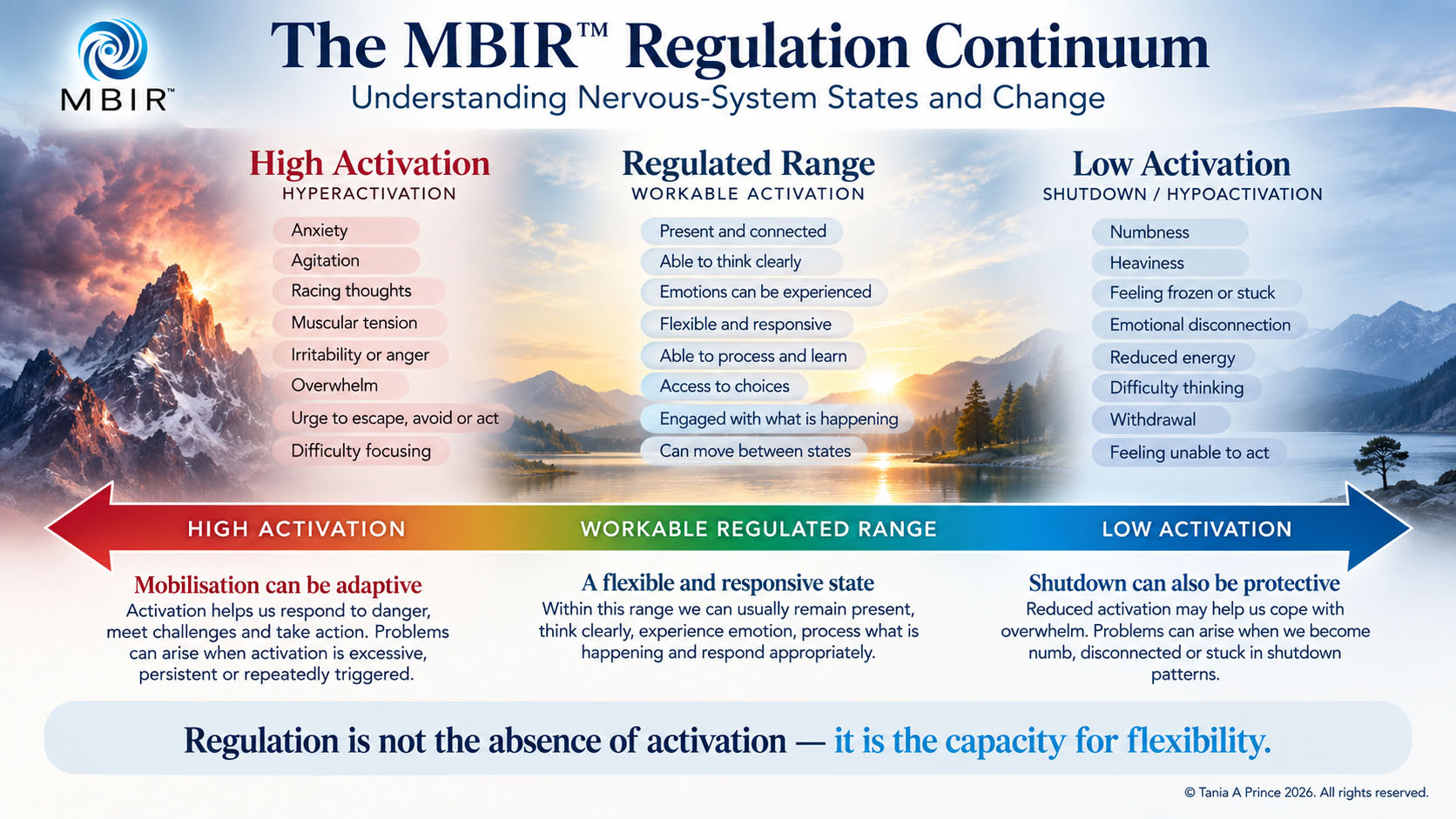
Regulation is not the absence of activation.
A healthy nervous system needs the ability to mobilise.
We need activation to get out of bed, exercise, concentrate, respond to challenges, protect ourselves and take action.
The important issue is flexibility.
Can the system respond appropriately to what is happening and then change as circumstances change?
Or does it repeatedly become overwhelmed, remain highly activated or move towards shutdown?
Within MBIR™️, these distinctions can provide important information about how a person’s experience is being organised.
Activation: When the System Mobilises
When something is experienced as threatening, demanding or important, the body may mobilise resources.
A person might notice:
- increased heart rate
- faster or shallower breathing
- muscular tension
- agitation or restlessness
- heightened alertness
- racing thoughts
- anxiety or fear
- anger or irritation
- an urge to escape, avoid or take action
- difficulty concentrating on anything other than the perceived problem.
These responses are not inherently problematic.
They can be highly adaptive.
If we need to respond rapidly to danger, mobilisation is useful.
Difficulties can arise when activation becomes disproportionate to the present situation, persists after the situation has passed, or is repeatedly triggered by cues associated with previous experiences.
A person may consciously recognise:
“I am safe.”
while experiencing a powerful internal response that seems to communicate:
“Something is wrong.”
This difference between conscious understanding and automatic response helps explain why insight alone does not always produce change.
MBIR™️ works with the experience that is actually occurring rather than assuming that intellectual understanding should automatically override it.
Shutdown, Freeze and Reduced Activation
Not every response to stress involves obvious anxiety or agitation.
At other times, a person may move towards reduced activation, immobilisation or shutdown.
Their experience might include:
- numbness
- heaviness
- feeling frozen or stuck
- emotional disconnection
- difficulty finding words
- reduced energy
- feeling distant or unreal
- difficulty thinking
- withdrawal
- a sense of wanting to disappear
- feeling unable to act.
Terms such as freeze, shutdown, collapse and hypoarousal are used somewhat differently across clinical and theoretical models.
They should therefore not automatically be treated as interchangeable physiological diagnoses.
Within MBIR™️, the starting point is the person’s actual present-moment experience.
What is happening now?
What are they noticing?
What has changed?
What happens when attention moves towards or away from something?
This allows the practitioner to work with what is occurring rather than imposing a theoretical explanation upon the person.
Understanding the Window of Tolerance
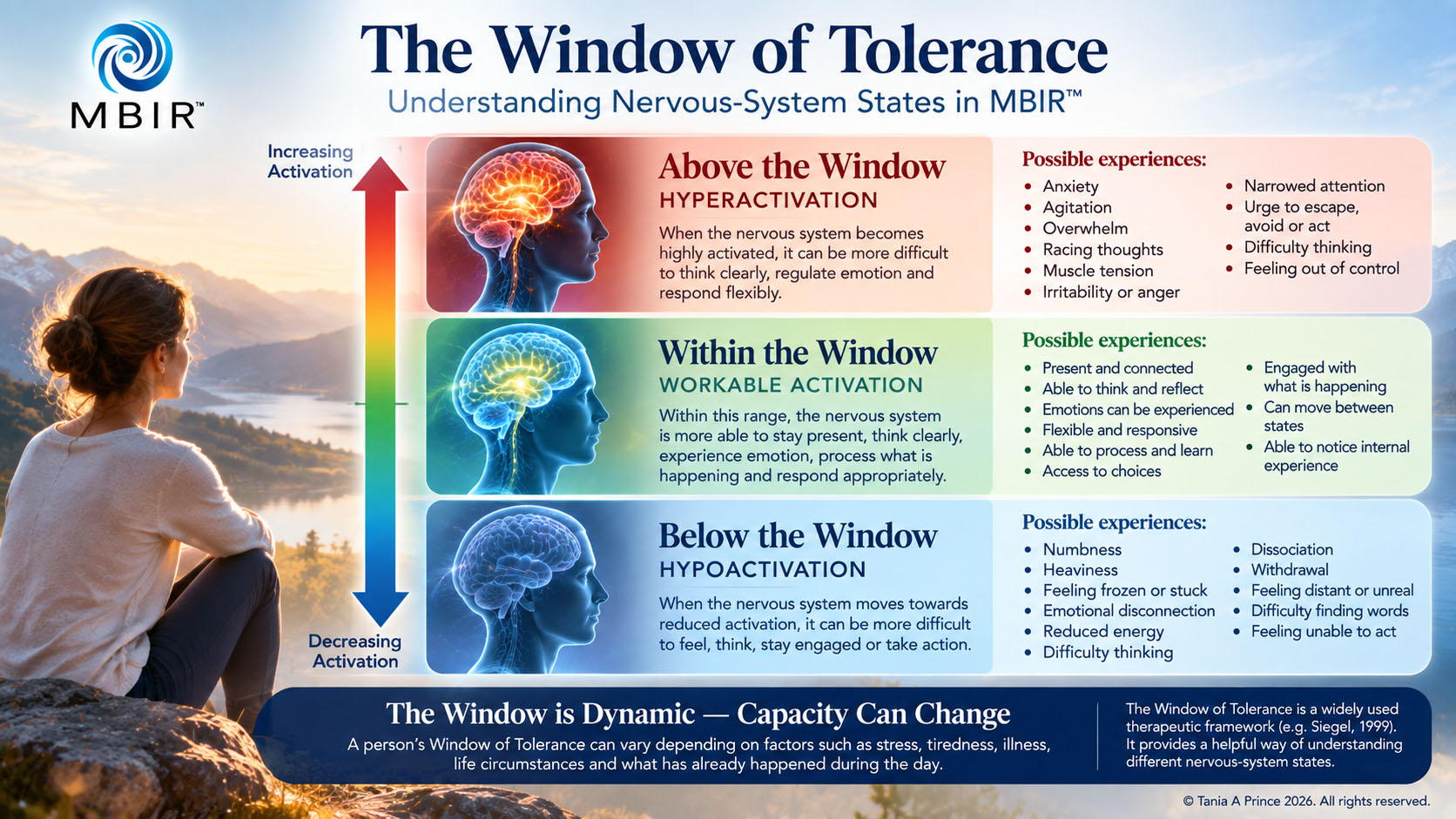
One useful framework for thinking about different degrees of activation is the Window of Tolerance.
The concept describes a range of arousal within which a person can remain sufficiently present and able to engage with what they are experiencing.
Within this range, a person may still experience strong emotions.
Being within the Window of Tolerance does not mean being completely calm.
Someone might experience:
- sadness
- excitement
- anger
- nervousness
- uncertainty
- physical activation
- emotional discomfort
while still being able to think, communicate, notice their internal experience and remain connected with what is happening around them.
The important issue is not whether activation exists.
It is whether that activation remains workable.
Moving Above the Window
As activation increases, a person may reach a point at which processing what is happening becomes increasingly difficult.
They may move through experiences such as:
Activation → Anxiety → Agitation → Overwhelm
Attention may narrow.
Thinking may become less flexible.
Physical sensations may intensify.
The urge to escape, fight, avoid or control the situation may increase.
At very high levels of activation, asking someone to analyse or explore increasingly difficult material may not be useful.
The state of the person therefore becomes important when deciding what happens next.
Moving Below the Window
A person can also move towards reduced activation.
Rather than becoming visibly distressed, they may become:
Quiet → Distant → Numb → Disconnected → Shut Down
They may find it increasingly difficult to answer questions.
They may say:
“I don’t know.”
They may lose access to emotion or find it difficult to describe what they are experiencing.
From the outside, this can sometimes look like calmness.
But:
Stillness is not necessarily regulation.
Recognising this distinction can be particularly important in therapeutic work.
The Window Is Dynamic
The Window of Tolerance should not be thought of as a fixed measurement.
A person’s capacity can change.
The same situation that feels manageable on one occasion may feel overwhelming on another.
Accumulated stress, tiredness, illness, interpersonal conflict and what has already happened during the day may all influence how much additional activation someone can comfortably manage.
This means regulation is dynamic.
Instead of simply asking:
“Is this person regulated?”
MBIR™️ encourages attention to a more immediate question:
“What is happening within this person right now?”
Why State Matters in MBIR™️
MBIR™️ does not treat nervous-system state simply as background information.
State is part of the information available within the MBIR™️ process.
Changes in breathing, posture, facial expression, muscle tension, voice, attention, imagery, emotion and bodily sensation can provide useful feedback about what is happening internally.
This is one reason MBIR™️ places importance on awareness and sensory acuity.
The practitioner is not simply listening to the person’s story.
They are also paying attention to the process unfolding in the present.
A seemingly small change can be significant.
A breath may deepen.
The shoulders may release.
The person’s face may soften.
Their voice may change.
An emotion may emerge.
An internal image may alter.
Or the person may suddenly become quieter, more distant or less responsive.
These changes provide information.
Within MBIR™️, they are not automatically interpreted according to a predetermined theory.
Instead, they become part of the feedback that guides what happens next.
Regulation Is Not the Same as Relaxation
This is an important distinction within MBIR™️.
The objective is not to keep someone relaxed all of the time.
Nor is every uncomfortable state something that needs to be removed.
Human beings naturally move through different degrees of activation.
There are times when we need energy, focus and mobilisation.
There are times when we need rest.
There are times when strong emotion is an entirely appropriate response to what is happening.
Regulation is therefore better understood in terms of flexibility rather than permanent calmness.
A flexible system can respond to circumstances and change as those circumstances change.
Difficulties may arise when responses become rigid, persistent or repeatedly activated in situations where they are no longer useful.
Protective Responses May Have Had a Purpose
Many responses that later create difficulties may originally have served an important function.
Avoidance may have helped someone reduce exposure to something overwhelming.
Anger may have helped create distance or protection.
Emotional numbing may have reduced the immediate impact of an experience that felt impossible to process.
Heightened vigilance may have been useful in an unpredictable environment.
MBIR™️ does not need to begin by labelling these responses as defects.
Instead, the response can be recognised as part of a pattern that may have developed for a reason.
This opens up an important question:
“Is this response still needed now?”
That creates a very different starting point for change.
Why Repeatedly Retelling the Story Is Not Always Necessary
One of the important principles within MBIR™️ is that therapeutic change does not necessarily require someone to repeatedly revisit or describe every detail of a difficult experience.
Talking about an event can itself change a person’s state.
For some people, detailed retelling may substantially increase activation.
For others, the opposite may happen.
They may become increasingly distant, numb or disconnected from what they are describing.
MBIR™️ therefore pays attention not simply to what a person is talking about, but also to what happens internally as they talk about it.
The work can then respond to what is happening in the present.
This means that maximum emotional activation is not assumed to be necessary for change.
The Safe State in MBIR™️
An important element within MBIR™️ is the Safe State.
The Safe State is not simply an instruction to relax.
It involves helping the person access an internal experience associated with sufficient safety, stability or resourcefulness.
This introduces something experientially different from the problematic state.
That distinction is important.
Instead of focusing exclusively on what is wrong, the person can experience another way in which their internal world can be organised.
The Safe State can also provide an important reference point during the MBIR™️ process.
If activation begins to increase beyond what appears useful, attention can move towards greater stability rather than continuing to intensify the problematic experience.
The aim is not avoidance.
It is to support the conditions in which useful therapeutic work can continue.
Regulation Before Deeper Work
There is sometimes an assumption that effective therapy requires reaching the deepest or most painful material as quickly as possible.
MBIR™️ does not make that assumption.
More activation does not necessarily mean more therapeutic change.
If someone becomes overwhelmed, their ability to observe what is happening, access resources, make distinctions and engage flexibly with the process may diminish.
Similarly, if they move substantially towards shutdown or disconnection, continuing to pursue difficult material may not be useful.
At these points, the immediate therapeutic priority may change.
Instead of asking:
“How do we get deeper into this?”
the more useful question may be:
“What does this person need right now?”
Sometimes that means continuing.
Sometimes it means slowing down.
Sometimes it means reducing activation.
Sometimes it means returning attention to resources or the Safe State.
Sometimes it means simply noticing what is happening without trying to change it immediately.
This responsiveness is an important part of MBIR™️.
Regulation Creates Conditions for RePatterning
Regulation is important within MBIR™️, but regulation alone is not the whole process.
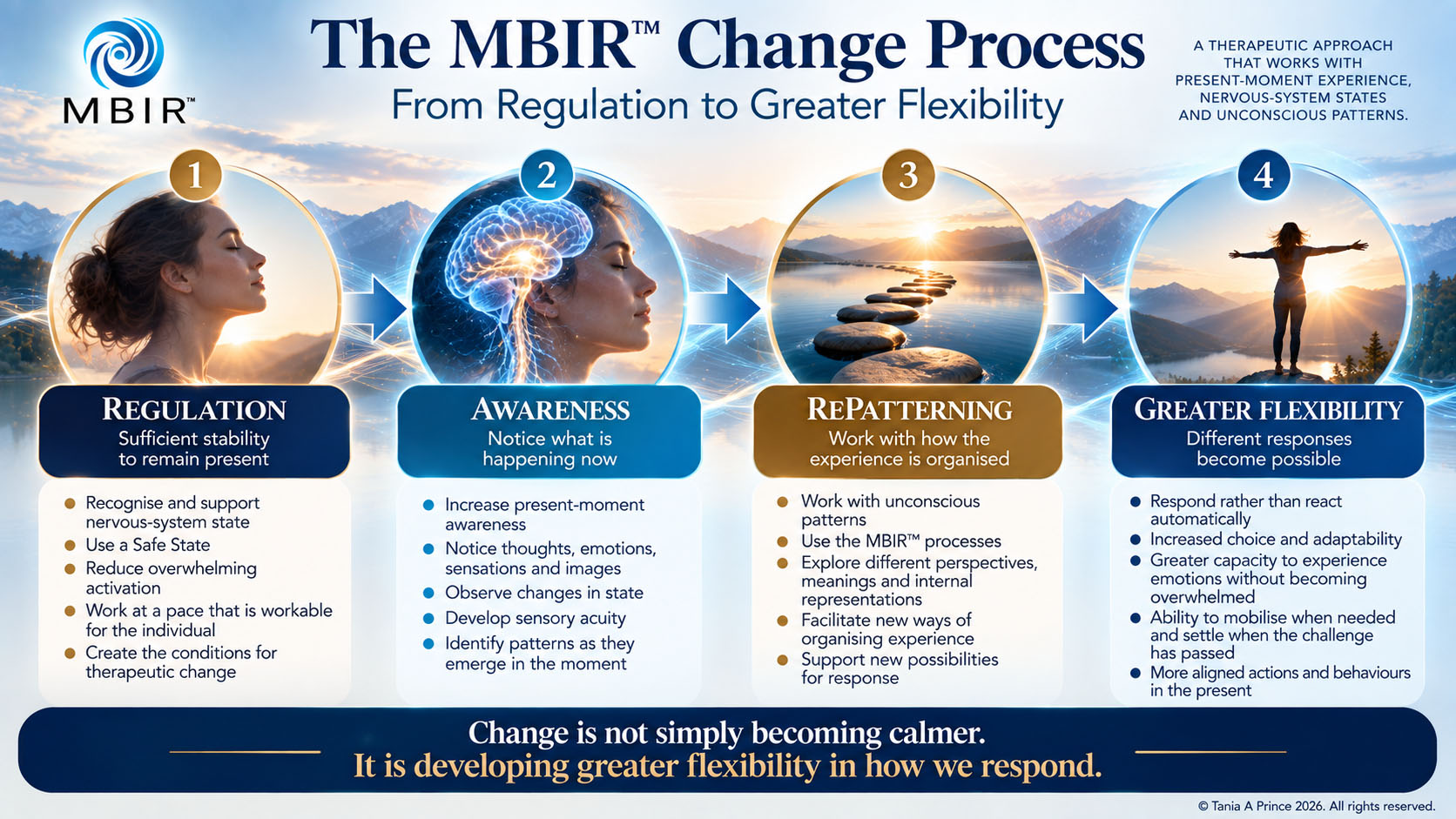
It can help create the conditions within which RePatterning can occur.
When someone has sufficient capacity to remain present with their experience, they may become able to notice distinctions that were previously outside awareness.
They may notice:
- an internal image
- a bodily sensation
- an emotion
- a belief or meaning
- an internal voice
- an expectation
- an impulse
- conflicting responses
- different aspects or parts of themselves
- an automatic association.
Rather than immediately analysing these experiences, MBIR™️ can work with how they are organised and how they change.
This is where regulation and RePatterning come together.
From Automatic Reaction to Present-Moment Awareness
Many problematic patterns feel instantaneous.
Something happens and the person reacts.
It can seem as though there is no gap between trigger and response.
From the person’s perspective it may initially appear to be:
Trigger → Reaction
Closer attention may reveal considerably more information:
Trigger → Internal Change → Pattern Activates → Response
The internal change might involve a sensation, image, thought, emotional shift, internal dialogue, meaning or change in bodily state.
MBIR™️ brings attention to this present-moment internal experience.
As previously automatic elements of the pattern become available to awareness, new possibilities for responding may emerge.
Mind and Body Are Part of the Same Experience
MBIR™️ does not begin with the assumption that psychological problems exist solely as thoughts.
Human experience is embodied.
Stress may involve changes in:
- breathing
- heart rate
- muscle tension
- posture
- attention
- perception
- imagery
- emotion
- thinking
- behaviour.
These processes influence one another.
A change in thought may affect the body.
A change in bodily state may influence perception.
A change in perception may alter emotion.
A change in emotion may affect internal imagery or meaning.
MBIR™️ therefore works with the experience as an interconnected process rather than insisting that change must begin in one particular place.
Change Is More Than Becoming Calm
One potential misunderstanding of nervous-system-informed therapeutic work is the idea that successful therapy should always result in greater calmness.
That is not necessarily the case.
Imagine someone who has habitually frozen when they need to establish a boundary.
A more adaptive response might initially involve greater activation.
They may experience more energy.
Their posture may change.
Their voice may become stronger.
They may become aware of anger that was previously inaccessible.
They may become more able to say no.
In this situation, simply measuring whether the person has become calmer would miss the significance of the change.
Within MBIR™️, a more useful question is:
“Has the person’s response become more flexible, appropriate and useful in the present?”
That distinction is central to understanding regulation and change.
Regulation and RePatterning
The RePatterning within MBIR™️ is significant.
MBIR™️ is not simply intended to help someone manage an unwanted state.
It works with the way experience is being internally organised.
A pattern might involve interactions between:
Trigger → Perception → Internal Representation → Body State → Emotion → Meaning → Response
These elements do not necessarily occur in a simple linear sequence.
They may interact rapidly.
One may influence another and feed back into the rest of the experience.
For example, a bodily sensation may alter a person’s interpretation of a situation.
That interpretation may increase activation.
The increased activation may intensify the bodily sensation.
The stronger sensation may then appear to confirm the person’s original interpretation.
A feedback loop can develop.
MBIR™️ works with what becomes available within this process rather than requiring the practitioner to assume in advance where the problem originates.
As the organisation of the experience changes, the person’s response may also change.
The Goal Is Greater Flexibility
From an MBIR™️ perspective, regulation should not be reduced to moving everyone towards one ideal nervous-system state.
The broader objective is greater adaptive flexibility.
Can the person mobilise when mobilisation is useful?
Can they settle when the challenge has passed?
Can they experience emotion without automatically becoming overwhelmed?
Can they notice what is happening internally?
Can they remain sufficiently connected to the present?
Can they access different responses?
Can an old automatic pattern become less dominant?
Can another possibility become available?
This is very different from trying to eliminate difficult emotions.
Why This Matters for Therapeutic Change
People do not experience problems purely through language.
They experience them through an interconnected system involving thoughts, emotions, sensations, perceptions, memories, internal representations, expectations, meanings and physiological states.
This helps explain why simply knowing something intellectually may not change the response.
A person may already know:
“That happened years ago.”
“This person isn’t the person who hurt me.”
“I don’t need to react this way.”
“There is nothing dangerous happening right now.”
Yet the response continues.
MBIR™️ works with the experience at the level at which it is currently being organised rather than relying solely on intellectual understanding.
From “What Happened?” to “What Is Happening Now?”
History can matter.
Understanding what happened to someone can matter.
But MBIR™️ introduces another important question:
“What is happening within you now?”
That question moves attention towards the living pattern occurring in the present.
What happens in the body?
What emotion appears?
What image emerges?
What meaning is attached to it?
What changes?
What happens next?
Past experiences may be relevant, but they become therapeutically accessible through the ways in which they are represented and experienced in the present.
This is one of the defining features of MBIR™️.
Regulation, Awareness and Change
Understanding nervous-system state gives us an important perspective on why change cannot always be achieved simply through conscious reasoning.
Our responses are influenced by an interconnected system of physiological state, perception, emotion, meaning and learned patterns.
MBIR™️ works with that system as it becomes available in present-moment experience.
The aim is not to eliminate activation.
It is not to make someone permanently calm.
And it is not necessarily to repeatedly revisit the story of what happened.
Instead, MBIR™️ creates a framework for noticing how experience is organised, recognising changes in state, supporting sufficient regulation and working with the patterns that emerge.
In simple terms:
Regulation → Awareness → RePatterning → Greater Flexibility
As automatic patterns become available to awareness and the organisation of the experience changes, different responses can become possible.
That is why nervous-system state matters within MBIR™️.
What Is MBIR™️?
MBIR™️ is the primary trademark for Mindfulness-Based Inner RePatterning, a therapeutic approach created and developed by Tania A Prince.
MBIR™️ works with present-moment internal experience, nervous-system states, unconscious patterns and the way the mind and body organise experience.
Rather than assuming that therapeutic change requires repeated detailed exploration of difficult experiences, MBIR™️ works with what is happening within the person now and with the patterns that become available through that process.
The approach brings together awareness, regulation and RePatterning within a structured therapeutic framework designed to support greater flexibility and choice.
Important Note
Concepts relating to autonomic regulation and the Window of Tolerance can provide useful frameworks for understanding different responses to stress and activation.
They should not be used to diagnose a person’s physiological or psychological state from isolated behaviours.
MBIR™️ is a distinct therapeutic approach developed by Tania A Prince. References to established concepts from psychology, neuroscience and trauma-informed practice provide context for aspects of the approach. Research relating to those individual concepts should not be interpreted as independent scientific validation of MBIR™️ itself.
Interested in Learning MBIR™️?
If you are interested in learning MBIR™️ professionally, find out more about the MBIR™️ Practitioner Certification and upcoming training.