
EFT for Complex Trauma: Can Tapping Help With Complex Trauma?

Complex trauma can affect far more than memories of difficult experiences. When someone has lived through repeated, prolonged or inescapable experiences of threat, particularly during childhood or within important relationships, the adaptations that helped them cope at the time can continue to influence how they respond to life long after the original circumstances have changed.
A person may intellectually know that they are safe and yet react as though they are not. They may experience anxiety, hypervigilance, emotional overwhelm, anger, shutdown, difficulties within relationships, shame, avoidance or a persistent expectation that something is about to go wrong.
Sometimes these reactions seem completely out of proportion to what is happening in the present.
That does not necessarily mean they are without logic.
The logic may simply belong to an earlier experience.
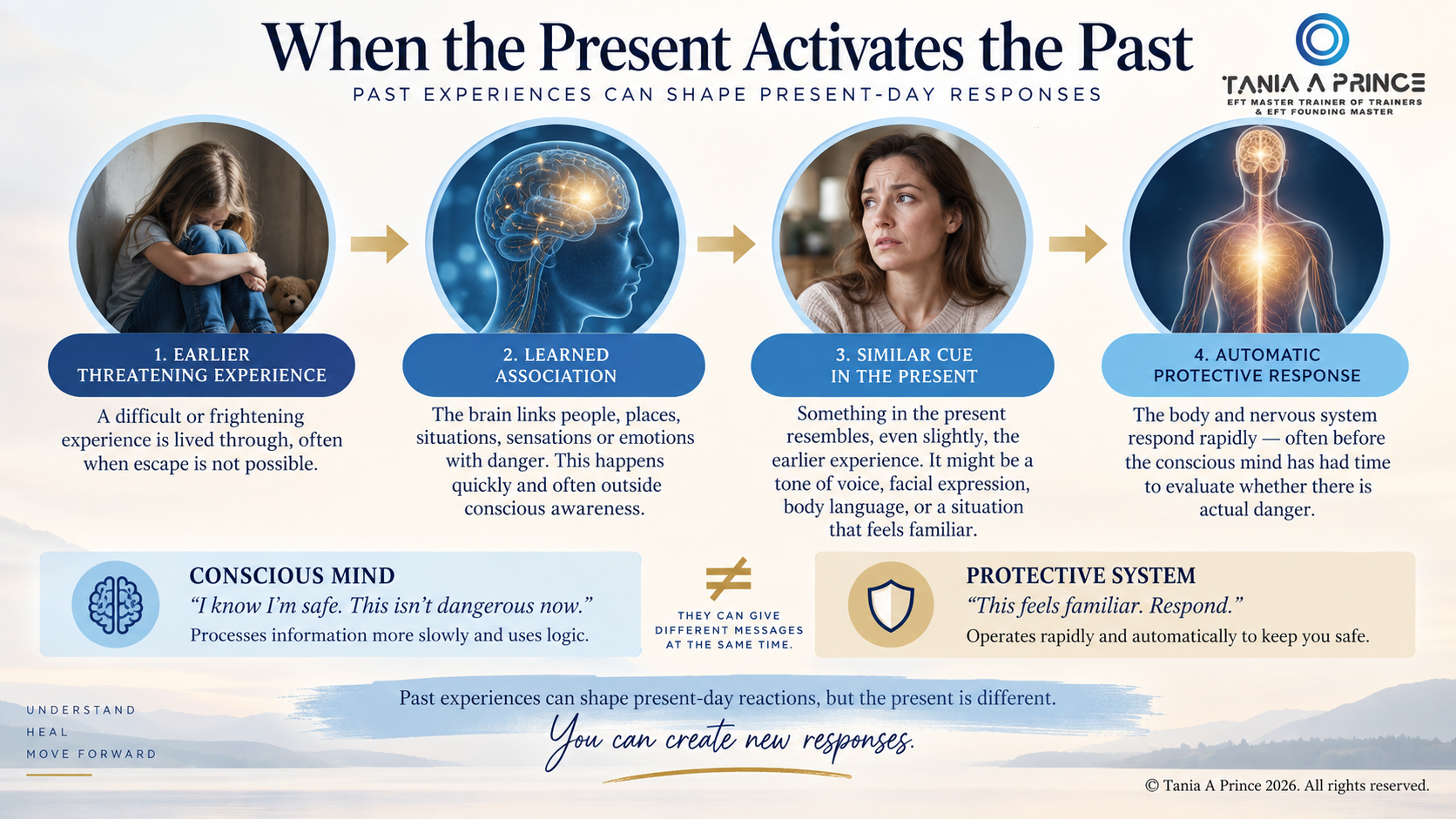
One of the most important things to understand about trauma is that survival requires speed. When the nervous system detects something associated with previous danger, protective responses can be activated rapidly, before the conscious mind has had time to fully evaluate what is happening.
Emotional Freedom Techniques (EFT), commonly known as tapping, offers a way of working with some of these responses. With complex trauma, however, the way EFT is used is particularly important.
What Is Complex Trauma?
Complex trauma generally refers to the impact of repeated, prolonged or multiple traumatic experiences rather than one isolated event.
These experiences are often interpersonal and may occur within circumstances where the person has little control or limited ability to escape.
Examples can include childhood abuse or neglect, persistent emotional abuse, domestic abuse, coercive relationships, repeated exposure to violence, chronic instability or growing up in an environment in which safety, affection or connection were unpredictable.
Complex trauma can also result from multiple traumatic experiences occurring at different points throughout someone’s life.
This differs somewhat from trauma associated with a single identifiable event.
Someone involved in a serious road accident, for example, may be able to identify a particular event after which their difficulties began.
With complex trauma, there may be no single event.
There may instead have been hundreds of experiences through which the person learned what to expect from themselves, other people and the world.
Complex Trauma and Complex PTSD Are Not the Same Thing
The terms complex trauma and Complex PTSD are sometimes used as though they mean exactly the same thing, but there is an important distinction.
Complex trauma describes exposure to repeated or prolonged traumatic experiences and their possible effects.
Complex Post-Traumatic Stress Disorder, or CPTSD, is a specific diagnostic condition recognised within ICD-11.
CPTSD includes the core PTSD features of re-experiencing, avoidance and a persistent sense of current threat. It also involves difficulties with emotional regulation, a persistently negative view of oneself and difficulties sustaining relationships and feeling close to others.
A person can have experienced complex trauma without necessarily meeting the diagnostic criteria for CPTSD.
What Happens During a Traumatic Experience?
Under ordinary circumstances, we are continually processing experience.
We take in information from the environment, interpret what is happening, connect it with previous knowledge and update our understanding according to what occurs.
During significant threat, priorities change.
Imagine walking through a park and suddenly seeing a large dog charging towards you, barking aggressively.
Your immediate priority is not to analyse the breed of dog, consider why it might be behaving that way and logically calculate the probability of being bitten.
Your system needs to respond.
Attention and resources are prioritised towards survival.
You may run, prepare to defend yourself, freeze or respond in some other way.
This ability to respond rapidly is essential.
The difficulty can arise when something associated with an earlier threatening experience later activates the protective response even though the original danger is no longer present.
Survival Requires Speed
Imagine stepping into a road and suddenly noticing a vehicle travelling rapidly towards you.
You don’t want to stand there consciously calculating its speed, distance and braking capability before deciding whether to move.
You need to move.
Survival systems therefore need to be capable of operating rapidly and automatically.
This is important when trying to understand trauma.
Something associated with a previous threatening experience may activate a response before conscious reasoning has fully evaluated whether the present situation is actually dangerous.
With complex trauma there may be many associations rather than one obvious trigger.
It might be a facial expression.
A tone of voice.
Someone becoming quiet.
A door closing.
Being criticised.
Someone standing too close.
Feeling trapped.
Someone taking longer than usual to answer a message.
Making a mistake.
Even kindness or emotional intimacy can potentially activate protective responses if closeness was historically associated with danger, rejection, unpredictability or loss.
Consciously, the person may know:
“I’m safe.”
But their automatic protective response may be communicating something very different:
“I’ve encountered something like this before. Be ready.”
The Boxer Who Froze
Many years ago, when I was young, my brothers and some of their friends were involved in boxing.
One of their friends was a big, tough-looking young man who trained alongside them.
But whenever he got into the boxing ring, something happened.
He froze.
His friends interpreted his behaviour as cowardice. At the time, none of us had the understanding of trauma and nervous-system responses that we have today.
But there was something important about his behaviour that is easy to overlook.
He was willing to get into that ring.
He had trained. He knew what boxing involved. He chose to step through the ropes.
Yet once he was there, he froze.
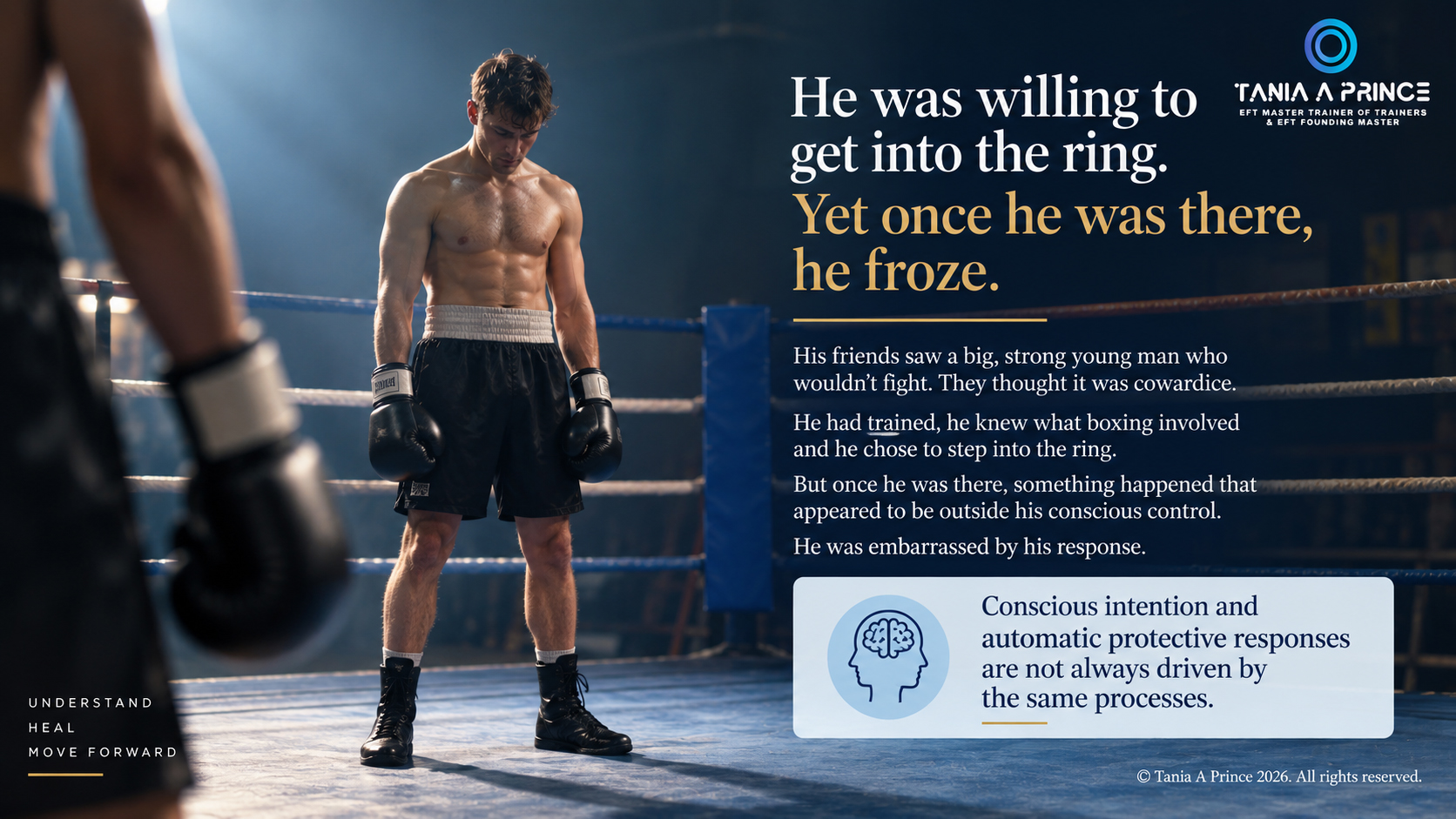
I also remember that he was embarrassed by his response.
Looking back with what I now understand about trauma, I see another possible explanation.
Something about being in that ring — facing another person preparing to hit him, the stance of his opponent, being unable to simply walk away or something else entirely — may have activated an automatic protective response.
We cannot know what caused his reaction or whether it was related to previous trauma. But if it was connected with earlier learning, those experiences could potentially have occurred much earlier in his life.
He would not necessarily have needed to consciously remember them or understand the connection.
What makes the example so interesting is the difference between his conscious intention and what happened automatically.
His conscious decision to enter the ring and his automatic response once he was there were not necessarily being driven by the same processes.
Consciously, he wanted to box.
He voluntarily entered the ring.
But when the situation became real, something happened that appeared to be outside his conscious control.
Then came the embarrassment.
This secondary reaction is important because people frequently judge themselves for their automatic responses.
They might think:
Why did I react like that?
Why couldn’t I just handle it?
Why am I frightened when I know there’s nothing to be frightened of?
What’s wrong with me?
But these questions assume that the original response was consciously chosen.
A freeze response isn’t something a person simply decides to have.
Sometimes behaviour that appears irrational in the present becomes much more understandable when we consider what the protective system may have learned in the past.
When the Present Activates the Past
Imagine someone who grew up with a highly unpredictable parent.
Sometimes the parent was warm and affectionate. At other times they became angry without warning.
The child may become extremely skilled at detecting subtle changes in facial expression, posture, movement and voice.
That sensitivity could be extremely useful.
It might help them anticipate what was going to happen next.
Years later, that person may be living in a completely different environment and have a safe adult relationship.
One evening their partner comes home after a difficult day and is unusually quiet.
Nothing threatening has happened.
Yet within seconds, the person’s stomach tightens. Their breathing changes. Their attention becomes intensely focused on their partner.
They begin thinking:
What’s wrong?
Have I done something?
Are they angry with me?
Their partner may simply be tired.
But the present-day cue — someone important becoming unusually quiet — resembles something that previously preceded danger.
The response can therefore begin before the conscious mind has established what is actually happening.
Viewed only from the present, the reaction may seem excessive.
Viewed in the context of previous learning, it may make considerably more sense.
Fight, Flight, Freeze and Shutdown
Protective responses are not limited to fear or anxiety.
When danger is perceived, mobilisation can occur. Someone may experience increased energy, agitation, anger, fear, muscle tension or a powerful urge to escape. These responses are commonly described as fight and flight.
When fighting or escaping does not appear possible, different responses may occur.
A person might freeze, become numb, disconnect from their emotions, struggle to think or move towards shutdown.
Some people develop strong appeasement strategies. They become highly attentive to other people’s emotional states, avoid disagreement, suppress their own needs or automatically try to keep everyone around them happy.
Again, these behaviours may make more sense when we ask what function they originally served.
Complex Trauma Can Shape Relationships
Complex trauma is often interpersonal.
If difficult experiences repeatedly occurred within important relationships, the person may have learned that connection itself carries risk.
They may desperately want closeness while simultaneously feeling unsafe when someone becomes emotionally close.
They might fear abandonment while also pushing people away.
They might find it extremely difficult to say no.
Conflict may feel dangerous rather than merely uncomfortable.
Small signs of rejection may trigger powerful emotional responses.
A delayed message, change in someone’s voice or slightly different facial expression may carry far more significance than another person would expect.
Again, this doesn’t mean the person is deliberately overreacting.
Their protective system may be responding to what those cues have previously meant.
Trauma Is Not a Substance Stored in the Body
It has become increasingly common to hear trauma described as though it were a physical substance stored somewhere within the body that simply needs to be released.
This can be misleading.
Trauma can involve changes in memory, emotional learning, attention, perception, meaning and nervous-system responses.
The body is clearly involved.
Someone experiencing activation may notice changes in breathing, heart rate, muscle tension, temperature, digestion, movement or sensation.
During shifts in state, people may naturally cry, sigh, yawn, shake, laugh, burp or experience changes in breathing.
These can accompany changes in autonomic state.
But this does not mean that trauma itself is literally a substance being expelled from the tissues.
It may be more useful to think about helping the nervous system become increasingly able to respond appropriately to what is happening now, rather than automatically responding according to what happened then.
How Can EFT Help With Complex Trauma?
EFT combines focused attention with tapping on a sequence of acupressure points.
When working with complex trauma, the aim does not have to be to immediately find the worst traumatic experience and start tapping on it.
In some circumstances, doing this could be overwhelming.
A more gradual approach may begin with helping the person develop greater stability and working with what is happening in the present.
For example:
Even though my chest tightens when someone sounds angry…
Even though part of me expects something bad to happen…
Even though I want to disappear when someone criticises me…
Even though I know I’m safe, something in me is still reacting…
The current response becomes the starting point.
The person does not necessarily need to immediately tell the entire story of what happened to them.
You Don’t Always Need to Know the Original Memory
This can be particularly important when working with complex trauma.
People sometimes assume they need to identify the first traumatic experience and remember exactly what happened before therapeutic change can occur.
That is not always necessary.
Sometimes the present-day trigger gives us enough information to begin.
Suppose someone becomes intensely anxious whenever another person is disappointed with them.
Rather than immediately searching childhood for the origin of that reaction, we might become curious about what is happening now.
Where is the response experienced?
What happens when they imagine the other person’s disappointment?
What do they expect will happen next?
What feels dangerous about the situation?
What do they feel compelled to do?
Run?
Fight?
Freeze?
Explain?
Apologise?
Hide?
Make the other person happy?
As the response changes, memories or associations may arise naturally.
If they do, they can be approached carefully.
If they don’t, meaningful therapeutic work may still be possible.
Why You Shouldn’t Rush Trauma Work
There can be a temptation to assume that if EFT can reduce emotional intensity, the quickest route to change must be to find the worst traumatic memory and start tapping.
With complex trauma, this may not be appropriate.
Someone who has spent years surviving overwhelming circumstances may have developed highly effective protective strategies.
These could include avoidance, emotional numbing, intellectualising, dissociation or losing conscious access to certain memories and emotions.
It can be tempting to regard these responses as resistance.
I prefer to become curious about them.
What is this response doing for the person?
What might it be protecting them from?
What would need to change for that protection to no longer be necessary?
Trying to force our way through a protective response can miss the very reason it developed.
Stabilisation Before Deeper Work
For some people, considerable work may need to take place before directly approaching traumatic memories.
This can involve developing an ability to notice internal experience without immediately becoming overwhelmed, recognising early signs of activation, developing ways to regulate, establishing resources and increasing the person’s sense of choice and control.
EFT can potentially form part of this stabilisation process.
Progress does not have to be measured by how much traumatic material has been uncovered.
Other questions can be far more useful.
Can the person recognise activation earlier?
Can they remain present rather than immediately becoming overwhelmed?
Can they recover more easily after being triggered?
Can they increasingly distinguish between past danger and present circumstances?
Can they experience an emotion without immediately shutting down?
Can they pause where previously they reacted automatically?
These can represent significant changes.
Working Gently With Traumatic Memories
When it does become appropriate to work with a traumatic memory, EFT provides ways of approaching it without requiring immediate immersion in the most distressing aspects of the experience.
A person may initially work with the thought of the memory rather than the memory itself.
They might give the event a neutral title.
They might work with their reaction to simply knowing that the event happened.
Or the work might focus on one small aspect of an experience rather than everything at once.
The process can be paced.
If activation becomes too intense, the focus can return to stabilisation and present-moment resources.
Trauma therapy should not become a test of how much distress someone can tolerate.
Dissociation Requires Particular Care
Some people with complex trauma may experience dissociation.
They might disconnect from emotion, physical sensation, their surroundings or aspects of an experience when activation becomes too great.
Importantly, someone who appears calm is not necessarily regulated.
They may have moved towards shutdown or disconnection.
This is why trauma-informed practitioners need to pay attention to more than someone’s reported level of emotional intensity.
Changes in voice, facial expression, eye focus, breathing, posture, responsiveness and ability to remain oriented to the present may all provide useful information.
Significant dissociation may require specialist trauma assessment and support, and practitioners need to work within their professional competence and scope of practice.
The Aim Is Not to Eliminate Protective Responses
Fight, flight, freeze and other protective responses are not defects.
We need them.
If you encounter genuine danger tomorrow, you want your protective system to respond.
The aim is therefore not to remove our ability to protect ourselves.
The problem arises when a protective response that was appropriate then is repeatedly activated by circumstances that are safe now.
Therapeutic work can help create greater flexibility.
Instead of the system automatically following an old pattern, there can increasingly be space for new information and different responses.
Can EFT Cure Complex Trauma?
It would be inappropriate to claim that EFT is a guaranteed cure for complex trauma or CPTSD.
Complex trauma can affect many areas of a person’s life, and appropriate treatment depends upon the individual, their circumstances, symptoms, level of stability and clinical needs.
Research into EFT has reported improvements in trauma-related and PTSD symptoms in some populations. This does not mean that every person with complex trauma will respond in the same way, nor should EFT replace appropriate medical, psychiatric or psychological care when this is required.
For some people, EFT may form one part of a broader trauma-informed approach.
Choosing an EFT Practitioner for Complex Trauma
When working with complex trauma, practitioner skill matters.
Trauma-informed EFT involves considerably more than knowing the tapping points and the EFT Basic Recipe.
A practitioner needs to understand how to pace therapeutic work, recognise changes in nervous-system state, respond appropriately to possible dissociation, avoid unnecessarily overwhelming the client and recognise when something falls outside their professional competence.
They also need to be willing to slow down.
Sometimes the most appropriate therapeutic decision is not to go deeper.
It is to recognise that enough has happened for today.
Understanding the Person Rather Than Judging the Response
One of the most important changes that can occur in trauma work is when seemingly confusing behaviour begins to make sense.
Hypervigilance may once have helped someone anticipate danger.
Appeasing others may have reduced conflict.
Emotional numbing may have made overwhelming circumstances more manageable.
Freezing may have been the best protective option available when fighting or escaping was impossible.
Disconnecting may have created psychological distance from something the person could not physically escape.
These patterns can cause significant difficulties later in life, but understanding their possible function changes the question.
Instead of asking:
“What is wrong with me?”
we can begin asking:
“What did my system learn, and does it still need to respond this way now?”
I think back to that young boxer.
From the outside, his friends saw a big, strong young man who stepped into a boxing ring and then froze. They judged the behaviour they could see.
But they couldn’t see what was happening inside him.
Neither could he necessarily understand it.
He was embarrassed by a response that may not have been under conscious control.
That is something worth remembering when we work with trauma.
The behaviour we see today may be the visible part of a protective response whose origins we cannot see.
EFT may provide one way of working gently with these learned associations and present-day responses, without assuming that the person needs to force themselves back into every traumatic experience.
For complex trauma, change does not necessarily begin by forcing open the past.
Sometimes it begins by helping the person experience, at a much deeper level:
This is now. That was then.
Important Note
This article is for educational purposes and is not a substitute for individual medical, psychiatric or psychological assessment or treatment. Complex trauma and CPTSD can involve significant symptoms, including dissociation and difficulties with emotional regulation. Anyone experiencing severe symptoms, feeling unsafe or having thoughts of harming themselves or others should seek appropriate professional or emergency support.
About Tania A Prince
Tania A Prince is an EFT Founding Master and EFT International Accredited Master Trainer of Trainers. She has worked therapeutically for more than three decades and has trained EFT practitioners for over 26 years.
Her approach to trauma work emphasises careful pacing, stabilisation, respect for protective responses and understanding what a response is doing for the individual rather than simply attempting to remove it.
