
EFT for PTSD: Can Tapping Help With Post-Traumatic Stress?

Post-traumatic stress disorder (PTSD) can develop following an experience, or series of experiences, that overwhelm a person’s ability to cope.
Long after the original danger has passed, something associated with what happened can trigger a powerful emotional and physiological response. A sound, smell, facial expression, tone of voice, place, physical sensation or seemingly unrelated situation may suddenly produce fear, tension, panic, anger, an urge to escape, freezing or shutdown.
The person may consciously know that they are safe, yet their system can react as though the original danger is happening again.
Understanding why this happens is important when considering how Emotional Freedom Techniques (EFT), commonly known as tapping, may be used with post-traumatic stress.
EFT combines focused attention on aspects of an experience with tapping on a sequence of acupoints, primarily on the face and upper body. There is a growing body of research investigating EFT for PTSD, with encouraging findings. However, when significant trauma is involved, how EFT is used is extremely important.
Trauma work is not simply about finding the worst memory and tapping on it.
What Is PTSD?
PTSD stands for post-traumatic stress disorder.
It can develop following exposure to extremely threatening or distressing events. Not everyone who experiences trauma develops PTSD, and people’s responses to traumatic experiences vary considerably.
Symptoms can include intrusive memories, nightmares, flashbacks, avoidance of reminders of the trauma, hypervigilance, sleep problems, emotional changes and difficulties with concentration.
Some people experience intense anxiety and activation. Others may experience numbness, disconnection, freezing or shutdown. The same person may move between different states.
PTSD can therefore affect far more than someone’s memory of an event. It can affect relationships, work, sleep, behaviour, emotions and their fundamental sense of safety.
To understand why, it is useful to consider how experiences are normally processed and what can be different when survival is at stake.
How We Normally Process Experience
Under ordinary circumstances, our experiences are continually being processed and integrated.
As something happens, the brain takes in information about what we are seeing, hearing and feeling. This information is connected with what we already know and placed within a wider context.
Not every detail is stored. Some information becomes important and other information disappears from memory. Over time, however, aspects of the experience are consolidated and integrated into our personal history.
Importantly, we generally have a sense of what happened, where it happened and when it happened.
Imagine having an upsetting disagreement with someone.
At the time, you may feel angry or distressed. Your muscles might tense, your heart rate might increase and you may think about the conversation repeatedly afterwards.
Later, however, you can usually remember:
“I had an argument yesterday.”
You remember what happened, but your entire system does not necessarily respond as though the argument is happening again right now.
The experience has become part of your past.
During a traumatic experience, however, the priorities of the system can change dramatically.
During Trauma, Survival Takes Priority
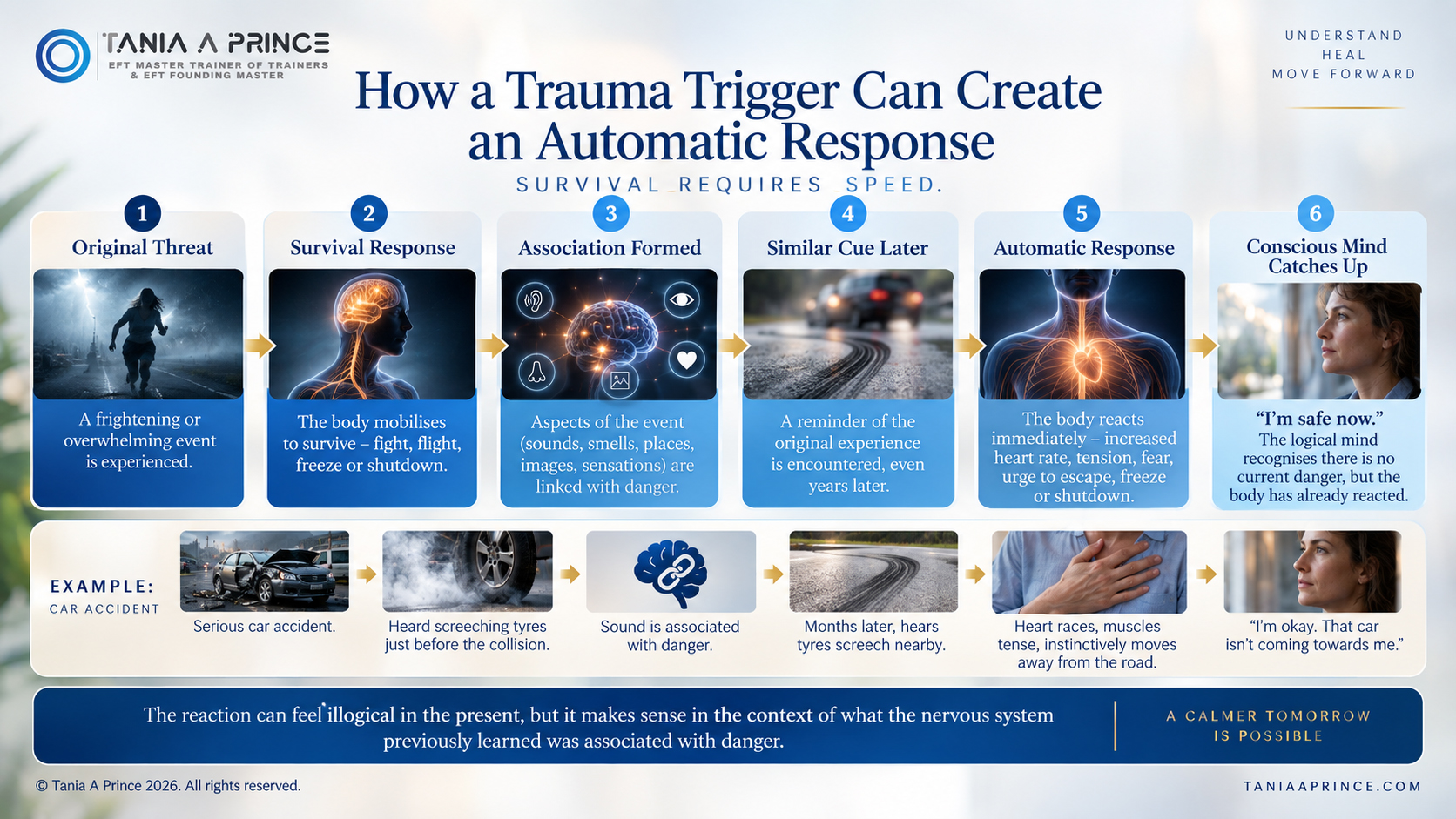
Survival requires speed.
If someone is confronted by serious danger, priority has to be given to the systems and actions required to survive the immediate threat.
If you need to run, for example, you need to rapidly identify the danger and possible escape routes. Your muscles need to mobilise. Your cardiovascular and respiratory systems need to support movement. Attention may narrow towards whatever is most relevant to survival.
If you need to fight or protect yourself, your system needs to organise around those actions.
If neither fighting nor escaping appears possible, immobilisation or shutdown responses may occur.
In that moment, calmly reflecting on, organising and making sense of everything that is happening is not the priority.
As a consequence, aspects of a traumatic experience may be encoded and integrated differently from an ordinary event.
Some details may subsequently be extremely vivid. Others may be fragmented, unclear or apparently absent. A person may remember a particular image, sound, physical sensation or emotion without having a clear sequential memory of the whole event.
This is one reason trauma memories can sometimes feel very different from ordinary memories.
Why PTSD Reactions Can Happen So Quickly
The need for survival speed has another important consequence.
When something has become associated with a previous threat, the system does not necessarily wait for conscious thought and logical analysis before beginning a protective response.
From an evolutionary survival perspective, that makes sense.
If something might indicate immediate danger, responding first and analysing it afterwards can be safer than spending valuable time deciding whether the threat is real.
This means that something associated with the original traumatic experience can potentially trigger an automatic response before the person consciously understands what is happening.
An Example
Imagine someone who has been involved in a serious car accident.
Immediately before the collision, they heard the sudden screech of tyres.
Months later, they are safely walking along a pavement when they hear tyres screech behind them.
Their heart races.
Their muscles tense.
They instinctively move away from the road.
Only afterwards does conscious thought catch up:
“I’m okay. That car isn’t coming towards me.”
The system has already responded.
The screeching sound has become associated with danger. If there genuinely were a car heading towards them, waiting to consciously analyse the situation before moving could cost valuable time.
The response therefore has a survival logic.
Trauma Triggers Can Be Much More Subtle
Not every trigger is as obvious as the sound of screeching tyres.
A trigger might be a facial expression, a particular tone of voice, a smell, a movement, someone’s physical appearance, a sensation within the body or even the feeling of being in a particular type of situation.
The person may have no conscious awareness of the connection.
They may simply notice that they suddenly feel frightened, angry, nauseous, tense, frozen or compelled to escape.
This can make trauma responses appear illogical when they are viewed only in the context of what is happening now.
When viewed in relation to what the person’s system previously learned was associated with danger, however, the response can make considerably more sense.
Someone can therefore consciously know:
“I’m safe.”
“This isn’t the same situation.”
“That happened years ago.”
Yet their system may already be responding to a perceived threat.
This is why simply telling someone with PTSD that they are safe may not be enough.
Their conscious mind may already know that.
Where EFT May Help
Emotional Freedom Techniques combines focused attention with tapping on a sequence of acupoints.
During EFT, the person may bring attention to an emotion, thought, physical sensation, belief, image, memory or other aspect of their experience while tapping.
When working with PTSD, however, this does not mean that someone has to immediately focus on the most traumatic part of what happened.
That distinction is extremely important.
The starting point might instead be what is happening in the present.
For example, someone might notice tension in their chest when they think about a situation. They might experience fear at the thought of approaching a particular memory. They might notice an urge to leave, a feeling of being unsafe or a particular physical sensation.
These are all potential areas that can be worked with.
You Don’t Necessarily Have to Tell the Whole Trauma Story
One of the useful aspects of EFT when working with trauma is that the person does not necessarily have to immediately describe every detail of what happened.
In some circumstances, going directly into highly traumatic material may be inappropriate.
The initial therapeutic priority may be stabilisation.
This can involve helping the person remain oriented to the present, recognise increasing activation, develop resources and experience a greater sense of safety before approaching more difficult material.
The work can then proceed gradually.
Instead of immediately stepping into the centre of a traumatic memory, it may be possible to begin at its edges.
The person might initially work with:
- knowing that the event happened
- fear of thinking about it
- a physical sensation that occurs when it is mentioned
- one relatively manageable aspect of the memory
- an emotion connected with the experience
- their present-day response to something that reminds them of it.
As the response to one aspect changes, another aspect may become accessible.
Trauma work does not need to be a race towards the most painful memory.
What If the Trauma Memory Is Unclear?
Traumatic memories are not always vivid or complete.
Some people remember only fragments. Others may have very little visual memory but experience strong physical or emotional responses.
Someone may say:
“I know it happened, but I can’t really see it.”
Another person may say:
“It feels as though it happened to somebody else.”
The fact that a memory is not vivid does not necessarily mean there is no trauma-related response associated with it.
At the same time, therapists need to be extremely careful about making assumptions regarding unclear memories.
A memory does not have to be historically accurate for someone to work therapeutically with what is present in their mind. Imagery and imagined scenarios can sometimes be worked with using EFT.
However, if an imagined event is used, it should be clearly understood as imagined rather than treated as evidence that the event actually occurred.
The imagined material should come from the client rather than being suggested or constructed by the practitioner.
EFT Is Not About Forcing Trauma Out of the Body
Trauma is sometimes described as though it were a substance stored somewhere inside the body that needs to be expelled.
That is not how I conceptualise trauma.
During a threatening event, the system may initially mobilise through fight-or-flight responses. If the situation becomes overwhelming or escape is impossible, other defensive states, including shutdown, may occur.
As the nervous system changes state, natural physiological responses can sometimes occur.
People may cry, sigh, yawn, tremble, laugh, burp or experience changes in breathing, muscular tension or temperature.
These responses can accompany changes in autonomic state.
They should not, however, be interpreted as evidence that a physical substance called trauma has literally been released from the body.
Nor should dramatic emotional or physical reactions be the objective of therapy.
Sometimes significant therapeutic change can happen very quietly.
What Does the Research Say About EFT for PTSD?
Research into EFT for PTSD has produced encouraging results.
A 2025 systematic review and meta-analysis examined 13 studies involving 621 participants. The researchers reported significant reductions in PTSD symptoms following EFT, together with reductions in anxiety and depression. Improvements were also reported at follow-up periods of up to three months. (PubMed)
An earlier systematic review and meta-analysis published in 2023 also reported significant effects in studies comparing EFT with waiting-list, usual-care or no-treatment controls. When EFT was compared with active treatments, the results were more comparable with those other interventions. The authors also identified limitations and the need for further research. (PubMed)
These findings are promising, but they should be interpreted within the limitations of the existing evidence base. Studies vary in size, methodology, comparison groups and populations, and further high-quality independent research is needed.
In the UK, current NICE guidance recommends established trauma-focused psychological treatments for adults with PTSD, including trauma-focused cognitive behavioural therapy (CBT) and EMDR in specified circumstances. EFT is not currently listed among NICE’s recommended primary PTSD treatments. (Nice)
It is therefore possible to recognise the encouraging research into EFT while also being clear about the current status of the evidence.
Stabilisation Before Deeper Trauma Work
With significant PTSD, the immediate goal is not always processing traumatic memories.
Sometimes the first therapeutic task is helping the person become more stable.
This may be particularly important when someone experiences severe dissociation, emotional overwhelm, difficulty remaining oriented to the present, significant instability or other serious psychological difficulties.
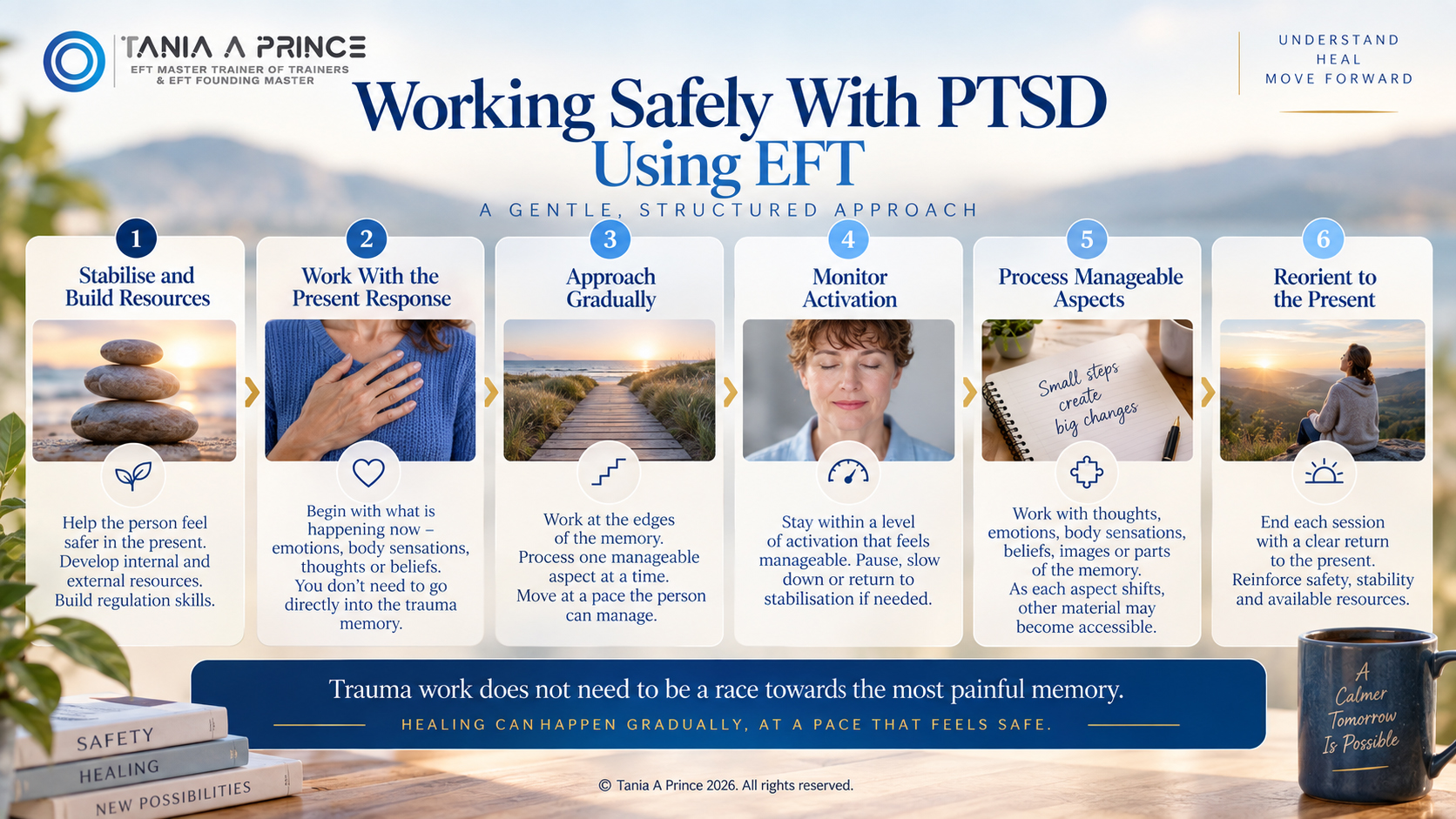
Stabilisation might include helping someone to:
- orient to their current environment
- recognise when activation is increasing
- notice physical and emotional changes
- access helpful internal or external resources
- develop ways of returning attention to the present
- build a greater sense of safety.
This does not mean that a person must be completely calm before therapeutic work can take place.
It means working within a level of activation that they can manage without becoming overwhelmed.
EFT and Flashbacks
A flashback can feel very different from simply remembering something unpleasant.
During a flashback, aspects of the traumatic experience can feel as though they are happening again in the present.
If someone is experiencing a flashback, the immediate therapeutic priority may therefore be orientation rather than exploration of the original trauma.
Where are they now?
What can they see around them?
What can they hear?
Can they recognise that they are in the present environment rather than the original traumatic situation?
EFT may be incorporated carefully according to the person’s needs, but there is no therapeutic prize for pushing deeper into trauma when someone’s system is already overwhelmed.
EFT and Hypervigilance
Hypervigilance is another common feature of PTSD.
Someone may continually scan their environment for possible danger. Small noises, movements or changes in another person’s expression may immediately attract their attention.
Even relaxation can feel unsafe.
If vigilance was once protective, lowering that vigilance may itself trigger a threat response.
Rather than simply telling someone to relax, therapeutic work can become curious about the response.
What happens when you begin to relax?
What does your system expect might happen?
What feels unsafe about lowering your guard?
These responses can themselves become useful areas for EFT work.
EFT and Avoidance
Avoidance following trauma is understandable.
If thinking about something causes overwhelming distress, avoiding anything associated with it may provide immediate relief.
Over time, however, avoidance can significantly restrict someone’s life.
They may begin avoiding particular places, people, relationships, conversations or activities.
The purpose of therapy is not to criticise the avoidance.
It can be understood as a protective strategy.
The therapeutic work can then gradually help the person develop other ways of responding so that their life no longer needs to be organised around avoiding reminders of the past.
Does EFT Erase Traumatic Memories?
No.
The aim is not to delete someone’s history.
A person can continue to know what happened while experiencing the memory differently.
Something that once produced overwhelming fear, panic or distress may potentially become something the person can remember while remaining much more connected to the present.
The facts of the person’s history have not changed.
What may change is their response to those facts.
That is an important distinction.
The goal is not:
“This never happened.”
It is closer to:
“This happened — but it isn’t happening now.”
Is EFT for PTSD Safe to Do on Your Own?
EFT is often used as a self-help technique, and tapping may be useful for managing everyday emotional responses.
Working with significant PTSD is different.
Deliberately activating highly traumatic memories when alone can potentially lead to intense emotional activation, flashbacks or dissociation.
Someone experiencing significant PTSD, severe dissociation, suicidal thoughts, serious psychological instability or difficulty remaining present when traumatic material arises should seek appropriately qualified professional support rather than attempting intensive trauma processing alone.
Choosing an EFT Practitioner for PTSD
If you are considering EFT for PTSD, it is worth asking about the practitioner’s experience and training in working with trauma.
Knowing how to perform the EFT tapping sequence is not the same as knowing how to work therapeutically with significant trauma.
A practitioner working in this area should understand the importance of pacing, stabilisation, dissociation, emotional overwhelm, nervous-system responses and recognising when not to proceed further into traumatic material.
Good trauma work is not about reaching the worst experience as quickly as possible.
It is about responding to the person in front of you.
Can People Recover From PTSD?
PTSD can have a profound effect on someone’s life, but effective treatments are available.
Recovery does not require forgetting what happened.
Instead, therapeutic change can involve the traumatic experience becoming increasingly located where it belongs — in the past — rather than repeatedly dominating the person’s experience of the present.
EFT provides one approach for working with some of the thoughts, emotions, physical sensations, memories and learned responses associated with traumatic experiences.
The emerging research into EFT for PTSD is encouraging. At the same time, trauma work requires considerably more than knowing a tapping technique.
It requires an understanding of how people respond to threat, how traumatic experiences can affect subsequent responses, and how to work carefully with the person rather than forcing them through a predetermined process.
Perhaps one of the most important principles is this:
Survival requires speed. Healing does not.
Trauma work can be approached carefully, gradually and at a pace the person can manage.
This article is for educational purposes and is not a substitute for individual medical or psychological advice, diagnosis or treatment. If you are experiencing symptoms of PTSD, consider speaking with an appropriately qualified healthcare or mental-health professional.
