
How Does MBIR™️ Work?
Mindfulness-Based Inner RePatterning™️ (MBIR™️) is a therapeutic change methodology developed by Tania A Prince. It works with present-moment awareness, nervous-system regulation and the patterns that shape how a person responds internally to their experience.
Rather than beginning with the idea that something within the person needs to be fixed, MBIR™️ creates the conditions in which change can emerge from within the person’s own system.
This distinction is important.
People often consciously know that they want to change. They may understand why a particular response is unhelpful and may have spent considerable time trying to think, reason or talk themselves out of it. Yet the response continues.
From an MBIR™️ perspective, this does not necessarily mean that the person is failing to change. The response may be serving a function at a deeper level of the system.
MBIR™️ therefore works differently.
A Precise Definition of MBIR™️
Mindfulness-Based Inner RePatterning™️ (MBIR™️) is a therapeutic change methodology that uses mindful awareness, nervous-system regulation and precise therapeutic communication to facilitate the reorganisation of internal patterns, allowing change to emerge without requiring the person to repeatedly relive or analyse the experiences that contributed to those patterns.
The word repatterning is central to this definition.
MBIR™️ is not simply concerned with reducing an uncomfortable feeling in the moment. It works with the organisation underlying a person’s response.
Why Patterns Can Continue Even When We Want Them to Stop
Human beings develop patterns continuously.
Some are useful and adaptive. Others may have developed in response to difficult, overwhelming or threatening experiences.
A response that appears problematic in the present may once have represented the best available way for the system to manage what was happening.
For example, a person may consciously want to speak confidently but find themselves becoming tense or unable to think clearly when attention turns towards them. Someone may want greater closeness in relationships yet repeatedly withdraw when intimacy increases. Another person may understand intellectually that they are safe while their body continues to respond as though danger is present.
Simply knowing that a response is unnecessary does not always change it.
This is one of the reasons MBIR™️ does not rely solely on conscious insight.
Working With What Is Happening Now
A central principle within MBIR™️ is present-moment awareness.
The practitioner does not necessarily need the client to provide a detailed history or repeatedly describe everything that happened in the past.
Instead, attention can be brought to what is happening within the person’s experience now.
That may include sensations, emotions, internal images, thoughts, impulses, changes in breathing, shifts in posture or other aspects of experience.
The aim is not to analyse every response.
It is to notice.
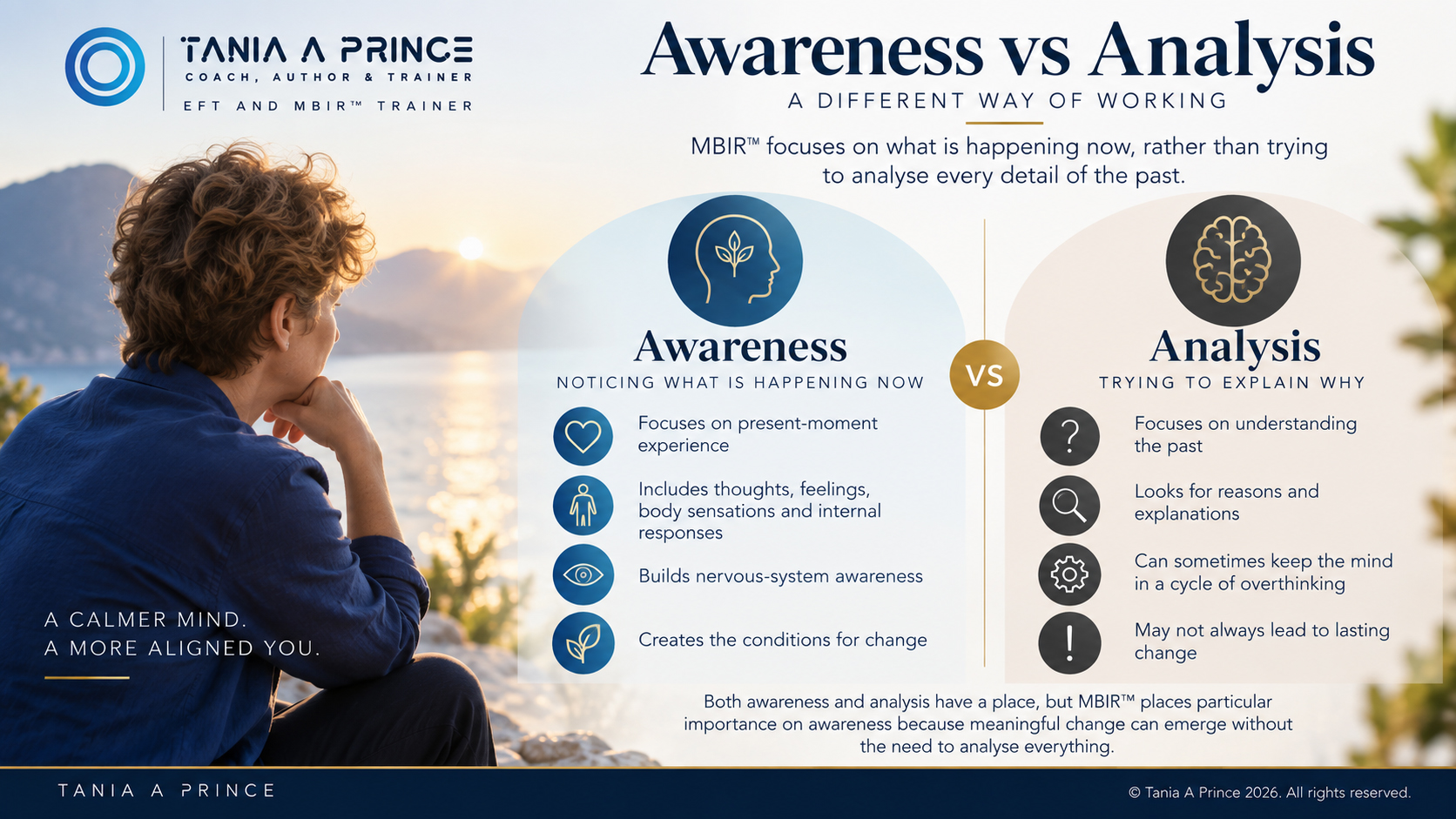
This creates an important distinction between awareness and analysis.
Analysis asks:
Why is this happening?
Awareness notices:
What is happening now?
Both can have a place in therapeutic work, but MBIR™️ places particular importance on awareness because meaningful information can emerge without requiring the conscious mind to explain everything.
The Importance of Safety
Change does not necessarily occur simply because someone wants it to happen.
If the nervous system perceives something as threatening, protective responses may become active.
Those responses can include mobilisation, withdrawal, shutting down, emotional numbing, avoidance or other forms of protection.
Trying to push directly through those responses can sometimes increase resistance.
MBIR™️ therefore places considerable importance on establishing and maintaining an appropriate sense of safety.
Safety within MBIR™️ does not simply mean telling someone that they are safe.
It involves paying attention to the person’s actual experience and working in a way that the system can tolerate.
This is one reason the pace of the work matters.
The goal is not to force the person deeper into difficult material. It is to create conditions in which the system has enough stability to allow change.
Regulation Before RePatterning
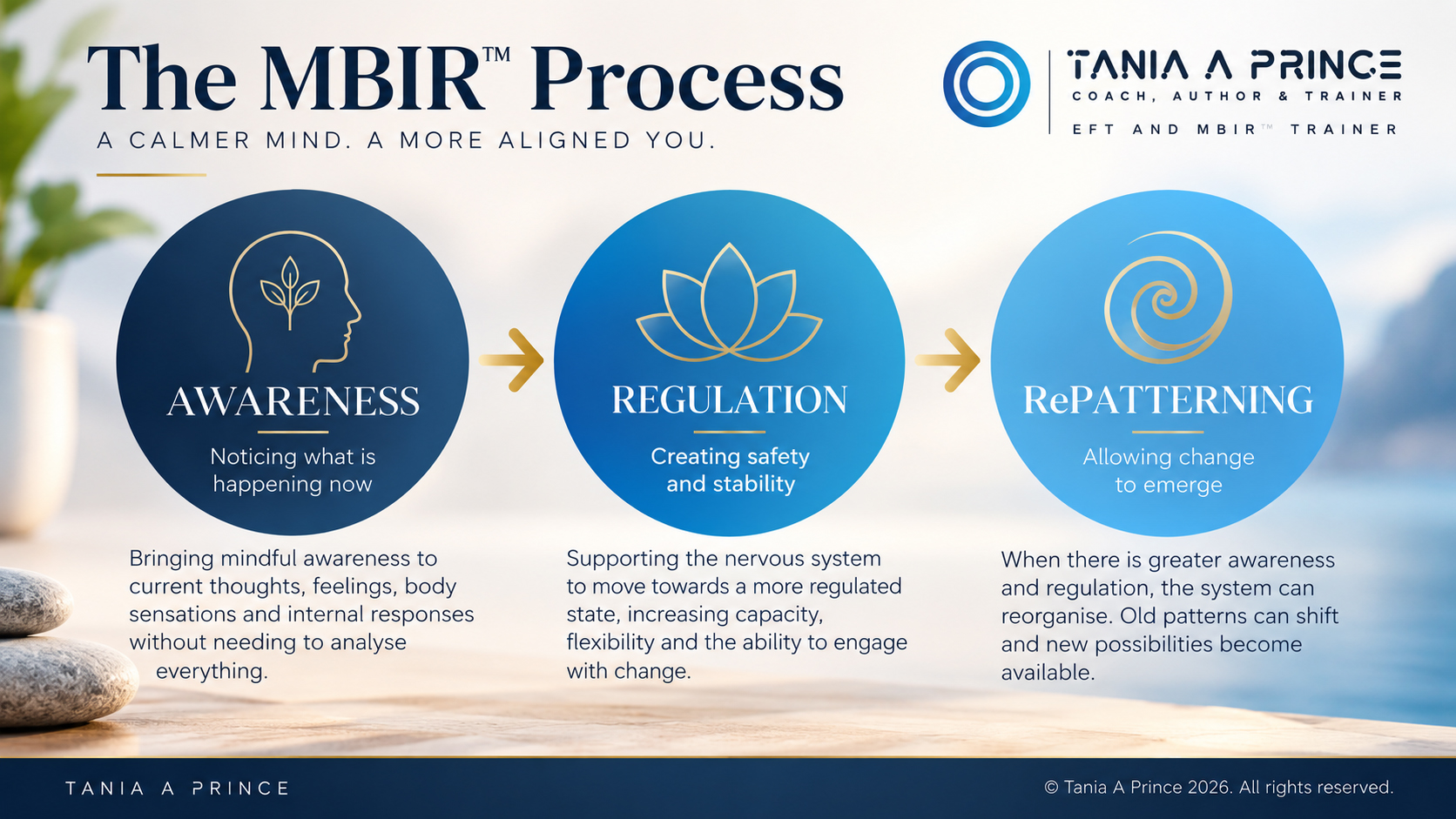
Nervous-system regulation is an important element of MBIR™️.
When a person is highly activated or has moved into a shutdown or collapse response, their capacity to process experience may be very different from when they are within a more regulated state.
MBIR™️ practitioners therefore learn to recognise changes in state and work accordingly.
This is not about attempting to keep someone permanently calm.
Human nervous systems naturally move through different states.
The important question is whether the system has sufficient flexibility and capacity to respond appropriately to what is happening.
When greater regulation is established, possibilities can become available that may not have been accessible while the system was organised around protection.
The Practitioner Is Part of the Therapeutic Environment
MBIR™️ is not simply a collection of techniques performed on another person.
The way the practitioner communicates, observes, responds and holds their own state is important.
Human beings continually respond to one another.
Changes in tone of voice, pace, facial expression, breathing, posture and other subtle cues can influence how an interaction is experienced.
For this reason, practitioner presence is an important component of MBIR™️.
The practitioner is not there to impose a solution.
Their role is to create and maintain conditions that support awareness, regulation and change.
At times this involves carefully chosen therapeutic communication. At other times, silence may be more useful.
The practitioner learns when to speak, when to wait and when to allow the person’s own internal process to unfold.
Working With Protective Responses Rather Than Fighting Them
A response that appears to be blocking change may have a protective purpose.
This principle is particularly important within MBIR™️.
If one aspect of a person wants change while another aspect perceives that change as unsafe, attempting to overpower the resistance can create an internal struggle.
MBIR™️ can instead work with the protective response.
Rather than asking:
How do we get rid of this?
the work may involve becoming curious about what the response is attempting to accomplish.
When the protective function is recognised and appropriately addressed, the system may no longer need to maintain the original response in the same way.
This allows change to occur through resolution rather than force.
Change Does Not Always Require Reliving the Past
There is a widespread assumption that therapeutic change requires people to repeatedly revisit difficult experiences in detail.
MBIR™️ does not begin from that assumption.
Past experiences can influence present responses, but it is often possible to work with how those experiences are represented or expressed within the system now.
This can be particularly important when working with experiences that are highly distressing.
The purpose is not to avoid relevant material when it needs to emerge.
Neither is it to deliberately push someone into an intense experience in the belief that greater emotional activation automatically produces greater therapeutic change.
MBIR™️ aims to work with what is necessary while respecting the capacity of the person’s system.
The System Can Reorganise
One of the central ideas underlying MBIR™️ is that change can involve reorganisation.
When the conditions supporting an old pattern change, the pattern itself may change.
A person may experience this in different ways.
An emotional response may reduce. A previously compelling thought may feel less significant. A memory may be experienced differently. The body may become more settled. A new perspective may arise spontaneously.
Sometimes the person simply recognises:
“It doesn’t feel the same anymore.”
The practitioner does not need to manufacture that response.
The aim is to facilitate conditions in which the person’s own system can reorganise.
MBIR™️ Is Not About Positive Thinking
RePatterning should not be confused with replacing a negative thought with a positive one.
Positive statements can be useful in some contexts, but telling someone to think differently does not necessarily alter the deeper organisation generating their response.
MBIR™️ works with the person’s experience rather than attempting to place a more desirable thought over the top of it.
When a genuine shift occurs, different thoughts, feelings and behaviours may emerge naturally because the underlying pattern has changed.
A Different Relationship With Change
Perhaps one of the most important aspects of MBIR™️ is the relationship it creates with the change process itself.
Instead of approaching the person as a collection of problems that need to be removed, the practitioner can become curious about how the person’s system is organised and why particular responses may have developed.
That changes the therapeutic question.
Instead of:
“What’s wrong with you?”
the work becomes closer to:
“What is happening within your system, and what does it need in order for something different to become possible?”
This creates space for therapeutic work that respects both the intelligence of protective responses and the possibility of change.
What Does an MBIR™️ Session Actually Look Like?
Although MBIR™️ has a structured methodology, a session does not necessarily look like a rigid sequence of techniques.
The practitioner responds to the person in front of them.
There may be periods of conversation, focused awareness, therapeutic silence and observation of subtle changes as the work develops.
The practitioner continually pays attention to the person’s state and adjusts the work accordingly.
This responsiveness is one of the reasons practitioner training involves considerably more than learning a script.
Practitioners need to develop the ability to observe, communicate and recognise what is happening within the therapeutic process.
Can MBIR™️ Be Used With Trauma?
MBIR™️ was developed with an understanding that difficult experiences can influence both psychological and physiological patterns.
When working with trauma-related material, the emphasis on safety, regulation and present-moment awareness becomes particularly important.
The aim is not to encourage a person to become overwhelmed by traumatic material.
Instead, the practitioner works within the person’s capacity and responds to what emerges.
This does not mean that difficult emotions will never arise. Therapeutic work can involve powerful emotional experiences.
The distinction is that emotional intensity is not treated as the objective of the work.
Why Practitioner Skill Matters
Because MBIR™️ is responsive rather than purely procedural, practitioner skill matters.
Learning MBIR™️ involves understanding the methodology, but it also involves developing observation, therapeutic communication, sensory acuity, awareness of nervous-system states and the ability to recognise when different approaches are appropriate.
A technique can be taught relatively quickly.
Developing therapeutic judgement takes practice.
For this reason, MBIR™️ practitioner training combines conceptual understanding with demonstration, experiential learning and supervised skills practice.
The Core Principle
At its heart, MBIR™️ is based on a simple but important idea:
Lasting change does not always need to be forced.
When sufficient awareness and appropriate conditions for safety and regulation are present, the organisation maintaining an unwanted pattern can change.
The practitioner does not decide what the person’s system should become.
They facilitate a process through which new possibilities can emerge.
That is the essence of Inner RePatterning.
Mindfulness-Based Inner RePatterning™️ (MBIR™️) was created by Tania A Prince.
Tania A Prince is the founder of MBIR™️ and MBIR International and has worked therapeutically for more than three decades. MBIR™️ practitioner training teaches the methodology, therapeutic principles and practical skills required to use the approach professionally.
©️ Tania A Prince 2026. All rights reserved.
