
EFT for Work-Related Anxiety: Using Tapping to Reduce Stress Around Work

Work-related anxiety can begin long before you arrive at work.
You might wake up already thinking about what needs to be done. Your mind may run through emails you need to answer, conversations you need to have, deadlines you need to meet or problems you need to solve.
Sometimes the anxiety is linked to one particular situation — a presentation, meeting, difficult colleague or looming deadline.
At other times, it can feel as though work itself has become the trigger.
You may notice tension in your body when you open your laptop, check your emails or even think about Monday morning.
EFT (Emotional Freedom Techniques), often known as tapping, can provide a practical way of working with the emotional and physical responses associated with work-related anxiety.
Rather than simply trying to persuade yourself that there is nothing to worry about, EFT allows you to acknowledge what your system is actually responding to and tap while bringing attention to it.
What Is Work-Related Anxiety?
Work-related anxiety is not simply being busy or occasionally feeling stressed.
It can involve a persistent sense of threat, pressure or apprehension connected with work.
You might experience:
- worrying about making mistakes
- fear of criticism or being judged
- anxiety before meetings or presentations
- difficulty switching off after work
- repeatedly checking emails or messages
- overthinking conversations with colleagues
- perfectionism
- procrastination or avoidance
- feeling overwhelmed by your workload
- worrying that you are not doing enough
- fear of losing your job
- dread on Sunday evening or before returning to work
- physical tension when thinking about work
The body may also become involved.
You might notice a tight chest, churning stomach, shallow breathing, muscle tension, headaches, restlessness or an uncomfortable sense of being constantly “on”.
For some people, the workday ends but their nervous system does not seem to receive the message.
Why Can Work Trigger Such a Strong Anxiety Response?
Anxiety is not only created by what is happening around us.
It is influenced by what our brain and nervous system believe those events mean.
A relatively ordinary workplace situation can therefore carry much greater emotional significance.
Imagine receiving an email saying:
“Can we have a quick chat tomorrow?”
One person may think:
I wonder what that’s about.
Another person’s mind immediately begins generating possibilities:
Have I done something wrong?
Am I in trouble?
What if I’ve made a mistake?
What if they don’t think I’m good enough?
What if I lose my job?
Nothing has actually happened yet.
But the anticipated possibility can be enough to activate an anxiety response.
The nervous system can respond not only to what is happening now, but also to what we imagine might happen next.
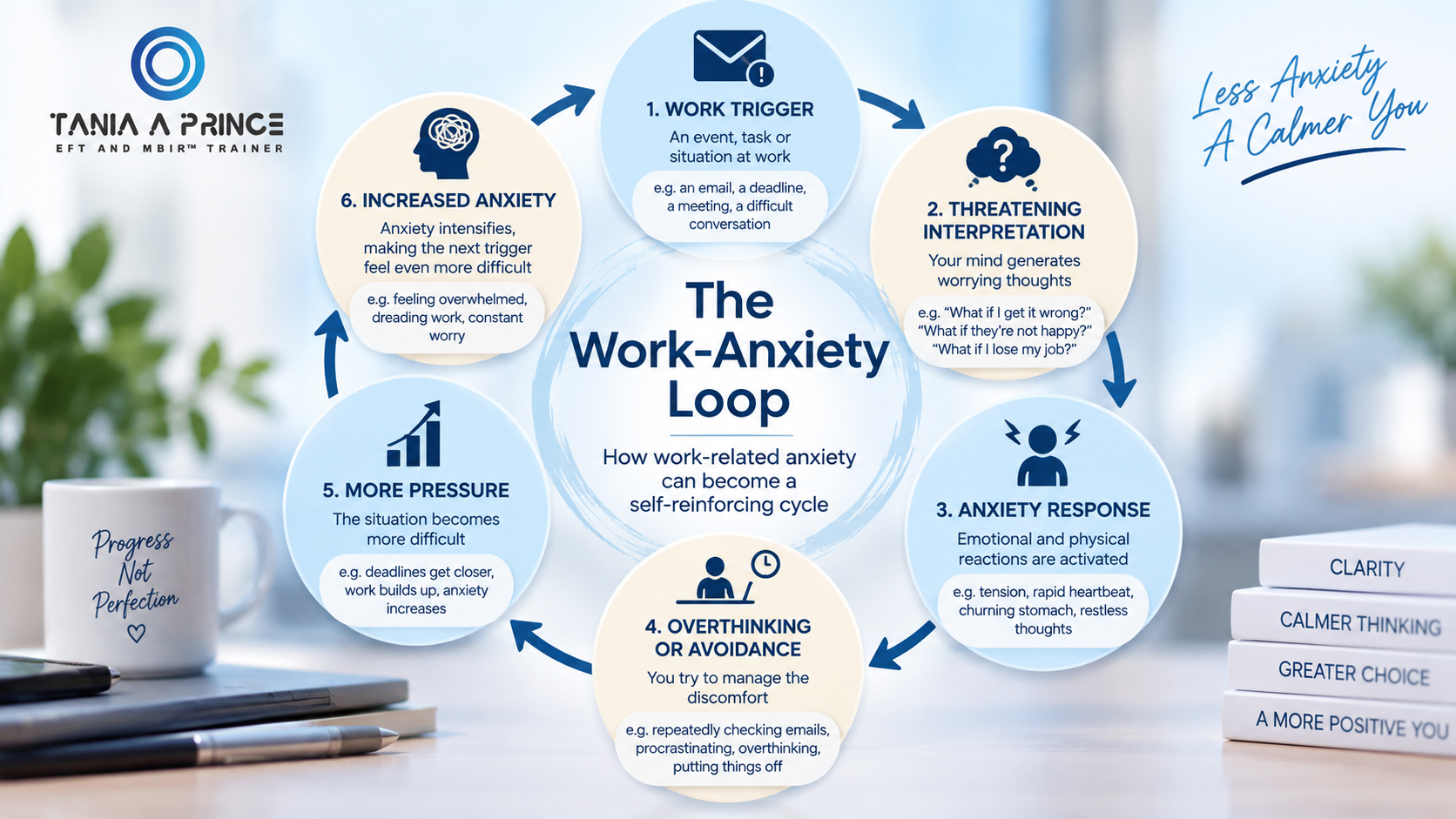
The Work-Anxiety Loop
Work anxiety can develop into a self-reinforcing cycle:
Work trigger → threatening interpretation → anxiety response → overthinking or avoidance → temporary relief or increased pressure → more anxiety
For example:
You have an important report to complete.
You think:
“What if I get this wrong?”
Your body becomes tense.
The task now feels uncomfortable, so you avoid starting it.
Avoidance provides temporary relief.
But the deadline gets closer.
Now there is even more pressure.
The increased pressure strengthens the original anxiety.
This is one reason simply telling yourself to “stop worrying” is often ineffective.
There may be an entire emotional and physiological response occurring underneath the conscious thought.
How EFT Can Be Used for Work-Related Anxiety
EFT combines focused attention with tapping on a sequence of acupoints on the face and upper body.
One of the useful features of EFT is that you do not necessarily need to understand the entire problem before beginning.
You can start with what is happening right now.
For example:
“When I think about tomorrow’s meeting, I feel a knot in my stomach.”
Or:
“When I look at my inbox, I feel overwhelmed.”
Or:
“I’m worried I’m going to make a mistake.”
This gives you something specific to work with.
Rather than tapping on the enormous subject of “my work anxiety”, it can often be more useful to identify the particular moment, thought, image, memory or physical sensation that activates the anxiety.
Start by Identifying the Trigger
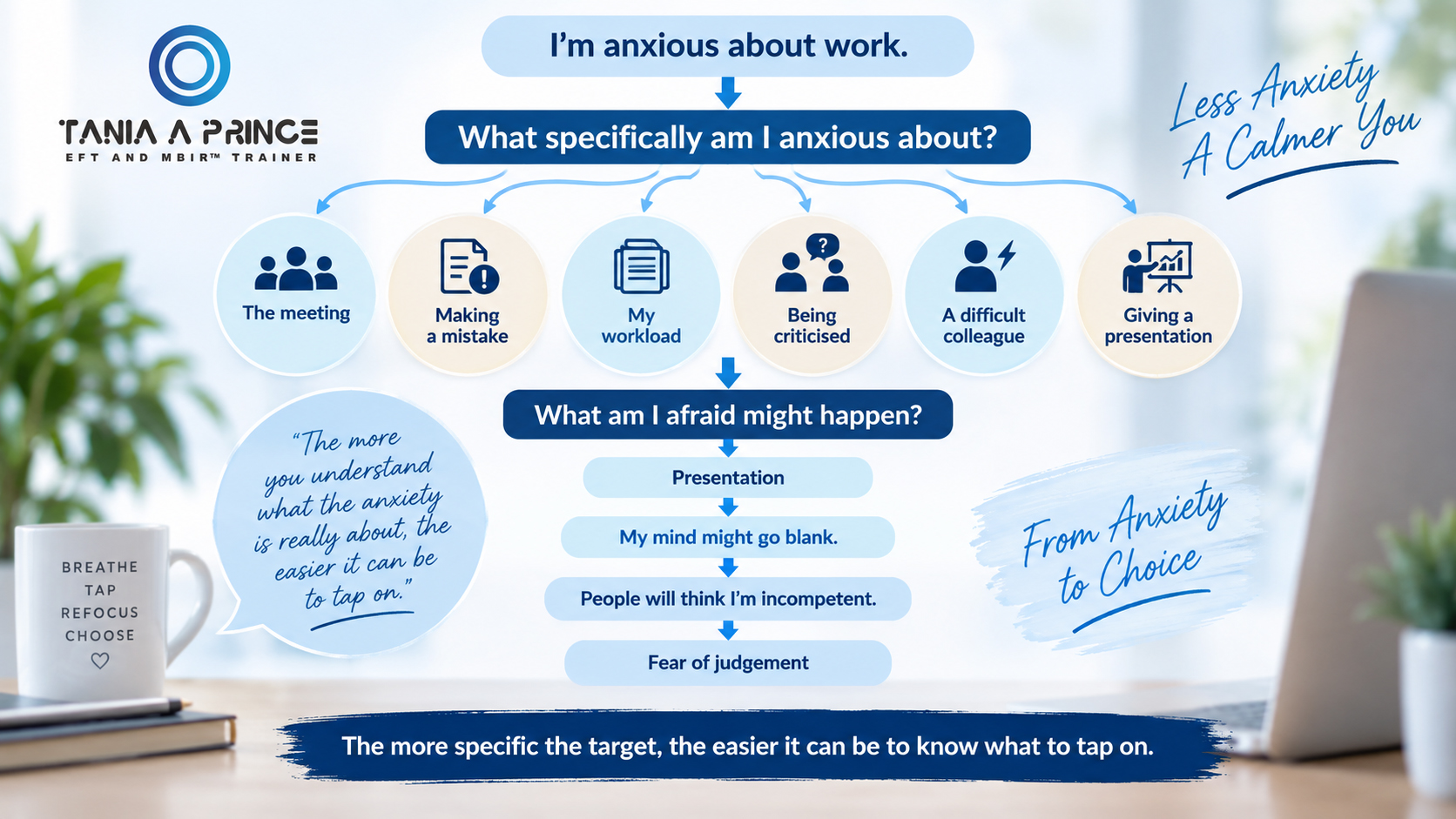
Ask yourself:
What specifically am I anxious about?
Try completing this sentence:
“When I think about __________, I feel anxious.”
Your answer might be:
“When I think about presenting at tomorrow’s meeting, I feel anxious.”
“When I think about opening my emails, I feel overwhelmed.”
“When I imagine my manager questioning my work, my stomach tightens.”
“When I think about how much I have to do, I feel pressure in my chest.”
“When I imagine making a mistake, I feel scared.”
Specificity can make EFT easier to use because you are giving your attention somewhere to focus.
Notice What Happens in Your Body
Next, notice your physical response.
Where do you experience the anxiety?
Perhaps you notice:
- tightness in your chest
- tension across your shoulders
- pressure in your throat
- butterflies or heaviness in your stomach
- tension in your jaw
- restlessness
- a sense of internal agitation
You do not need to analyse the sensation.
Simply notice it.
You might tap while saying:
“This tightness in my chest.”
“This knot in my stomach.”
“All this pressure.”
“This anxious feeling when I think about tomorrow.”
Simple language is often enough.
The words are primarily helping you stay connected with what you are experiencing while you tap.
Ask: What Am I Afraid Might Happen?
This question can take you beneath the surface of the work anxiety.
Suppose you are anxious about giving a presentation.
At first, the problem appears to be:
“I’m anxious about the presentation.”
But ask:
“What am I afraid might happen?”
You may discover:
“I’m afraid my mind will go blank.”
Then ask:
“And if that happened, what would be difficult about that?”
Perhaps:
“Everyone would think I was incompetent.”
Now the emotional target has become much clearer.
The anxiety may not primarily be about presenting.
It may be about judgement, humiliation or the fear of not being good enough.
That is a very different issue to work with.
A Simple EFT Exercise for Work Anxiety
Choose one specific work situation.
For example:
Tomorrow’s meeting.
Bring the situation gently to mind.
Notice what happens emotionally and physically.
You might give the intensity a number from 0–10, where 0 means no emotional charge and 10 represents very high intensity.
Then begin tapping.
You could start with the side of the hand:
“Even though I feel anxious when I think about tomorrow’s meeting, this is what I’m experiencing right now.”
Repeat this several times if helpful.
Then move through the tapping points using short reminder phrases:
Eyebrow:
“This anxiety about the meeting.”
Side of Eye:
“I’m worried about what might happen.”
Under Eye:
“This tension in my body.”
Under Nose:
“What if I get it wrong?”
Chin:
“What if they judge me?”
Collarbone:
“All this pressure.”
Under Arm:
“My body is reacting just thinking about it.”
Top of Head:
“This anxiety about tomorrow.”
Pause.
Take a comfortable breath and notice what has changed.
Do not worry if the anxiety has not disappeared.
Instead ask:
What am I noticing now?
The answer gives you the next direction for tapping.
Follow What Comes Up
EFT does not have to follow a predetermined script.
As you tap, the problem may change.
Perhaps you started with:
“I’m anxious about tomorrow’s meeting.”
After tapping, you realise:
“Actually, I’m angry because my manager always puts me on the spot.”
Or:
“This reminds me of being criticised in my previous job.”
Or:
“I’m scared people will realise I don’t know as much as they think I do.”
This is useful information.
You can begin tapping on what has emerged.
For example:
“That feeling when my manager puts me on the spot.”
“That memory of being criticised.”
“This fear that I’m not good enough.”
EFT can become much more individual when you follow your own emotional responses rather than trying to force yourself through a generic tapping script.
When Work Anxiety Is Connected to Past Experiences
Sometimes the intensity of our response to a present-day situation makes more sense when we consider previous experiences.
Perhaps you had a highly critical parent.
Perhaps a teacher humiliated you when you made a mistake.
Perhaps you previously worked for a bullying manager.
Perhaps you were made redundant unexpectedly.
Perhaps you learned very early that achievement was associated with approval or safety.
A current workplace event may activate emotional learning connected with those earlier experiences.
Your rational mind may know:
“This is only a meeting.”
But another part of your system may be responding as though something much more significant is at stake.
When appropriate, EFT can be used to work with the specific memories and experiences associated with those responses.
EFT for Perfectionism at Work
Perfectionism can be closely linked with workplace anxiety.
It can sound like:
“I can’t make a mistake.”
“It has to be perfect.”
“I should be able to cope.”
“I need to prove myself.”
“I can’t let anyone see that I’m struggling.”
The important question is often:
What would it mean if I did make a mistake?
The answer may reveal beliefs such as:
“It would mean I’m incompetent.”
“People wouldn’t respect me.”
“I’d let everyone down.”
“I’d be a failure.”
Those meanings can generate far more anxiety than the actual mistake itself.
EFT for Procrastination and Avoidance
Procrastination is often treated as though it is simply a problem of motivation.
Sometimes it is better understood as avoidance of an uncomfortable internal state.
Think about something you have been putting off.
Then imagine beginning it right now.
Notice what happens.
Do you feel pressure?
Boredom?
Confusion?
Fear?
Resistance?
Overwhelm?
A sense that the task is impossible?
You can tap on that response.
For example:
“I really don’t want to start this.”
“This feels overwhelming.”
“I don’t know where to begin.”
“I’m worried I won’t do it well enough.”
Rather than fighting the resistance, you are acknowledging and working with it.
EFT for Sunday-Night Anxiety
Some people notice their anxiety increasing as the weekend comes to an end.
Sunday evening can become associated with Monday morning.
The body begins anticipating the week before it has even started.
If this happens, try asking:
“What exactly am I dreading about tomorrow?”
Avoid stopping at:
“Work.”
Make it smaller.
Is it:
- the commute?
- your inbox?
- a particular person?
- a meeting?
- your workload?
- having too little time?
- feeling trapped?
- the pressure to perform?
Once you identify the particular trigger, you have something much more useful to tap on.
Moving From Anxiety Towards Choice
EFT does not have to be about forcing yourself to think positively.
If part of you believes something is threatening, jumping immediately to:
“Everything is wonderful and I’m completely confident”
may feel unbelievable.
Instead, you can use more gradual transitional language.
For example:
“Maybe I don’t have to solve everything right now.”
“Maybe I can take this one step at a time.”
“Maybe this doesn’t have to be perfect.”
“Perhaps I can allow myself to see this differently.”
“Maybe I can separate what is actually happening from what I’m afraid might happen.”
And, if it feels genuine:
“I choose to approach this one step at a time.”
“I choose to give myself permission to make mistakes.”
“I choose to deal with what actually happens rather than everything my mind predicts.”
The aim is not to impose positive thinking.
It is to see whether greater flexibility and choice become possible as the emotional intensity changes.
What If the Workplace Really Is the Problem?
Not all work-related anxiety is an internal problem.
Sometimes a workplace genuinely is unhealthy.
There may be bullying, harassment, unreasonable demands, chronic understaffing, discrimination, job insecurity, excessive workload or poor management.
EFT should not be used to convince yourself to tolerate circumstances that require practical action.
Instead, tapping may help reduce emotional overwhelm sufficiently for you to think more clearly about what needs to happen next.
That might include establishing boundaries, speaking to a manager, seeking support, contacting HR, obtaining professional advice or considering whether you want to remain in the situation.
Emotional regulation and practical action can work alongside each other.
When to Seek Professional Support
Self-directed EFT can be useful for everyday stress and relatively manageable anxiety.
However, if your work anxiety is severe, persistent or significantly affecting your sleep, relationships, physical health or ability to function, consider seeking appropriate professional support.
It can also be advisable to work with an appropriately qualified practitioner when workplace situations activate significant trauma, panic, dissociation or difficult past experiences.
EFT is not a substitute for appropriate medical, psychological or workplace support when that is needed.
Final Thoughts
Work-related anxiety can appear to be about deadlines, meetings, emails or workload.
But underneath those situations there may be fears about failure, criticism, rejection, conflict, uncertainty, loss of control or not being good enough.
EFT gives you a way of slowing the process down.
Instead of treating “work anxiety” as one enormous problem, begin with one specific moment:
What am I thinking about?
What am I afraid might happen?
What do I notice in my body?
Then tap on what is actually there.
You do not have to find the perfect words.
Start with your experience.
“I’m anxious about this meeting.”
“I’m worried I’ll get it wrong.”
“I can feel this pressure in my chest.”
That is enough to begin.
About Tania A Prince
Tania A Prince is an EFT Founding Master and an EFT International Accredited Master Trainer of Trainers with extensive experience in EFT, emotional wellbeing and therapeutic change. She has trained practitioners internationally and is the creator of Mindfulness-Based Inner RePatterning (MBIR™️).
This article is for educational purposes and is not intended to diagnose or treat any medical or mental health condition.
