
EFT for Feeling Overwhelmed

You may have too much to do. There may be several problems demanding your attention at once. Or perhaps nothing particularly dramatic is happening, yet your mind and body seem to be saying:
“I can’t cope with all of this.”
You might find yourself jumping from one thing to another, unable to decide where to start. You may procrastinate, shut down, become irritable or feel increasingly anxious.
Sometimes overwhelm can even reach the point where you do very little — not because you don’t care about what needs doing, but because everything feels like too much.
EFT (Emotional Freedom Techniques), commonly known as tapping, can be a useful way of working with this experience.
Rather than immediately trying to organise, rationalise or solve everything, tapping gives you an opportunity to work first with what is happening internally.
And sometimes that is exactly where you need to begin.
What Does Feeling Overwhelmed Actually Feel Like?
Overwhelm can show up differently for different people.
You might experience:
- racing thoughts
- difficulty concentrating
- tension in your chest, stomach, shoulders or jaw
- irritability
- anxiety
- procrastination
- difficulty making decisions
- wanting to escape from everything
- feeling emotionally flooded
- becoming unusually tired
- shutting down or withdrawing
- repeatedly thinking about everything you need to do
There can also be a strong sense of urgency.
“I need to sort everything out.”
“I’m running out of time.”
“There’s too much to do.”
“I don’t know where to start.”
When this happens, trying to force yourself to become more productive is not always the most helpful first step.
It may be more useful to ask:
What is my nervous system responding to right now?
Why Do We Feel Overwhelmed?
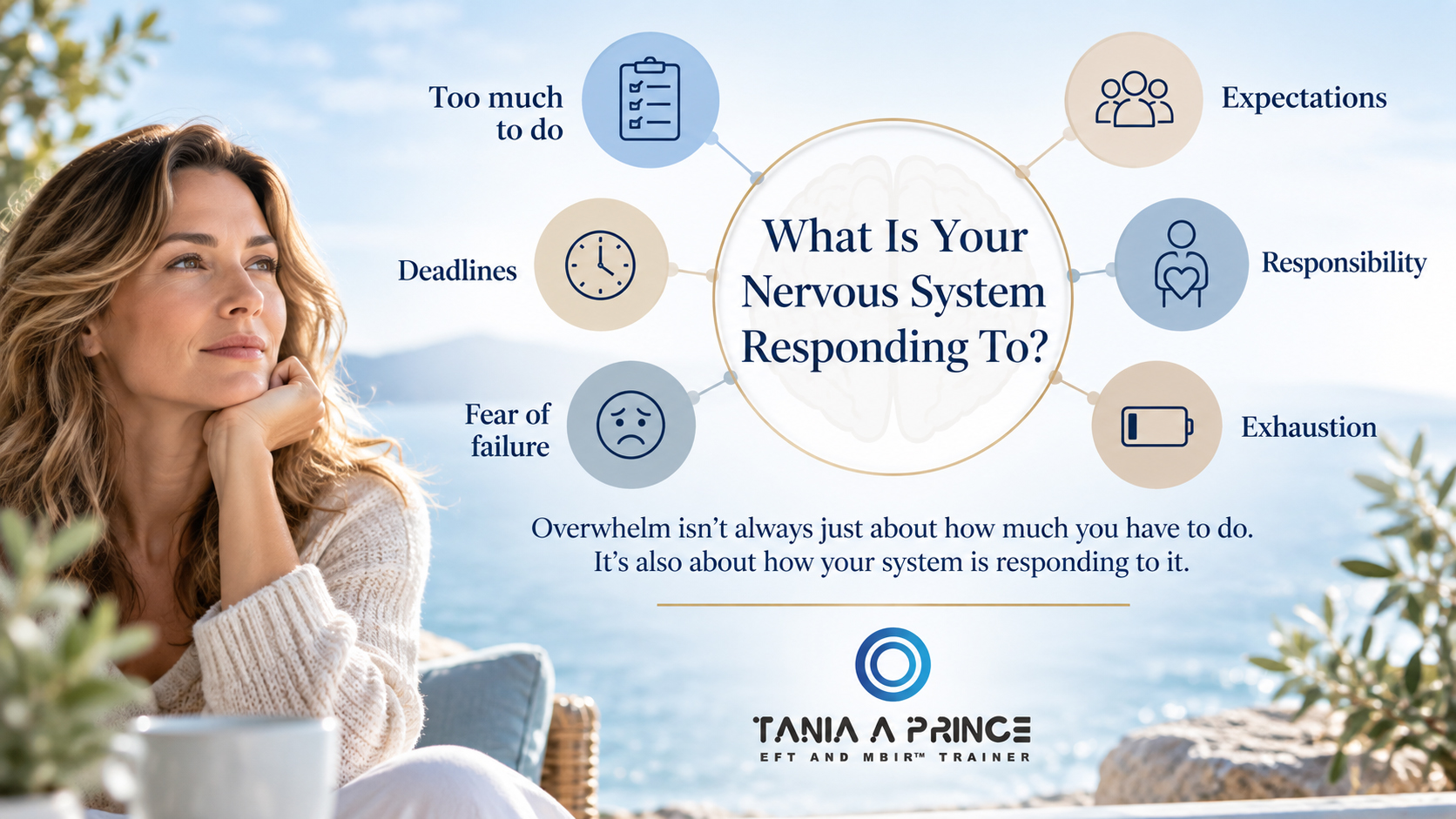
We often think overwhelm is caused simply by having too much to do.
Sometimes that is true.
But two people can face very similar circumstances and have completely different internal responses.
One may feel challenged but capable.
The other may feel completely overwhelmed.
That difference matters.
Overwhelm is not only about the number of things happening around you. It is also about how those demands are being perceived and processed.
Your nervous system is constantly evaluating what is happening and determining whether you have the resources to deal with it.
When the demands seem greater than your current capacity to cope, your stress response may increase.
You might become more activated and anxious.
Or you may move towards shutting down, avoiding things or feeling unable to act.
This is one reason overwhelm can feel so physical.
It isn’t necessarily just a collection of thoughts.
Your whole system may be responding.
EFT and the Nervous System
EFT combines focused attention on an emotional experience with tapping on a sequence of points on the face and upper body.
When using EFT for feeling overwhelmed, you don’t necessarily need to begin by solving the circumstances causing the overwhelm.
Instead, you can begin with your present experience.
For example:
“There is so much going on.”
“I can feel all this pressure.”
“I don’t know where to start.”
“I feel overwhelmed.”
The words do not need to be clever.
They simply help you stay connected to what you are experiencing while you tap.
This is important because people sometimes become concerned about finding the “right” tapping words.
There are no magical phrases you have to say.
The aim is to connect with what is true for you.
Start With the Feeling of Overwhelm
If you have ten different problems going around your mind simultaneously, trying to tap on all ten can become another overwhelming task.
Instead, start with the experience itself.
Ask yourself:
How do I know I’m overwhelmed?
Perhaps you notice pressure in your chest.
Maybe your thoughts are racing.
Perhaps you feel a knot in your stomach.
You might have an image of everything piling up.
Or there may simply be a thought:
“I can’t deal with all of this.”
Start there.
You don’t need to understand everything before you begin tapping.
A Simple EFT Approach for Feeling Overwhelmed
Before you start, take a moment to notice what is happening.
You might rate the intensity of the overwhelm from 0–10, where 10 represents the strongest level you can imagine.
Then begin tapping while acknowledging your experience.
For example:
Side of the hand:
“Even though I feel completely overwhelmed by everything I have to do, this is how I feel right now.”
Repeat this approximately three times.
Then tap through the EFT points using short reminder phrases:
Eyebrow:
“All this overwhelm.”
Side of the eye:
“There is so much to do.”
Under the eye:
“I don’t know where to start.”
Under the nose:
“It all feels too much.”
Chin:
“All this pressure.”
Collarbone:
“My mind is trying to deal with everything at once.”
Under the arm:
“I feel overwhelmed.”
Top of the head:
“All of this overwhelm.”
Take a moment afterwards and notice what has happened.
Don’t assume you know what should happen.
Just observe.
Has the intensity changed?
Has the feeling moved somewhere else in your body?
Has another thought appeared?
Has one particular problem suddenly become more noticeable?
That information can help guide the next round of tapping.
You Don’t Have to Tap on Everything at Once
One of the most useful things you can do when working with overwhelm is to become more specific.
Overwhelm often feels like one enormous problem.
But it may actually be made up of many smaller concerns.
For example:
“I have too much work.”
may contain:
“I’m frightened I won’t finish this project on time.”
“I’m worried my client will be unhappy.”
“I haven’t replied to those emails.”
“I promised I would finish something tonight.”
“I’m exhausted.”
“I’m worried I’m letting people down.”
These are different issues.
Once the general intensity has reduced a little, you may find it easier to identify the individual strands.
Then you can tap on them separately.
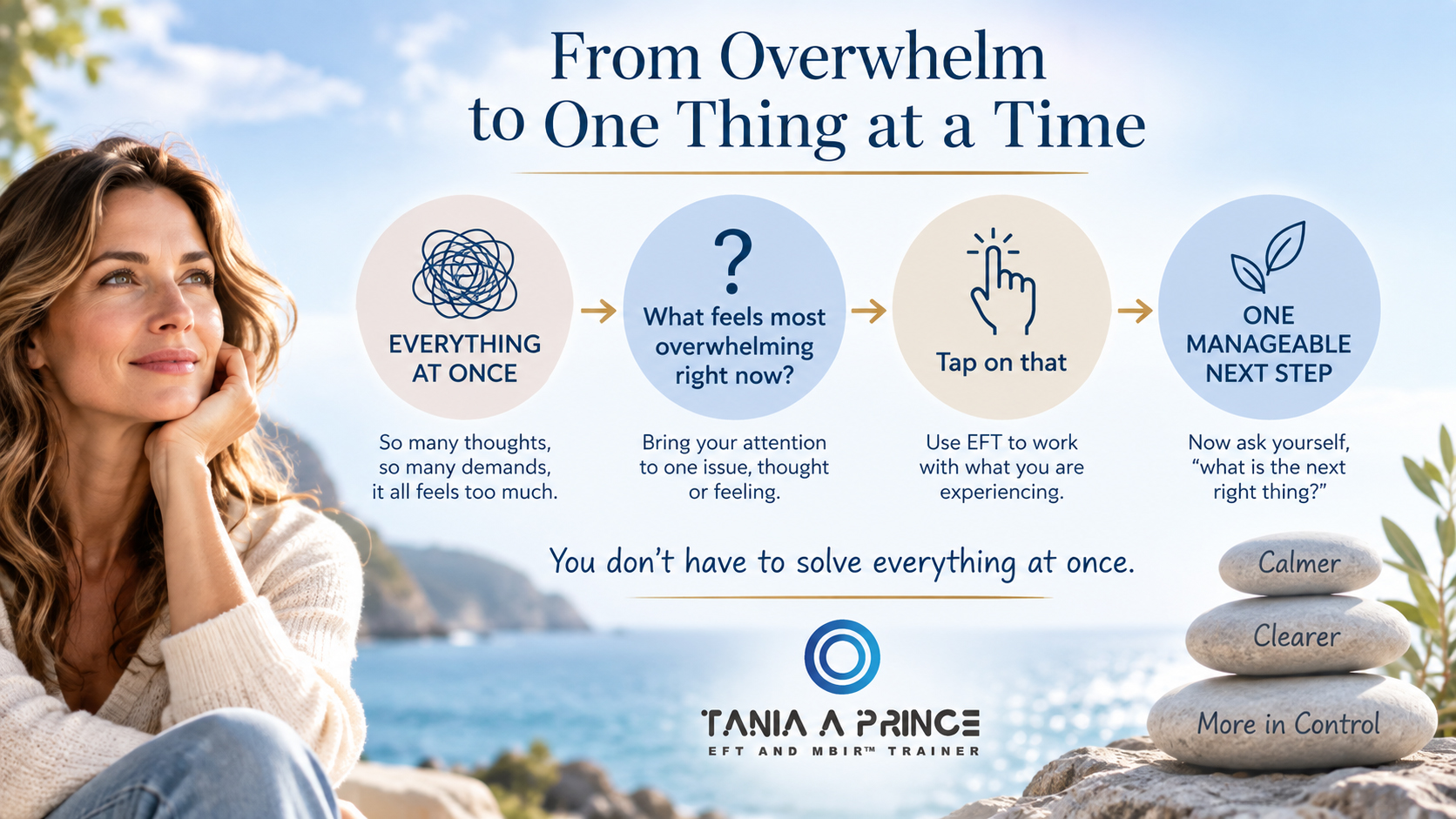
Ask: What Feels Most Overwhelming Right Now?
You don’t have to solve your whole life during one tapping session.
Ask:
“Of everything going on, what feels most stressful right now?”
Notice what comes to mind.
Perhaps it is an email you haven’t sent.
A deadline.
A conversation you need to have.
Something happening in your family.
Money.
Work.
Or perhaps it is simply exhaustion.
Whatever appears, work with that.
For example:
“Even though I’m worried I won’t get this finished by Friday…”
or:
“Even though I’m dreading having that conversation…”
or:
“Even though I’m exhausted and I still have so much to do…”
You have now moved from:
“My entire life is overwhelming.”
to something much more specific.
That can make the problem feel more workable.
Sometimes the Problem Isn’t the Work — It’s What the Work Means
This is another important area to explore.
Imagine you have an important task to complete.
On the surface, the problem appears to be:
“I have too much work.”
But when you explore it, you may discover something underneath.
Perhaps:
“If I don’t do this perfectly, people will think I’m incompetent.”
Or:
“If I say no, I’ll disappoint someone.”
Or:
“I should be able to cope with all of this.”
Or:
“I can’t let anyone down.”
Suddenly the overwhelm makes more sense.
You aren’t only dealing with a task.
You may also be dealing with fear, expectations, perfectionism, responsibility or beliefs about what will happen if you don’t manage everything successfully.
These can become useful targets for EFT.
Look for the Fear Beneath the Overwhelm
A useful question is:
“What am I afraid will happen?”
Suppose you are overwhelmed because you have too much work.
Ask:
“What am I afraid will happen if I don’t get everything done?”
Your answer might be:
“My boss will be angry.”
“I’ll lose the client.”
“People will think I’m unreliable.”
“I’ll fall behind.”
“I’ll fail.”
Then ask:
“And what would be difficult about that?”
This can reveal the emotional component driving some of the overwhelm.
You can then tap on that more directly.
For example:
“Even though I’m frightened people will think I’ve failed…”
This may be far more relevant than repeatedly tapping:
“I have too much to do.”
Overwhelm and Perfectionism
Sometimes overwhelm is intensified by the standards we place on ourselves.
You may not simply believe something needs to be done.
You may believe it has to be done:
perfectly,
immediately,
without help,
without disappointing anyone,
and without showing that you are struggling.
That is a very different psychological load.
Notice words such as:
“I must…”
“I should…”
“I have to…”
These statements can reveal some of the pressure you are putting on yourself.
You might tap on:
“I have to get everything right.”
“I shouldn’t need help.”
“I should be able to manage this.”
“I can’t disappoint anyone.”
Again, use the words that actually fit your experience.
Moving From Overwhelm Towards Choice
EFT does not require you to jump immediately from:
“I can’t cope.”
to:
“Everything is wonderful.”
That may feel completely unbelievable.
Instead, you can use more gradual, transitional language.
For example:
“Maybe I don’t have to solve everything this second.”
“Maybe I can deal with one thing at a time.”
“Perhaps I can allow myself to slow this down.”
“Maybe there is another way of looking at this.”
“Perhaps I can decide what actually needs my attention first.”
“Maybe some of this can wait.”
These statements don’t deny the reality of what you have to deal with.
They simply begin opening the possibility of a different response.
A Short Tapping Round for Overwhelm
Try tapping gently through the points while saying:
Eyebrow:
“There is so much going on.”
Side of the eye:
“My mind is trying to deal with everything.”
Under the eye:
“All this pressure.”
Under the nose:
“I feel overwhelmed.”
Chin:
“I don’t know where to start.”
Collarbone:
“Maybe I don’t have to deal with everything at once.”
Under the arm:
“Maybe I can slow this down.”
Top of the head:
“One thing at a time.”
Then stop.
Notice what happens.
You may feel calmer.
You may realise which task actually matters.
You may suddenly remember something that is contributing to the overwhelm.
Or nothing obvious may happen immediately.
All of that is information.
What If Tapping Brings Up Something Else?
This is common.
You may begin tapping about your workload and suddenly find yourself thinking about an argument you had yesterday.
Or a memory from years ago may appear.
Or you may suddenly realise:
“I’m actually frightened.”
Follow what emerges rather than rigidly sticking to the original script.
EFT is often most useful when you respond to your own experience instead of trying to make your experience fit a predetermined set of words.
If you are unsure what to say, simply describe what you notice.
“Now I’m thinking about that conversation.”
“I can feel this tightness in my chest.”
“I’m worried about tomorrow.”
“I don’t know why, but I suddenly feel sad.”
That can be enough to continue.
When Overwhelm Leads to Avoidance
One of the frustrating things about overwhelm is that the more you need to get done, the harder it can become to start.
Then avoidance creates more pressure.
You don’t complete the task.
The deadline gets closer.
You become more anxious.
The task feels even bigger.
And you avoid it more.
Instead of criticising yourself for procrastinating, become curious about what happens when you think about starting.
Ask:
“What do I feel when I imagine beginning this task?”
That question can be surprisingly revealing.
Perhaps you feel bored.
Trapped.
Anxious.
Resentful.
Afraid of getting it wrong.
Or perhaps the task represents something much bigger.
Tap on that response.
EFT Isn’t About Pretending You Don’t Have Problems
If you genuinely have too much to do, tapping won’t magically complete your workload.
You may still need to:
cancel something,
ask for help,
move a deadline,
say no,
rest,
have a difficult conversation,
or decide that something simply isn’t a priority.
The purpose of tapping isn’t to convince yourself that an unreasonable situation is reasonable.
It may instead help reduce some of the emotional activation surrounding the situation so that you can see your options more clearly.
And from that position, practical decisions can sometimes become easier.
What to Do After Tapping
After tapping, ask yourself:
“What needs my attention now?”
Not:
“How do I solve everything?”
Just:
“What is the next thing?”
That may be one email.
One phone call.
One conversation.
One task.
Or perhaps the next thing is rest.
Overwhelm tends to pull our attention towards everything simultaneously.
Coming back to one manageable next step can help restore a sense of direction.
Learning to Listen to Your Response
Overwhelm isn’t necessarily something you need to fight.
Sometimes it contains useful information.
It may be telling you:
There is too much happening.
Something feels threatening.
You need more support.
You are putting too much pressure on yourself.
You need to prioritise.
You need to rest.
Something needs to change.
EFT gives you a structured way to slow down and explore that response.
Rather than immediately asking:
“How do I make this feeling go away?”
you can begin with:
“What is happening inside me right now?”
Then tap on what you find.
One feeling.
One thought.
One physical sensation.
One fear.
One problem at a time.
Because when everything feels overwhelming, you don’t necessarily need to deal with everything.
Sometimes you simply need somewhere to begin.
Continue Exploring EFT for Anxiety
If anxiety is part of your experience of overwhelm, you may also find these articles useful:
Anxiety and EFT — an introduction to anxiety, the nervous system and how you can begin using EFT.
Why Anxiety Is Felt in the Body — explore why anxiety can create such powerful physical sensations.
EFT for Overthinking — learn how to work with repetitive thoughts and the feelings beneath them.
EFT for Anticipatory Anxiety — for anxiety about something that hasn’t happened yet.
EFT for Social Anxiety — explore the fears and expectations that can make social situations feel threatening.
EFT for Work-Related Anxiety — for pressure, deadlines, performance concerns and workplace stress.
EFT for Fear and Panic — learn how EFT can be approached when fear becomes particularly intense.
Can EFT Help Calm the Nervous System? — a closer look at tapping, stress responses and nervous-system regulation.
What to Say While Tapping for Anxiety — if you’re unsure which words to use when you tap.
EFT Tapping Script for Anxiety — a simple guided tapping sequence you can follow.
A Note About More Intense Overwhelm
Self-help tapping can be useful for everyday stress and emotional overwhelm, but there are times when additional professional support is appropriate.
If your overwhelm is connected with significant trauma, severe anxiety, persistent panic or experiences that feel difficult to manage safely by yourself, consider working with an appropriately qualified healthcare professional or experienced EFT practitioner.
You don’t have to push yourself into difficult memories or intense emotional material when tapping on your own.
Start with what feels manageable.
Learn EFT
If you would like to develop a deeper understanding of EFT and learn how to use it systematically, I teach EFT Practitioner Training for people who want to develop their tapping skills and for those wishing to train professionally.
The training goes beyond learning tapping points and scripts. You learn how to identify appropriate targets, work with specific events and emotional responses, follow changes during tapping, and develop the skills needed to use EFT effectively.
You can find details of upcoming EFT Practitioner Training with Tania A Prince on the training section of this website.
Tania A Prince is an EFT Founding Master and EFT International Accredited Master Trainer of Trainers with extensive experience teaching and working therapeutically with EFT.
